
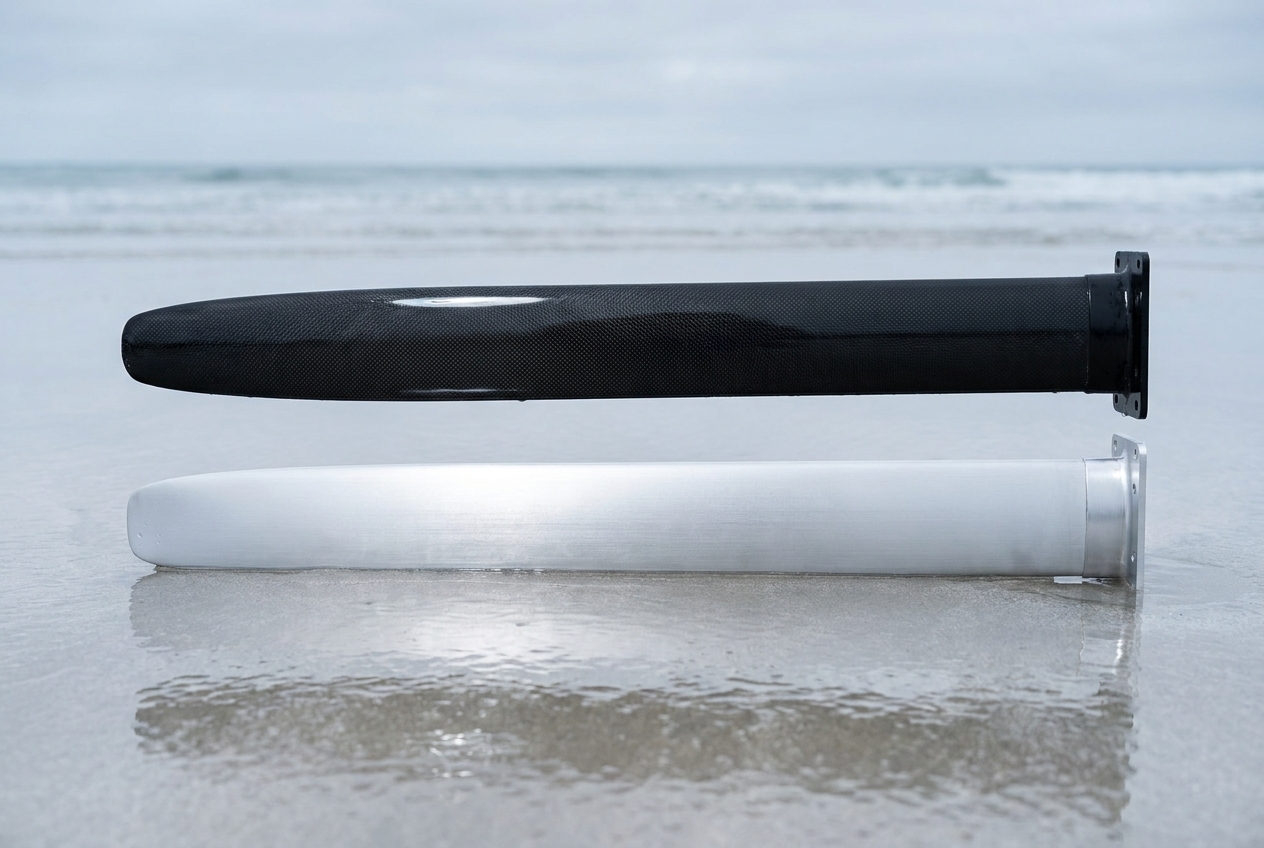
A carbon foil mast is stiffer, thinner and marginally lighter than aluminium, which sharpens how the foil responds and adds glide at speed. It also costs roughly nine times more. Aluminium is the better buy until you can hold long flights and can genuinely feel the mast flexing under load.
The mast is the one part of a foil setup where the marketing gap and the real-world gap are furthest apart. Carbon is objectively better on every performance metric, yet the numbers behind those gains are smaller than the price tags suggest. For what each part of the setup, the front wing, stabiliser, fuselage and mast, actually does, read our explainer on how a hydrofoil works. This guide puts real prices, measured weights and honest use cases against each other so you can work out where your money actually goes.
What is the actual difference between a carbon and aluminium foil mast?
The difference is stiffness per unit of thickness. Carbon lets a manufacturer build a thinner, more rigid mast for the same weight, so there is less drag through the water and less lag between your foot input and the foil’s reaction.
Aluminium masts are extruded, which makes them cheap, consistent and thick. Carbon masts are laid up from prepreg sheets, which is slow and expensive but lets the builder put stiffness exactly where the load is.
There is also a third tier that muddies the comparison. High-modulus (HM) carbon uses a stiffer fibre again, and published figures put it at roughly 30% less bending and 40% less torsion than a standard carbon layup.
| Property | Aluminium | Standard carbon | High-modulus carbon |
|---|---|---|---|
| Bending stiffness | Adequate, flexes under big wings | High | ~30% stiffer again than standard carbon |
| Torsional stiffness | Balanced, the material’s strong suit | Good | ~40% stiffer again than standard carbon |
| Profile thickness | Thickest, most drag | Noticeably thinner | Thinnest |
| Typical price (82 cm) | $117 | $1,107 | $1,403 |
| Best for | Learning, travel spares, rocky launches | Riders holding long flights | Racing, downwinders, big-wing pumping |
Prices above are AXIS 2026 list prices for a comparable 82 cm mast in each material, taken from their wing foil mast range.
How much lighter is a carbon mast, really?
Less than you would guess. When SURF magazine weighed matched carbon and aluminium versions of the same foils, the saving ranged from 180 g to 780 g across a complete rig.
| Foil model | Carbon mast version | Aluminium mast version | Weight saved |
|---|---|---|---|
| Fanatic Aero Free WS 100 | 4.04 kg | 4.82 kg | 780 g |
| F4 Freerace | 5.4 kg | 5.72 kg | 320 g |
| Starboard Race Evolution | 5.8 kg | 6.06 kg | 260 g |
| Slingshot Phantasm 926/872 | 5.1 kg | 5.28 kg | 180 g |
That test was run on windsurf foils at Lake Garda with testers between 82 and 88 kg, so treat the absolute figures as indicative rather than wing-specific. The pattern holds across the sport: the mast is not where most of a foil’s weight lives.
Published spec weights tell the same story. Armstrong lists its 86.5 cm Performance Carbon mast at 1,960 g, while GONG lists its 85 cm 17 mm aluminium mast at 1,950 g. Two masts of near-identical length and near-identical weight, one carbon and one aluminium.
The point is not that carbon fails to save weight. It is that carbon spends its weight budget on stiffness instead of lightness, and if you are buying a mast purely to shave grams off the walk to the water, you are buying the wrong upgrade.
Does mast stiffness actually change how the foil rides?
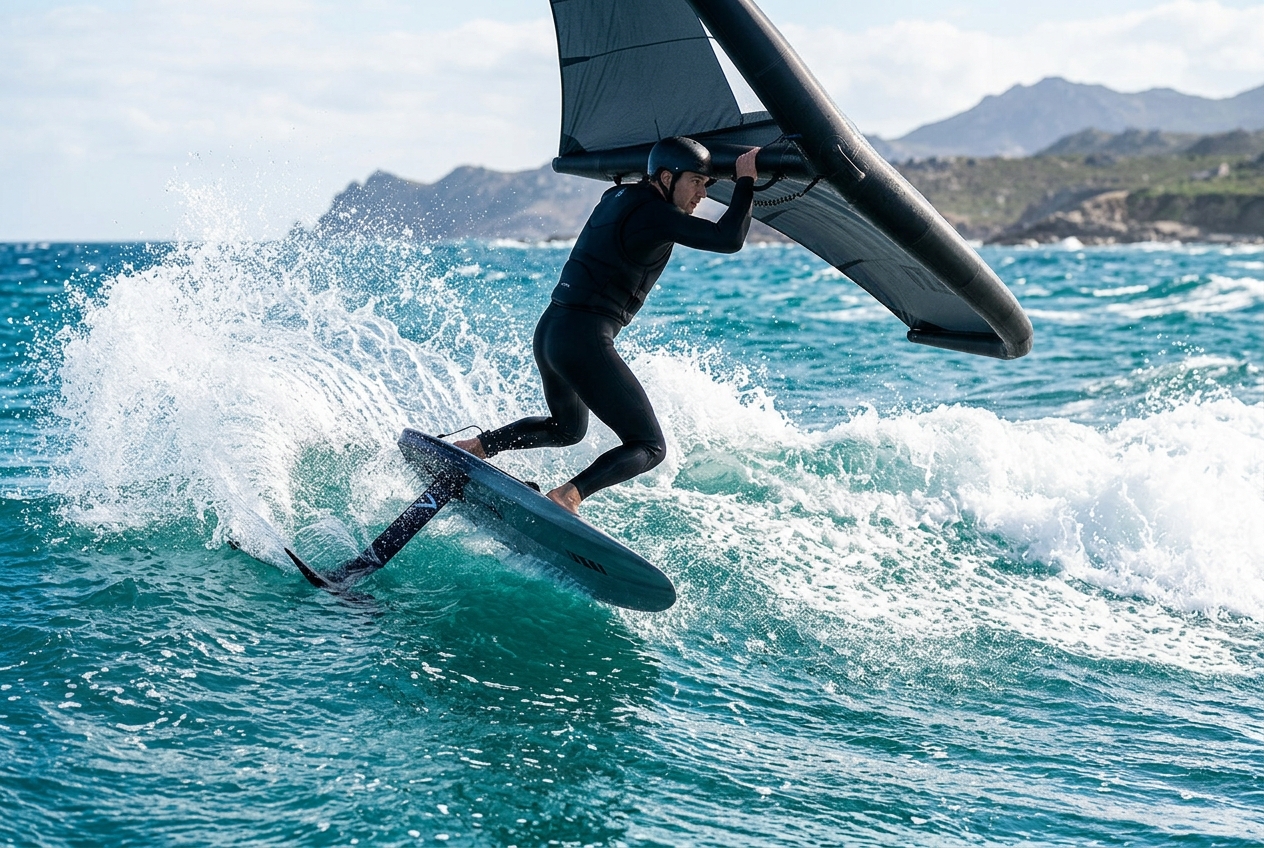
Yes, and this is the real reason to buy carbon. A stiffer mast transmits your foot input to the front wing with less delay, so the foil turns when you tell it to rather than a fraction of a beat later.
Where you notice it depends entirely on what you ride. The flex in an aluminium mast is invisible at 15 knots on a small wing and obvious at 25 knots on a big high aspect front wing loading up through a carve.
- Pumping and downwinding. Stiffness matters most here. Every bit of flex is energy you put into bending the mast instead of driving the foil forward.
- Top-end speed. Carbon masts are thinner, so there is measurably less section drag at speed and the foil holds a longer glide.
- Big front wings. A big front wing generates enough load to twist a thin aluminium mast. GONG sells a 19 mm aluminium mast specifically for front wings over 100 cm wingspan for this reason.
- Learning to fly. Stiffness is close to irrelevant, and the extra mass of aluminium acts as a damper that makes early flights feel less twitchy.
The honest caveat comes from the testers themselves. Real-world comparison riding has found no significant loss of performance between carbon and aluminium masts for riders who are not already at the limit of their gear.
How much more does a carbon mast cost?
Around nine times more for standard carbon, and up to 24 times more at the top of the range. This is the widest price multiple of any single component in a wing foil kit.
| AXIS mast | Length | Price (USD) | vs aluminium |
|---|---|---|---|
| 19 mm Aluminium | 820 mm | $117 | Baseline |
| Power Carbon | 82 cm | $1,107 | 9.5x |
| Power Carbon High Modulus | 82 cm | $1,403 | 12x |
| Pro Ultra High Modulus Carbon | 800 mm | $2,758 | 24x |
Other brands sit in the same shape of curve at different absolute numbers. GONG prices its 85 cm aluminium mast at $95 against $753 for its 79 cm HM carbon mast, while Armstrong’s Performance Carbon masts run from $1,399.99 to $1,699.99 depending on length.
Put that in context. A carbon mast upgrade often costs more than the entire wing and board portion of a starter kit, which is why it shows up so late in most riders’ buying order. Our full wing foiling cost breakdown maps out where a mast sits against everything else you need.
One saving grace: masts are modular. Most systems let you swap the mast alone, so an aluminium mast bought today is not money wasted when you upgrade, and it becomes your travel spare or your rocky-launch mast.
Which mast is more durable?
Aluminium wins on impact, carbon wins on corrosion. They fail in completely different ways, and which one matters depends far more on where you ride than on how you ride.
| Failure mode | Aluminium | Carbon |
|---|---|---|
| Hitting a rock or reef | Dings and scrapes, keeps riding | Can crack or delaminate |
| Dropping it in the car park | Cosmetic | Potential structural damage |
| Saltwater corrosion | The main enemy, especially at bolt threads | No metal corrosion in the mast itself |
| Seized bolts | Common with stainless hardware | Much reduced |
| Repair | Rarely worth it, but replacement is cheap | Specialist job, and cracks usually mean replacement |
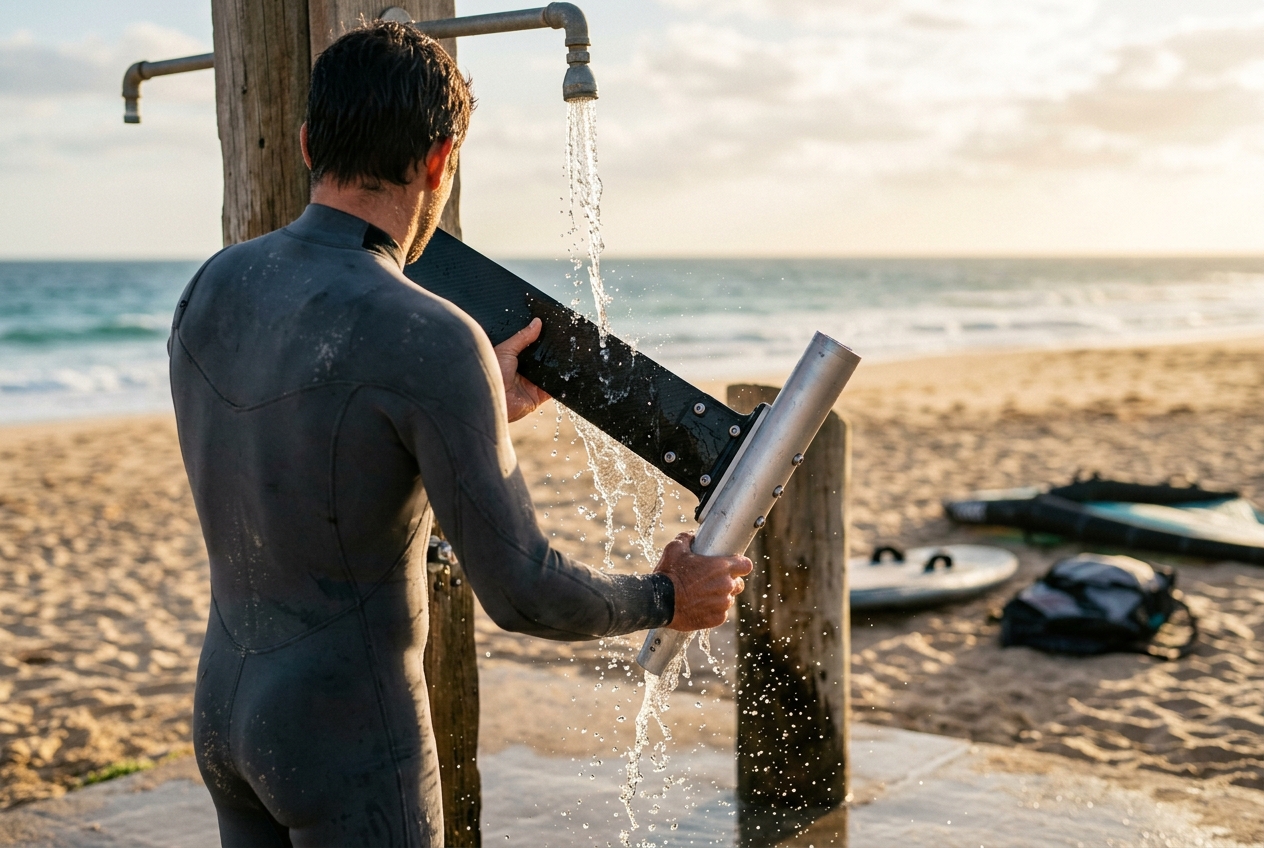
The aluminium tax is maintenance. Stainless bolts in an aluminium mast set up galvanic corrosion in saltwater, which is why foil brands sell PTFE anti-seize paste like Tef-Gel and tell you to use it on every thread.
Rinse the threads after every session and strip the mast down periodically. Skip that and you will eventually round out a bolt head trying to free a fastener that has welded itself into the mast.
For carbon, the rule is simpler and harsher. A cracked mast carries the highest load in the whole setup, and the standard advice is to replace rather than repair it, because riding a compromised mast puts the entire foil at risk.
Should you buy carbon or aluminium at your skill level?
Buy aluminium until the mast is the thing holding you back, which for most riders is somewhere past their first full season. The gear that limits a beginner is the board volume and the wing, not the mast material.
| Level | Mast length | Material | Reasoning |
|---|---|---|---|
| Beginner | 65 to 75 cm | Aluminium | Shorter falls, added mass damps the ride, and you will bump the bottom while you learn |
| Intermediate | 75 to 85 cm | Either | Carbon becomes worth it once you hold long flights and ride bigger wings |
| Advanced | 85 cm and up | Carbon or HM carbon | Pumping, downwinding and top-end speed all reward stiffness directly |
Length guidance is fairly settled across the industry. MACkite’s mast sizing guide puts beginners at around 60 to 70 cm, on the basis that a shorter mast keeps you closer to the water and feels less intimidating. Lean toward the upper end of the beginner range if you can, because the shortest masts are the quickest to outgrow.
Buy carbon when
- You can hold flights of several hundred metres and link transitions without thinking about them.
- You are pumping or downwinding, where flex directly costs you energy on every stroke.
- You ride front wings over about 100 cm wingspan and can feel the mast twisting under load.
- You are chasing top-end speed and the thinner profile’s drag saving is worth paying for.
Stay on aluminium when
- You are still working on consistent flight and transitions. See our beginner’s guide for where your money actually helps at this stage.
- Your home spot has rocks, reef or a shallow launch that will punish a carbon mast. Knee-deep lagoons like Lo Stagnone in Sicily, where the bed hides seagrass and the odd rock, are exactly where aluminium earns its keep.
- You travel with your gear and want a mast you can throw in a board bag without flinching.
- The same money would buy you a second wing size, which will add more riding days than any mast will. Our gear buyer’s guide covers the full priority order.
If you are still assembling a first setup, start with the beginner package checklist and the board size calculator. Mast material is the last decision on that list, not the first.
Carbon vs aluminium foil mast FAQ
Is a carbon foil mast worth the money?
It is worth it once you can hold long flights, pump, or ride front wings big enough to flex an aluminium mast. Below that level the stiffness gain is largely wasted, and testers have found no significant real-world performance loss on aluminium for riders who are not already at the limit of their gear.
How much lighter is a carbon foil mast than aluminium?
Less than most people expect. A magazine test that weighed matched carbon and aluminium versions of the same foils found savings of 180 g to 780 g across a complete rig. Some published spec weights are almost identical, because carbon manufacturers spend the material advantage on stiffness rather than on shaving grams.
Can you learn to wing foil on an aluminium mast?
Yes, and it is the better choice. Aluminium is far cheaper, survives the bumps and shallow launches that come with learning, and its extra mass damps the ride so the foil feels less twitchy while you find your flight height. A 65 to 75 cm aluminium mast is the standard beginner recommendation.
What is high-modulus carbon and do you need it?
High-modulus carbon uses a stiffer fibre than standard carbon, with published figures of roughly 30% less bending and 40% less torsion. Most riders do not need it. It earns its price in racing, downwinding and heavy pumping, where every bit of flex is energy lost from the stroke.
Do aluminium foil masts corrode?
Yes. Stainless bolts in an aluminium mast set up galvanic corrosion in saltwater, which is why foil brands sell PTFE anti-seize pastes such as Tef-Gel for the threads. Rinse the threads after every session and strip the mast down periodically, or you will eventually face a permanently seized bolt.
Can you upgrade just the mast on a foil?
On most modern systems, yes. Masts are modular within a brand’s ecosystem, so you can swap length or material without replacing the front wing, fuselage or stabiliser. That makes an aluminium first mast a low-risk purchase, since it becomes your travel spare or rocky-launch mast after you upgrade.
