
Most riders need about 12 knots to get onto foil, and that floor moves with body weight: light riders on a big wing sneak down near 10 knots, while heavier riders usually want 14. Below that, wind power falls away faster than wing area can make up for, so your foil and your board decide the session more than your wing size does.
Light wind riding is close to its own discipline. The gear priorities invert, the take-off becomes an active skill rather than a passive one, and the honest answer to “can I ride today?” depends on numbers most forecasts do not show you.
What is the realistic minimum wind for wing foiling?
Roughly 10 to 14 knots, depending on what you weigh and what you are riding. WindUp puts the practical floor at about 12 knots for a typical setup, which is “enough to load a 5-6 m wing, build board speed and pop onto the foil”.
Weight moves that number in both directions. The same guide notes that “light riders on a big wing and a high-volume board sneak it down to about 10 kt”, while “heavier riders often want 14 kt before it’s worth rigging”.
Hawaii shop Paka’a Foil gives the same band in miles per hour: “a minimum wind speed of around 12-18 mph is required for wing foiling”, or roughly 10 to 16 knots, and adds that beginners “do the best with about 15mph of steady onshore wind”, about 13 knots.
| Rider weight | Light wind range | Wing | Front wing area |
|---|---|---|---|
| ~65 kg | 10-16 kt | 5.0-6.0 m | 1500-2000 cm² |
| ~80 kg | 12-18 kt | 5.0-6.0 m | 1500-1800 cm² |
| ~95 kg | 14-20 kt | 6.0-7.0 m | 1800-2200 cm² |
Treat the 6-knot stories with suspicion
MACkite is blunt about it. Hearing seasoned riders talk about riding in minimal wind “like 6 knots, might sound impressive, but it’s essential to take such claims with a grain of salt”, because experience, technique, gear and rider weight all change what a given number means.
The same guide sets the general consensus for people new to the sport much higher: “the ideal wind speed lies between 16 to 20 knots, preferably in flat water”. Light wind riding is a skill you add later, not a place to learn, and our complete guide for beginner wing foilers covers the conditions worth holding out for while you build foil control.
Steadiness beats the average
Once you are flying you “stay up on far less wind than it took to launch”, so the lulls are what end sessions, not the mean. WindUp’s summary of it: “A steady 14 kt often beats a gusty 18 kt average for wing foiling.”
Read the spread on the forecast, not the headline number. Our full wing foil wind range guide covers where the top end sits as well. Venue helps too: flat, shallow water like Lo Stagnone in Sicily takes chop out of the equation, and chop is what breaks a low-powered take-off. Some venues are light-wind by default: Jericho Beach in Vancouver runs on a modest afternoon sea breeze for its whole May-to-September season, and San Diego builds the same 8-10 knot afternoon sea breeze through its March-to-October season. Puget Sound’s 12-15 knot afternoon breeze is the same light-wind profile, covered in our Pacific Northwest guide.
Should you go bigger on the wing or bigger on the foil?
Fix the foil first. Windance advises working “from the bottom up”, because “big inflatable wings can be clunky, as can big boards”, and the foil delivers the gain “while adding the least additional deadweight and clunkiness”.
Their diagnostic is worth memorising: “If you struggle to take off in low wind, the foil is almost always the limiting factor”. Not your technique, and not your wing size.
Why each extra metre of wing does less
ENSIS makes the point with arithmetic. Power tracks surface area, but a one-metre step is a shrinking percentage as the wings get larger.
| Size step | Increase in area |
|---|---|
| 2 m to 3 m | 50% |
| 3 m to 4 m | 33% |
| 4 m to 5 m | 25% |
| 5 m to 6 m | 20% |
| 6 m to 7 m | roughly 16% |
ENSIS also describes a light wind sweet spot rather than a straight line. Taking 8 knots as a benchmark, they say that “for many riders on an efficient foil, both a 5m and an 8m wing can work”, with the 5 m demanding more active pumping and the 8 m allowing a passive take-off.
Drop from 8 knots to 6 and the maths stops helping. Wind power falls away much faster than most riders expect, and at that point “going bigger in wing size does not help”.
The two routes through a light wind day
- Big foil, smaller wing. Reptile Sports puts a wide front wing above about 1200 cm² here, a foil that “provides high lift at low speeds, making it easier to take off and maintain stability in light winds”. The smaller wing paired with it is the part that is “easier to handle and less tiring”. The foil does the work.
- Big wing, smaller foil. A compact front wing of 600 to 950 cm² has less drag and more top speed, but the same source says it “requires precise technique and strong pumping skills to stay in flight” and is “not suitable for beginners or those unfamiliar with active pumping”.
What foil size do you need in light wind?
Somewhere between about 1500 cm² and 2400 cm², set by the wind you are chasing and what you weigh. Windance publishes both breakdowns.
| Wind | Front wing area |
|---|---|
| 10-14 knots | 1500-1900 cm² |
| 8-12 knots | 1800-2200 cm² |
| Under 8 knots | 2000+ cm² |
| Rider weight | Front wing area |
|---|---|
| Under 70 kg | 1500-1900 cm² |
| 70-85 kg | 1700-2100 cm² |
| 85-100+ kg | 1900-2400 cm² |
If you are already in those brackets and still cannot fly, the number is the first thing to check. Windance is direct: “If your wind is 8-12 knots and you can’t get up, the foil is almost definitely undersized.”
One useful counterpoint from Paka’a Foil, who ride waves as often as flat water: they have found that “foil size is more dictated by wave size than wind speed”. Flat-water light wind and small-surf light wind are not the same problem.
Does a high aspect foil help in light wind?
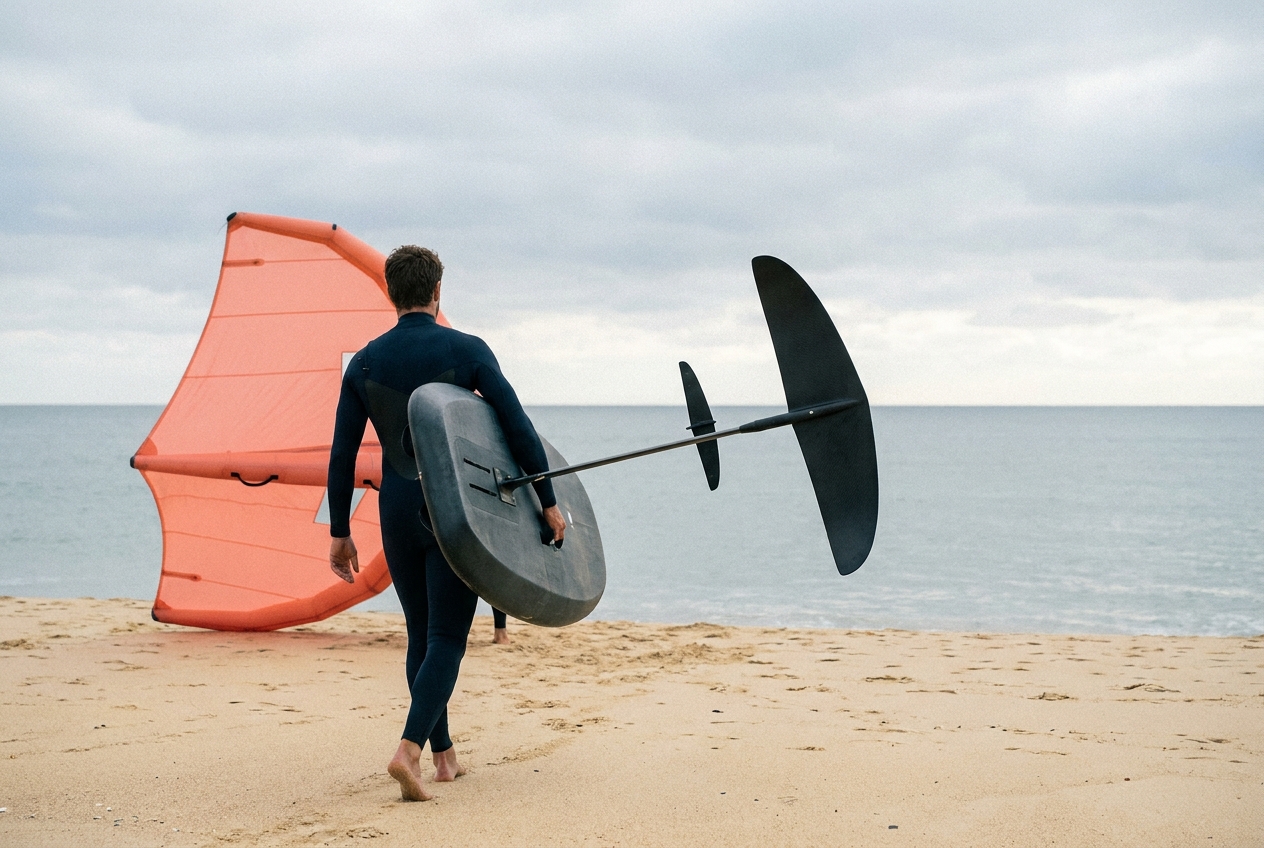
It helps once you are flying, and hurts while you are trying to get there. Area is what lifts you at low speed; aspect ratio is what lets you glide and pump efficiently after take-off.
Windance frames it as a trade rather than an upgrade. Larger areas give lift at slower speeds, while more efficient shapes “help you glide farther and faster to survive lulls, reduce how much pumping you need, and are easier to pump”.
The catch is the entry price. “Switching to high-aspect too early” appears on their list of common beginner mistakes in low wind foiling, and their standing recommendation is blunt: “Most beginners should stick with large mid-aspect foils for low wind.”
Mast height changes the recovery, not the lift
- 70 to 85 cm is what Windance recommends for beginners and calls “great for low wind”.
- Short masts reduce glide after take-off but carry less drag and are “more responsive to pumping”.
- Long masts have more drag but “give you more height to glide down from during lulls”.
- Neither changes lift. Mast height “does not change lift, but it affects how easy it is to maintain lift”.
Stiffness is the other half of that, since a mast that flexes absorbs energy you meant to put into the foil, which is the same reasoning behind pumping a wing at higher pressure. Our comparison of carbon vs aluminium foil masts covers where that trade is worth paying for.
What board works best when the wind drops?
A longer, narrower board with at least your body weight in litres. ENSIS puts the baseline at matching your weight in litres, and says that for an intermediate rider “going slightly above your body weight in volume makes things easier”.
Length is the part riders underrate. ENSIS splits the take-off into two components, the active pumping you do with your legs and the passive board speed that comes from length and waterline, and notes that “a longer board increases glide and naturally builds speed with less effort”.
Width works the other way. Windance points out that “narrower boards require less power to taxi up onto foil than wider boards do”.
Three board tweaks that cost nothing
- Move the foil back in the track. ENSIS offers this as a bonus tip: because of foil leverage, “you can improve board speed by moving your foil further back in the foil box”, which gives more leverage over the front wing and makes it easier to build board speed.
- Borrow a mid-length for the marginal days. For winds under 10 mph, about 9 knots, Paka’a Foil says it is “extremely helpful to have a longer and narrower downwind or mid-length board”. They add that mid-lengths need more practice and balance to pop up than traditional shapes.
- Pump the wing harder than usual. When the wind gets light, Paka’a Foil wants a rigid wing that translates pumping into board speed, which “usually means 8+ psi for the leading edge”. Their reasoning: “You don’t want all of your power in the pump to go into flexing the wing.”
If you are still assembling a quiver, our wing foiling gear buyer’s guide and the wing foiling gear calculator will size the everyday setup that your light wind kit sits alongside.
How do you get onto foil in marginal wind?
You wait for a gust, then coordinate a wing pump with a foil pump instead of relying on either alone. The Duotone Wing Academy sequence, published by MACkite, runs like this.
- Read the water first. In really light wind there are patches where you simply cannot start, so before wasting energy “take a moment to observe the water surface for gusts” from the riding position.
- Bear away slightly. “Try to steer slightly downwind as you prepare to pump”, which aligns you with the wind and reduces resistance.
- Lead with the front hand. Bend the knees, stretch the arms forward, then pull them in “with the front hand moving a split second before the backhand”.
- Add the foil pump just after. Once the wing pump is initiated, “push yourself up mainly with your back leg” to start pumping the foil too.
- Repeat through the acceleration. Stretch the arms out, drop back down and repeat. The more explosive the back leg push during acceleration, the cleaner the release.
- Shift forward once you fly. Bring your weight slightly forward and keep pumping until you have speed, then settle into the flying position.
The wing pump itself
MACkite’s light wind pumping tutorial describes a deep circular motion: “clockwise motion on your left foot tack and a counter-clockwise pump on your right foot tack”. Pushing the sail back into the wind on the way down keeps it loaded and creates apparent wind.
The rhythm changes once you are up. The author uses a large, slow rhythm to break free, then finds the deep grunty motion ineffective on foil: “You’ll want to use short, fast pumps.”
How much does it buy? The author’s own estimate, for his own riding, is modest but real: “Right now, I find that with these techniques I can add about 3 knots to my bottom end of riding.”
Frequently asked questions
What is the minimum wind speed for wing foiling?
About 12 knots for a typical rider and setup. WindUp notes that light riders on a big wing and a high-volume board can get down to roughly 10 knots, while heavier riders often want 14 before rigging. Below that, sustained flight becomes a specialist exercise rather than a normal session.
What size wing do you need for light wind?
Commonly 5 to 6 m for riders around 65 to 80 kg, and 6 to 7 m for riders near 95 kg. Remember that each extra metre adds a smaller percentage of area, so a 6 m to 7 m step is only about a 16% gain according to ENSIS. Going bigger has diminishing returns.
Should you buy a bigger foil or a bigger wing for light wind?
The foil, in most cases. Windance recommends working from the bottom up, because a bigger foil adds the least bulk for the most gain, and says that if you struggle to take off in low wind the foil is almost always the limiting factor rather than technique or wing size.
Is a high aspect foil better in light wind?
Only once you can already get up. Efficient shapes glide further and are easier to pump, which helps you survive lulls, but they need more speed to start flying. Windance lists switching to high aspect too early as a common low wind mistake and points most riders to large mid-aspect foils instead.
Why is steady wind better than a higher gusty average?
Because you stay on foil with far less wind than it took to launch. A lull drops you off the foil and forces a restart in whatever power is left, so a steady 14 knots often beats a gusty 18 knot average. Read the spread on the forecast, not just the mean.
Can beginners learn to wing foil in light wind?
It is a poor place to learn. MACkite puts the general consensus for newcomers at 16 to 20 knots, preferably in flat water. Light wind sessions still have value for practising wing handling and balance, but sustained flight demands pumping technique that beginners have not built yet.
