
Aspect ratio is a foil’s wingspan squared divided by its area. Low aspect wings (under about 5.5) lift early, turn tight and forgive mistakes. High aspect wings (about 7.5 to 10) glide further and hold a wider speed range, but stall higher and punish sloppy pitch control. Most riders should learn on something in between. For the underlying physics of lift and the roles of the front wing, stabiliser and mast, see our explainer on how a hydrofoil works.
This is the argument that fills every foiling forum, and most of it is conducted without anyone agreeing on what the numbers mean. Below is what aspect ratio actually measures, what changes under your feet, and where the marketing runs ahead of the physics.
What does aspect ratio actually mean on a foil?
Aspect ratio describes how long and slender a front wing is relative to its area. The precise formula is wingspan multiplied by wingspan, divided by the projected area of the wing.
Worked through with real figures, a wing with a 90 cm span and 1200 cm² of area gives (90 × 90) ÷ 1200, which is an aspect ratio of 6.75. A long thin wing pushes that number up. A short fat wing drags it down.
The four bands
| Category | Aspect ratio | Character |
|---|---|---|
| Low aspect | Up to approx. 5.5 | Lots of lift at low speed, early take-off, forgiving, but slower and less efficient |
| Mid aspect | Approx. 5.5 to 7.5 | The sweet spot: good lift with decent speed, still manoeuvrable |
| High aspect | Approx. 7.5 to 10 | More efficient, holds speed better, faster, suited to riding swell |
| Super high aspect | From around 10 | Maximum efficiency and long glides, demanding on take-off and in manoeuvres |
Worth noting before you go shopping: these bands describe measured geometry, not the label on the box. Brands apply the terms loosely and calculate the ratio in slightly different ways, so check the published span and area before trusting a badge.
What actually changes on the water?
Six things change, and they trade off against each other rather than improving together. There is no aspect ratio that wins everywhere.
| Behaviour | Lower aspect | Higher aspect |
|---|---|---|
| Stall speed | Gives lift at slower speeds | Higher low-end stall speed |
| Acceleration | Aggressive lift, rapid acceleration | Slower acceleration |
| Speed range | Limited speed range | Much greater speed range |
| Glide and pumping | Less glide, which hinders the pumping effect | Exceptional glide, more efficient to pump (less force, slower cadence) |
| Turning | Better turning and recovery, rolls easily edge to edge | Harder to turn and to recover from a turn |
| Learning | Easier to learn pitch control on | Pitch mistakes feel louder, touchdowns harder to recover |
The pumping line is the one that surprises people. A high aspect wing needs less force and a slower cadence to keep pumping, which is why downwind and flatwater pumping riders chase the tall numbers, usually on a stiff carbon mast that does not flex the effort away.
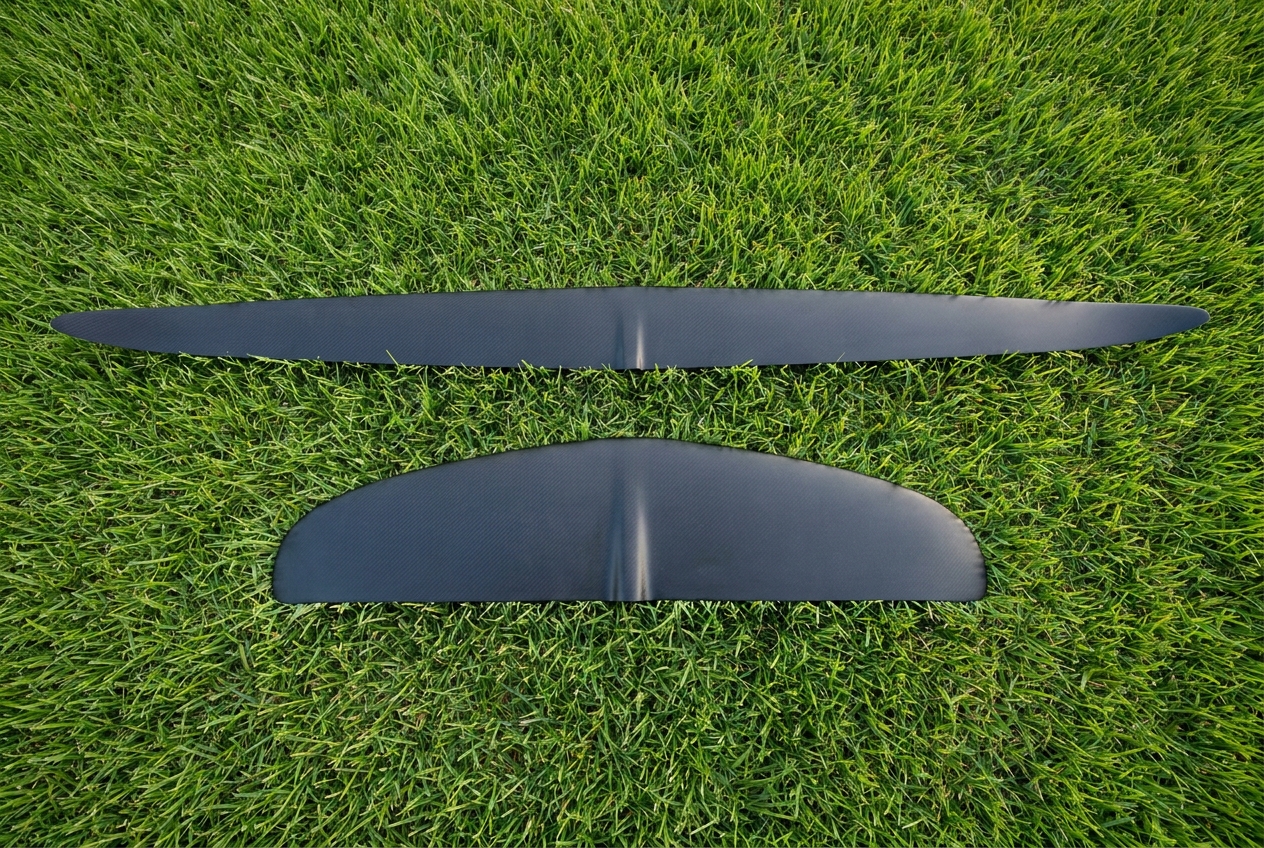
Does a higher aspect ratio mean a smaller foil?
No, and this is the most common misreading of the spec sheet. Aspect ratio describes shape, not size, so a high aspect wing can easily have more area than a lower aspect one.
The published specs make the point better than any explanation. Sorted by aspect ratio, the areas do not follow along.
| Front wing | Wingspan | Projected area | Aspect ratio |
|---|---|---|---|
| Axis 810 | 810 mm | 1022 cm² | 6.42 |
| Axis 1060 | 1060 mm | 1726 cm² | 6.51 |
| Armstrong MA1225 | 935 mm | 1225 cm² | 7.14 |
| Axis 1150 | 1150 mm | 1713 cm² | 7.72 |
| Armstrong HA1525 | 1200 mm | 1525 cm² | 9.50 |
Read the middle rows carefully. The Axis 1060 carries 1726 cm² at an aspect ratio of 6.51, while the Armstrong MA1225 carries only 1225 cm² at a higher 7.14.
The highest aspect wing in the table is also far from the smallest. At 1525 cm², the HA1525 has more area than the MA1225 and an aspect ratio over two points higher, because Armstrong pitches it at riders over 86 kg (190 lbs).
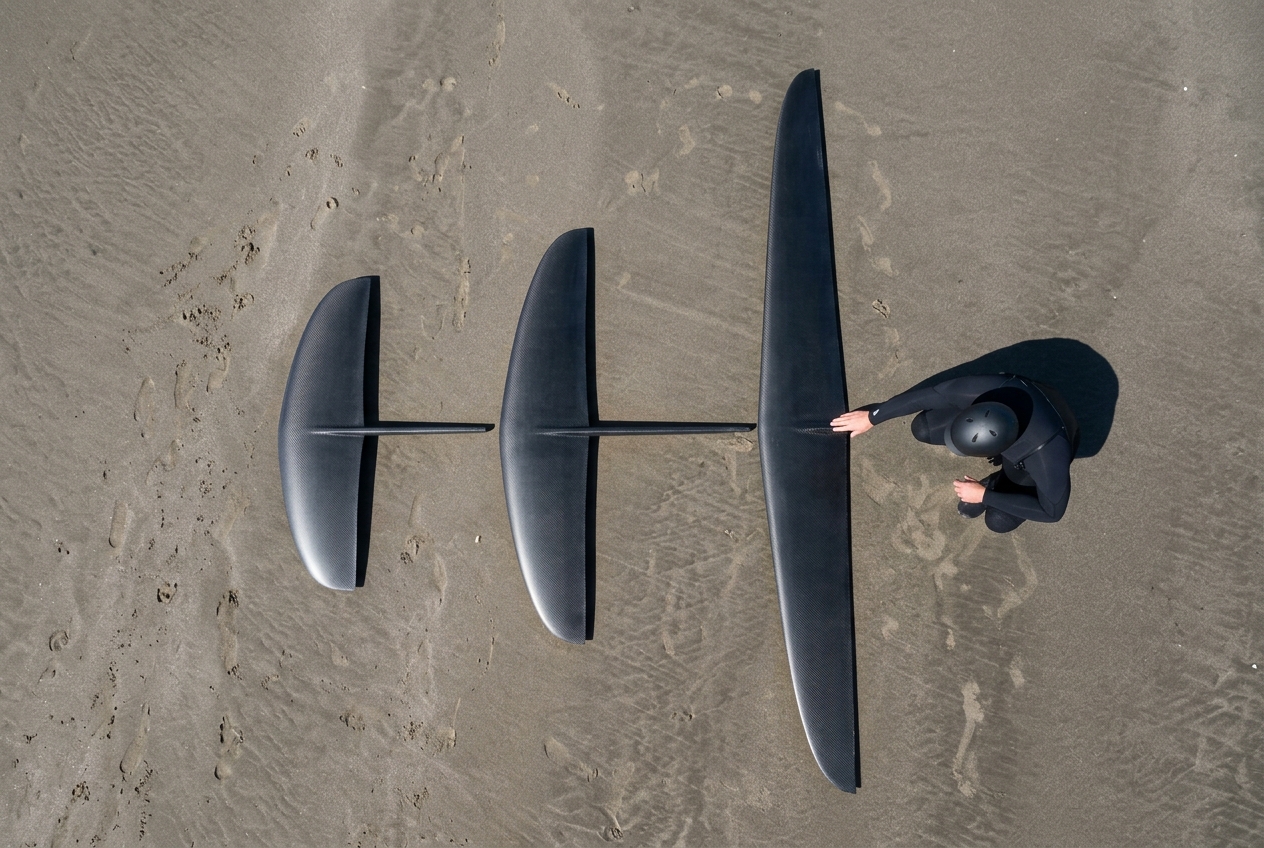
When should you upgrade to a high aspect foil?
Not until you can already do three specific things. Paka’a Foil Hawaii sets the bar at these milestones, and they are a good honest filter:
- Pump to stay on foil. If you cannot sustain flight through a lull, a higher stall speed will simply drop you sooner.
- Turn and recover reliably. High aspect wings need more force on the opposite side to come out of a turn.
- Jibe or tack while winging. Both demand the pitch control that a high aspect wing assumes you already have.
Miss those and the upgrade goes backwards. A high aspect wing has a higher low-end stall speed, so it needs a cleaner, faster start, and touchdowns that a mid aspect wing shrugs off will end your run.
There is a safety dimension too. High aspect wings are sharp and pointy, which matters most in exactly the phase where you are still falling off regularly.
Why do two foils with the same aspect ratio feel different?
Because the number is not measured the same way twice. Manufacturers use slightly different calculation methods, so identical ratios across brands may not be equivalent on the water.
Projected area versus actual area
A curved wing has two areas: the actual surface area, and the smaller projected area you would see looking straight up at it. Which one goes into the formula moves the answer.
Axis publishes both for the 810, at 1070 cm² actual and 1022 cm² projected. Run the formula both ways and you get 6.42 on projected area (the figure Axis advertises) or 6.13 on actual area, a swing of roughly 0.3 from nothing but a definition.
The model number is not the aspect ratio
Brands do not even count in the same units, which trips up plenty of comparison shopping:
- Axis numbers are wingspan in millimetres. The 810, 1060 and 1150 have spans of exactly 810 mm, 1060 mm and 1150 mm.
- Armstrong numbers are area in square centimetres. The MA1225 has 1225 cm² of projected area and the HA1525 has 1525 cm².
- Neither number tells you the aspect ratio. An Axis 1150 and an Armstrong HA1525 sound comparable and sit almost two points apart at 7.72 and 9.50.
The practical takeaway is to compare published span and area directly, and to treat a brand’s own “high aspect” label as marketing rather than measurement. Ask for the two raw numbers and do the division yourself.
Which aspect ratio should you buy?
Match the number to the riding you actually do now, not the riding you picture yourself doing next season. Mid aspect is the honest default for most people, and it is the wing assumed throughout our complete beginner’s guide to wing foiling.
| Rider | Aim for | Why |
|---|---|---|
| Learning to fly | Mid aspect | Stable, calm and versatile, and easier to learn pitch control on |
| Riding confidently, working on jibes | Mid aspect | Better turning and recovery while the technique is still forming |
| Pumping, downwinding, connecting swell | High aspect | Exceptional glide and less force needed per pump stroke |
| Carving and playful surf-style riding | Lower aspect | Rolls easily edge to edge with aggressive lift |
| Strong wind and top-end speed | High aspect | Much greater speed range before the wing runs out |
One foil rarely does all of it, which is the real reason riders end up with several front wings on one fuselage. If you are buying a single wing, buy for the conditions you get most weekends, then let the wing foiling gear calculator size the board and hand wing around it. The high aspect wing earns its place once your weekends start to look like Maui’s Maliko downwind run.
Frequently asked questions
How do you calculate the aspect ratio of a foil?
Multiply the wingspan by itself, then divide by the projected area of the front wing. A wing with a 90 cm span and 1200 cm² of area works out at (90 × 90) ÷ 1200, or an aspect ratio of 6.75. Both figures are usually on the manufacturer’s spec sheet.
What aspect ratio counts as high aspect?
Roughly 7.5 to 10 is high aspect, with anything from about 10 upwards classed as super high aspect. Below that, 5.5 to 7.5 is mid aspect and up to about 5.5 is low aspect. Brands apply these labels loosely, so check the published span and area rather than the badge.
Should a beginner ride a high aspect foil?
No. A mid aspect wing is stable, calm and versatile, and it is easier to learn pitch control on. High aspect wings have a higher stall speed, need cleaner starts, are harder to recover from touchdowns, and make pitch mistakes feel much louder while you are still learning.
Is a high aspect foil smaller than a low aspect one?
Not necessarily, because aspect ratio describes shape rather than size. The Armstrong HA1525 has an aspect ratio of 9.5 and 1525 cm² of area, more area than the MA1225 at 1225 cm² and an aspect ratio of 7.14. A high aspect wing is longer and narrower, not automatically smaller.
When should you switch to a high aspect foil?
Once you can pump to stay on foil, turn and recover reliably, and jibe or tack while winging. Those three milestones mean you have the pitch control a high aspect wing assumes. Upgrade earlier and the higher stall speed and harder recoveries will hold your progression back.
Why do foils with the same aspect ratio feel different?
Manufacturers use slightly different calculation methods, so the same number is not always measuring the same thing. Using actual area instead of projected area shifts the Axis 810 from 6.42 to 6.13. Profile thickness, outline shape and stabiliser pairing then change the feel further.
