
To jibe on a wing foil, build speed on a reach, carve a wide downwind arc with heel pressure, bring the wing overhead into neutral, switch your feet while it is depowered, then flip the wing and sheet in on the new tack. Most riders need 30 to 60 sessions to land it fully foiling.
The jibe is the first real transition most wing foilers chase, and it is the move that turns short back-and-forth reaches into continuous sessions. This guide breaks the turn into steps, covers foot switch timing and the mistakes that cause most crashes, then looks at the cowboy jibe once your basic turn is dialled. From there, the wing foil 360 is the natural next step.
What is a jibe in wing foiling?
A jibe is a downwind turn that takes you from one tack to the other. Unlike a tack, which points the nose up through the wind, a jibe keeps some power in the wing for most of the arc, which is why it is the transition to learn first.
The version everyone chases is the full foiling jibe: you enter flying and exit flying, and the board never touches the water. On the way there you will pass through slower stepping-stone versions, and every one of them counts as progress.
| Jibe stage | What it looks like | When you are ready |
|---|---|---|
| Touch-down jibe | Carve through the turn, let the board settle onto the water, then pump back onto the foil | You can ride comfortably on the foil in both directions |
| Foiling jibe | Enter flying, exit flying, feet switched mid-turn | Touch-down jibes are consistent and you can hold long flights |
| Toeside-exit jibe | Same arc, but you keep your stance and ride out toeside | You want to keep the foil flying and delay the foot switch |
| Cowboy jibe | Styled freestyle variation of the standard jibe | Your standard jibe is fully dialled |
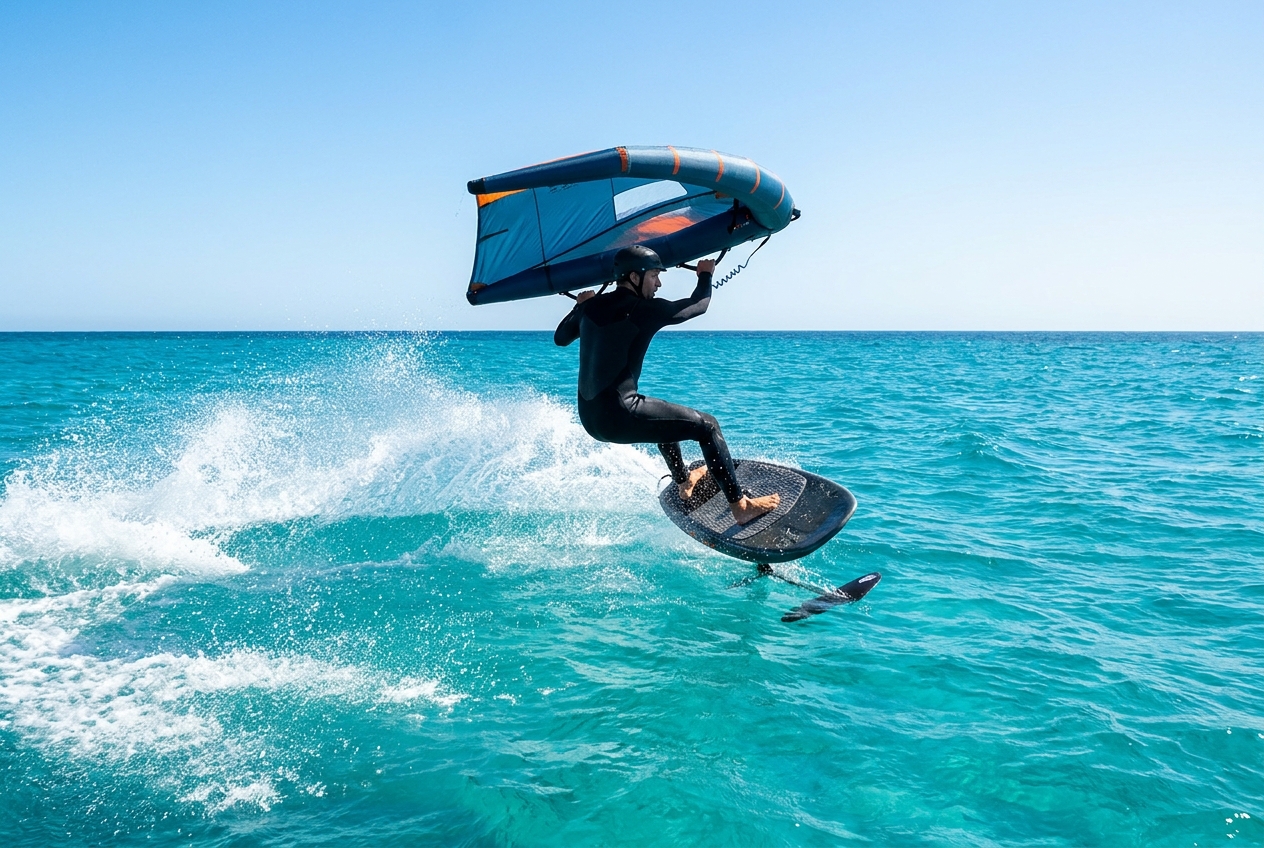
What are the steps to jibe on a wing foil?
A foiling jibe breaks into seven steps, and entry speed is the one that matters most. Before you start, you should be able to hold a steady flight for at least 100 metres, because the jibe borrows exactly that board control. If you are not there yet, work through our wing foiling for beginners guide first.
- Build speed on a reach. Aim for 25 to 30 km/h before the turn. That momentum is what carries you through the powerless downwind zone.
- Carve a wide arc. Apply smooth heel pressure through your back foot and draw a wide arc on the water, not a sharp pivot.
- Neutralise the wing overhead. Raise your hands and level the wing above your head, both hands on the front handle, fully depowered.
- Switch your feet in one shuffle. While the wing is neutral, swap front and back foot in a single small step, not two separate movements.
- Flip the wing after dead downwind. Push the leading edge forward so the wing swaps sides. Wait until you are past straight downwind before you do it.
- Sheet in with your new back hand. Bring the power back on progressively, not in one yank, or the wing will pull you off balance.
- Bear off and rebuild speed. You will exit at roughly 15 km/h, so accelerate on the new reach before pointing back upwind.
Through all seven steps, your eyes stay on the exit point and your shoulders and hips keep rotating through the turn. The body leads and the board follows.
When should you switch your feet in a jibe?
Most riders switch feet mid-turn while the wing sits neutral overhead, but there are three workable timings and none of them is wrong. Pick the one that keeps your foil flying, then widen your options later.
| Timing | How it works | Best for |
|---|---|---|
| Before the turn | Switch stance on a straight line at full power, carve the arc toeside, exit in your normal stance | Riders who find moving their feet easier at full power on a straight run |
| Mid-turn | Swap feet during the neutral-wing phase at the apex of the arc | Most riders. This becomes the default once it clicks |
| After the turn | Keep your stance, exit riding toeside, switch once stable or not at all | Keeping the foil flying, and the gateway to proper toeside riding |
Whichever timing you choose, rehearse the shuffle on land first. The switch should be one fluid step, and drilling it on grass costs nothing but saves a lot of swimming.
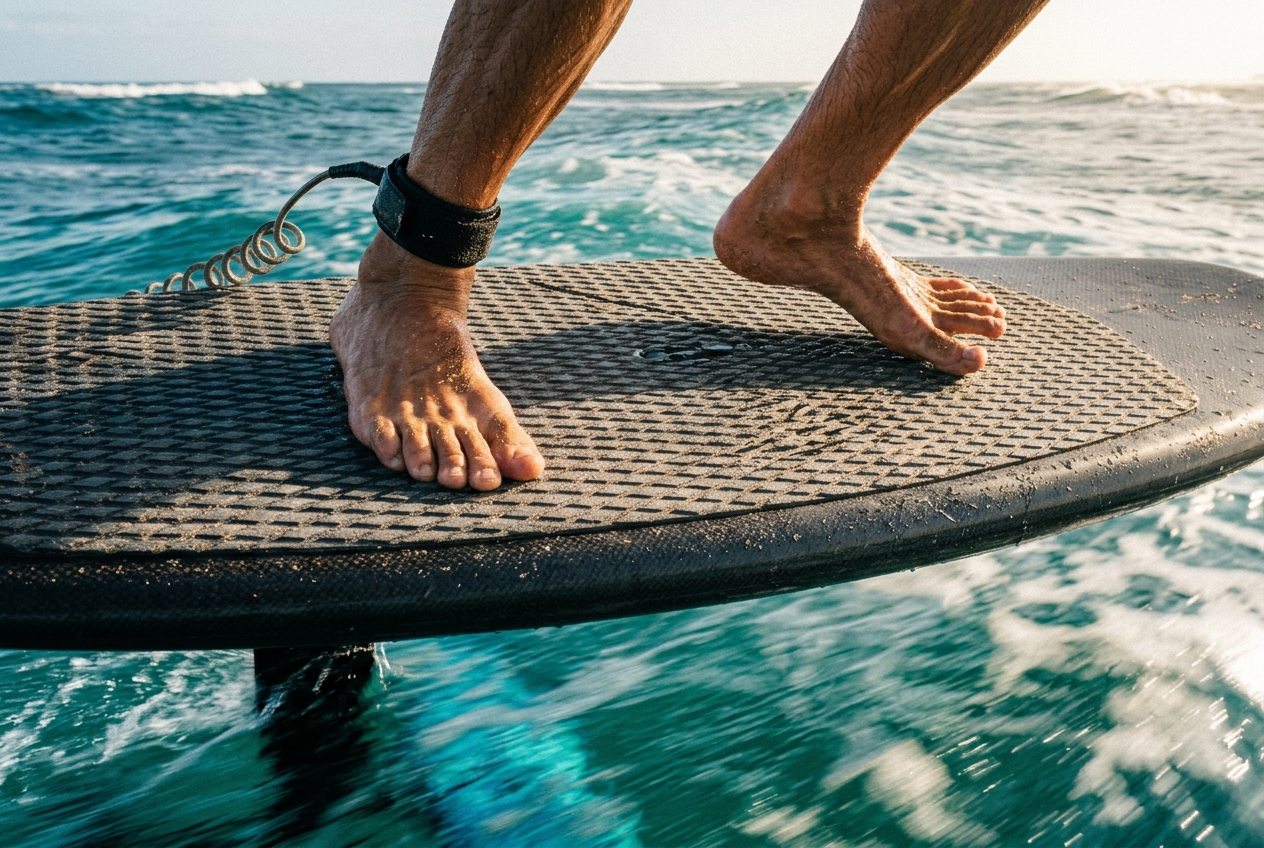
What are the most common wing foil jibe mistakes?
Most failed jibes die at entry, not at exit. Come in with too little speed and the foil stalls in the dead downwind zone before you ever reach the foot switch.
| Mistake | What happens | Fix |
|---|---|---|
| Entering too slow | The foil stalls dead downwind | Commit to a 25 to 30 km/h entry |
| Leaning back | Weight loads the back foot, the nose pitches up, the foil stalls | Shift weight forward through the exit |
| Flipping the wing too early | The wing repowers against you before you pass downwind | Flip only after dead downwind |
| Two-stage foot switch | The board rocks and the foil breaches | One fluid shuffle while the wing is neutral |
| Looking down at your feet | Rotation stops and the arc collapses | Eyes on the exit point the whole way |
| Carving too sharply | Speed bleeds off and the foil breaches | Wide arc, gentle heel pressure |
| Depowering too early | You sink before the arc is established | Keep power on until the carve has started |
What is the cowboy jibe?
The cowboy jibe is a styled freestyle variation of the standard jibe, a way to add flair to the same downwind carve once the fundamentals are automatic.
Technique guides classify it as a combination of the wingpass jibe, the variation where you pass the wing around your body mid-turn, which itself starts from a switch stance. In other words it layers a hand-pass on top of a carve you can already do without thinking.
It is strictly a post-jibe trick. The tutorial from pro wing foilers Gwen Le Tutour and Damien Leroy is blunt about the prerequisite: you must have your regular jibe dialled before attempting it. If your standard jibe is not yet consistent, time spent here is time taken from the turn that actually unlocks your sessions.
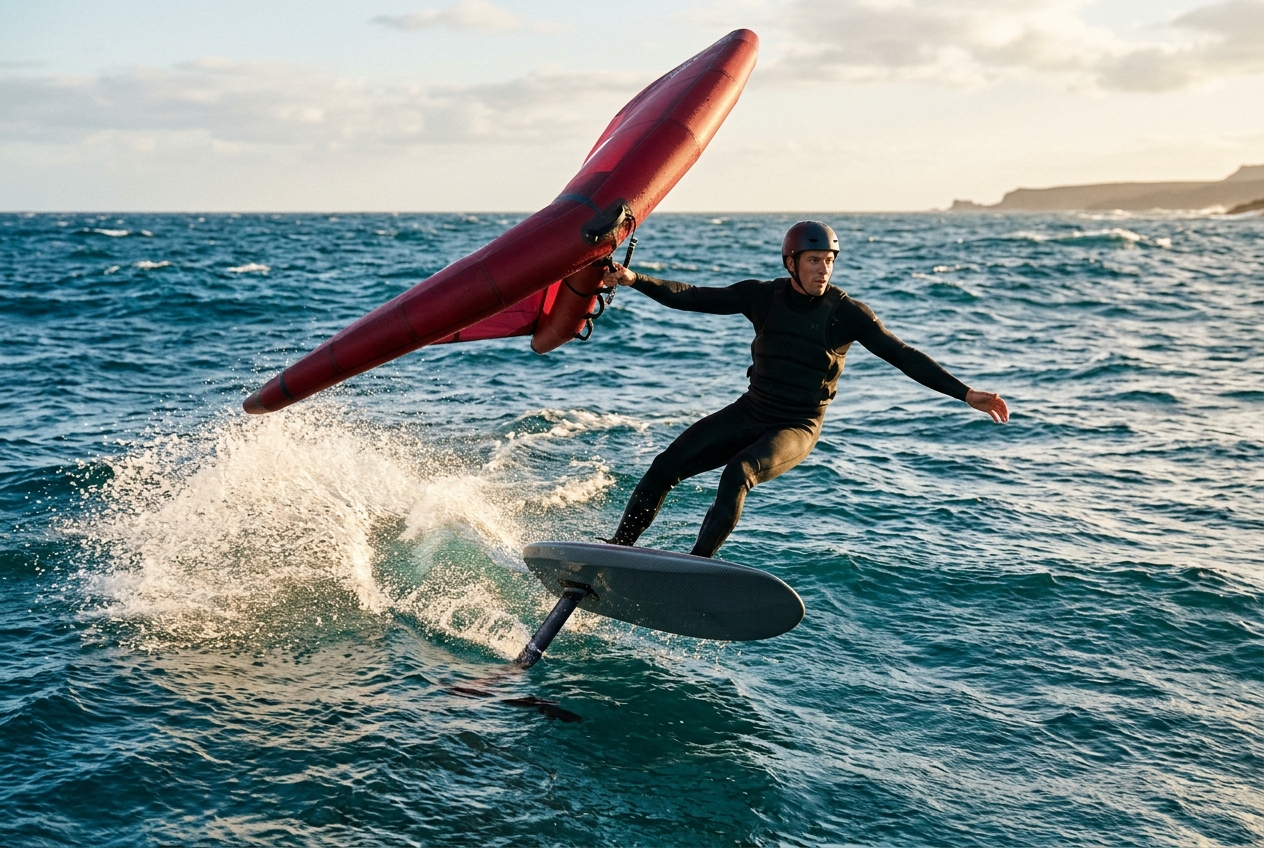
How long does it take to learn the wing foil jibe?
Expect 30 to 60 sessions of attempts before your first clean, fully foiling jibe. First jibes come much sooner: schools report students landing their first successful jibes within 2 to 3 hours of focused flat-water practice. A glassy venue like Lo Stagnone in Sicily makes those early attempts far easier to stack up.
Conditions matter as much as talent. A steady 16 to 22 knots is the sweet spot: under about 15 knots you are likely to stall mid-turn, and over 25 knots everything happens too fast to learn from. Our wing foil wind range guide covers how to judge conditions for every stage of progression.
If you are still working on your first flights, start with our guide to how long wing foiling takes to learn. And since jibe practice means falling, a lot, it is worth reading our honest safety guide on how to fall safely around a foil.
Wing foil jibe FAQ
Should I learn to tack or jibe first?
Learn the jibe first. It turns downwind, so the wing keeps power through most of the arc and small errors cost you a splash rather than a full stall. The tack carries you up through the eye of the wind with almost no power in the wing, which makes it the harder transition for nearly everyone.
What wind strength is best for learning to jibe?
A steady 16 to 22 knots is ideal. Below about 15 knots you will struggle to carry enough speed through the dead downwind zone and the foil stalls mid-turn. Above 25 knots the whole turn happens too fast to process, so you crash without learning anything from the attempt.
Why does my foil stall halfway through the jibe?
Almost always one of two things: you entered too slowly, or you leaned back mid-turn. Aim for 25 to 30 km/h at entry so momentum carries you through the powerless downwind zone, and keep your weight driving forward through the arc so the nose stays down and the foil keeps flying.
Can you jibe without switching your feet?
Yes. Keep your stance through the turn and exit riding toeside, then switch once you are stable, or not at all. Many riders find this keeps the foil flying more reliably because there is no mid-turn shuffle to unsettle the board, and it doubles as your entry into proper toeside riding.
Do you have to stay on the foil for it to count as a jibe?
No. A touch-down jibe, where the board settles onto the water mid-turn and you pump back up afterwards, is a legitimate stepping stone and the way almost everyone learns. Schools report students landing their first successful jibes within 2 to 3 hours of flat-water practice, while the full foiling version typically takes 30 to 60 sessions.
