
Wing foiling rewards endurance and stability far more than raw strength. Train two to three short sessions a week: squats and lunges for the legs, rows and pull-ups for the shoulder blades that hold you upright against the wing, planks and anti-rotation work for the core, and grip endurance to hold off forearm burn. Balance drills fill the gaps.
What does wing foiling actually demand from your body?
Constant small corrections, not big efforts. The tiring part of a foil session is the stream of tiny balance adjustments you make every second, and those load muscles that most gym programmes ignore.
Sports scientist Dr Christoph Jolk observed riders at a foil camp for German magazine SURF, which notes that his findings and exercises transfer to wingfoiling. His summary of the beginner phase is blunt: “In order to achieve a level of riding safety of perhaps 70 per cent, the foil beginners estimated that they needed to exert 90 per cent of their maximum potential in terms of strength, balance and coordination.” That is the riders’ own estimate of their effort, not a lab measurement, but it matches how wrecked most people feel after session three.
SURF points at the mechanism: the overshooting movements, the exaggerated corrections, “are more energy-sapping than a constant load, such as in normal windsurfing or kitesurfing”. One camp participant put it better than any coach: “Windsurfing is like riding a bike, foilsurfing is like riding a unicycle”.
There is good news buried in that. SURF reports that experienced foilers, being more sensitive on the board, find the static and dynamic effort of foiling less than normal windsurfing. The brutal phase is temporary. Gear shortens it too: a board with too little volume for you makes the balance task harder than it needs to be, which our wing foil board size calculator will rule out in a minute.
French brand Sroka Company, whose fitness guide is written under the name of former kite world champion Bruno Sroka, maps the load onto specific muscle groups. Combine the two sources and the training list writes itself.
| Body area | What it does on the water | What to train off the water |
|---|---|---|
| Scapular stabilisers (mid-back) | Sroka calls these “among the most heavily used muscle groups in wingfoiling” because “they hold your shoulders back when the wing pulls you forward” | Rows, inverted rows, pull-ups in both pronated and supinated grips |
| Shoulders | Per Sroka, they “provide lateral support for your arm when you’re on the water” and need to be strong “to allow you great stability in strong winds” | Overhead press, lateral raises, decline push-ups |
| Core and deep back | SURF notes the torso twists against the pelvis to hold the rig at a good angle, straining the short deep back muscles that everyday life rarely uses | Planks, side planks, anti-rotation holds, back extensions |
| Quads and glutes | Pumping and the low crouch of a waterstart. Sroka trains these with squats and lunges as the foundation | Squats, lunges, split squats, step-ups |
| Calves and shins | SURF singles these out because foiling balance runs mostly on the front-to-back axis | Calf raises and single-leg balance work |
| Forearms and grip | SURF: “Gripping and holding the boom or handles puts a lot of strain on the forearm muscles in general, and foiling involves particularly frequent, strong steering movements” | Loaded carries, rows, deadlifts, hand-grip work |

What is the best off-water workout plan for wing foiling?
Two or three short full-body sessions a week, built from a handful of compound movements, stopped well short of failure. You are training to last three hours on the water, not to set a personal best.
Kitewingandfoil’s strength guide for kitesurfing and wing foiling sets the dose plainly: “Don’t do all 20 in one session. Pick 5–7 moves, train 2–3 days/week, and keep 1–2 reps ‘in the tank’.” Sroka takes the same line on loading, arguing “we are not here to hypertrophy (enlarge) the muscle” and prescribing long sets rather than heavy ones.
A three-day template you can rotate
This is Kitewingandfoil’s own structure, which lists the third day as optional. The same guide puts most riders at two sessions a week, with a third added if you are recovering well.
- Day A, lower body plus pull. Squat or leg press, rows, lunges or step-ups, finishing with a plank.
- Day B, hinge plus push. Romanian deadlift, bench press, shoulder press, finishing with Russian twists.
- Day C, power plus conditioning. Box jumps, pull-ups or lat pull-downs, calf raises, curls and triceps, finishing with sit-ups.
Progression is deliberately unglamorous. The same guide says to add one or two reps per set each week, or a small weight increase, while keeping form clean.
Why endurance loading beats heavy loading
Nothing in a wing session asks for a one-rep max. It asks you to hold a moderate load for the length of a session while your feet do fiddly work underneath you.
Sroka’s programme reflects that, favouring bodyweight or similar loads for the upper body and “long sets without aiming to lift heavy weights” for the legs, aimed at efficiency and endurance rather than muscle volume.
Which balance drills carry over to foiling?
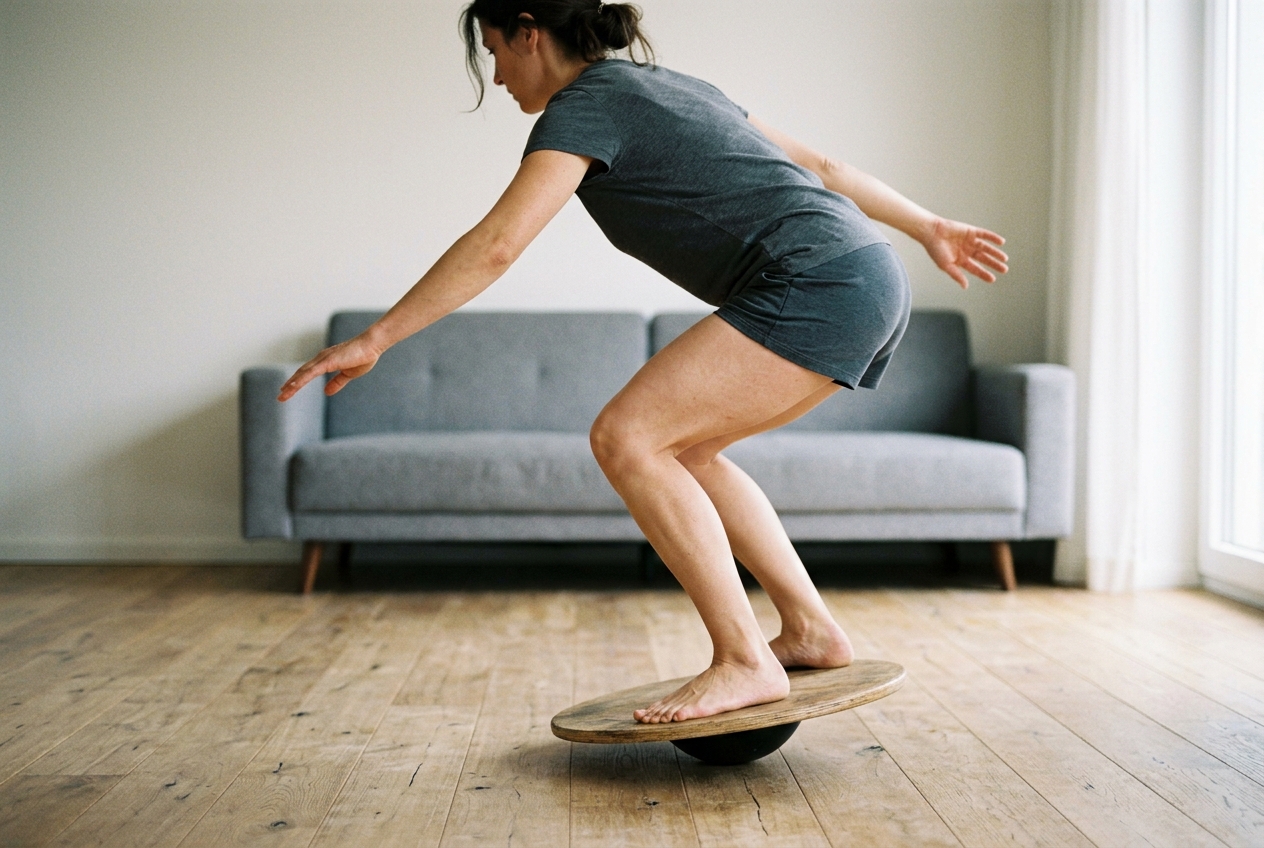
Single-leg work and balance boards help, with an honest caveat: riders rate them as maintenance for the nervous system, not as a substitute for water time.
A Progression Project forum thread asked exactly this question, from a foiler facing six frozen months. If your winter looks like that, a week on the flat-water lagoons at El Gouna will do more for your riding than any indoor drill. The most enthusiastic answer: “It absolutely helps. I have an indo board and even using it 10-20′ a day while watching TV will help your nervous system maintain some of those neurons that help maintain/improve balance.”
Another rider in the thread rates a ball-based skill board over a roller board, calling it “much closer to foil balance”. Worth knowing before you buy the cheapest roller in the shop.
The dissent in the same thread is worth more than the agreement. One rider wrote: “Balance boards are fun. Slack lines are even harder but more fun imo. I’m not sure either has helped my foiling. Absolute best thing you can do to improve pumping is dock starting.” He is not sure either has moved his foiling.
- Single-leg squats. Build the quads and glutes while loading the ankle stabilisers that regulate foil height.
- Planks with leg lifts. Add an unstable limb to a static hold, which is closer to what your trunk does in chop.
- Balance board, 10 to 20 minutes daily. The forum dose, and low enough to actually do it in front of the TV.
- Dock starts, if you can find a dock. The one drill the sceptic in that thread rated above all land training for pumping.
How do you fix forearm and wrist fatigue when wing foiling?
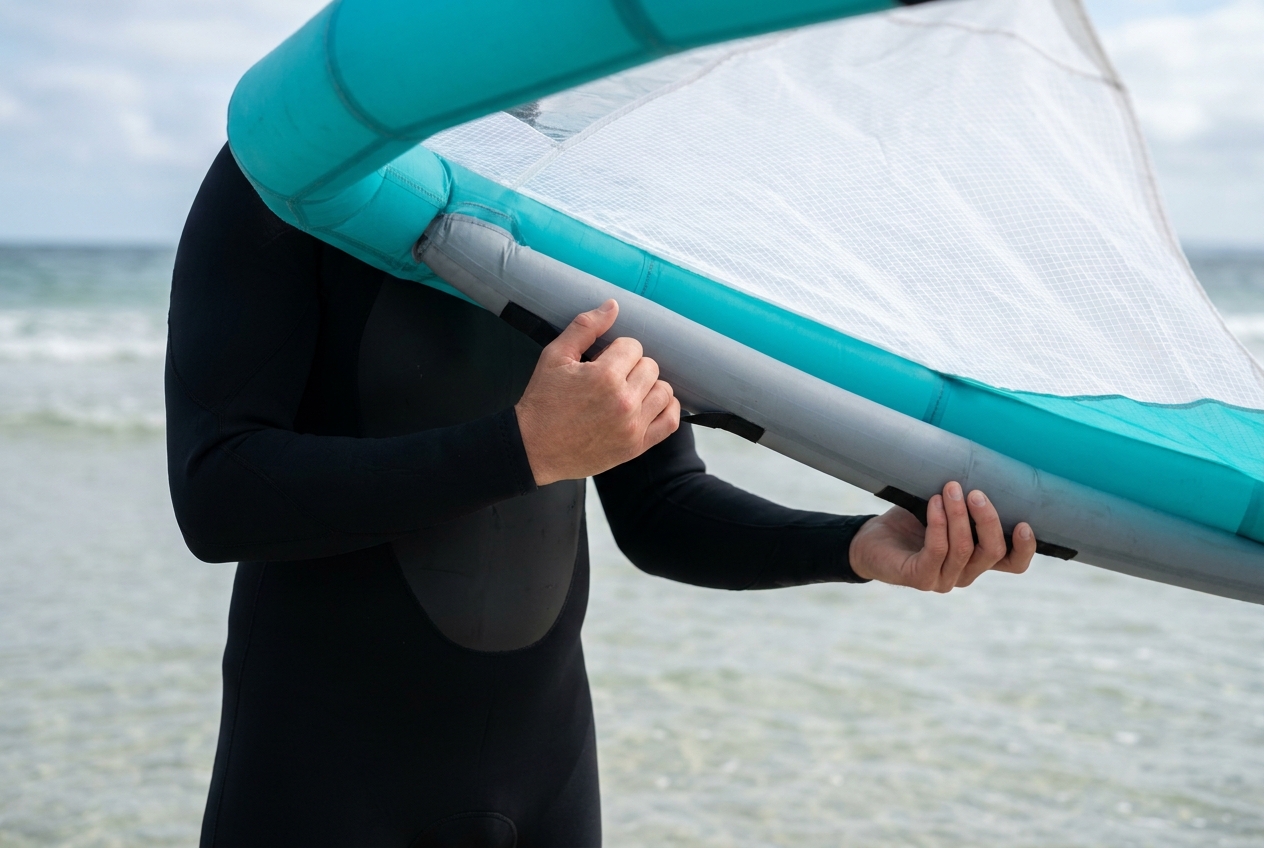
Reduce the load on your hands before you try to strengthen them. Forearm burn is usually a symptom of over-gripping, no harness, arm-driven pumping, or simply being overpowered because the wing is too big for the day, which our guide to wing foil wind ranges covers. No amount of grip training fixes any of those.
Ride Engine describes the problem accurately: “In strong winds, the pressure exerted by the wing can strain your arms considerably. Even in lighter winds, the constant gripping and pumping can quickly fatigue even the strongest gym rat forearms.” Strong forearms are not immunity.
The fixes, in the order worth trying them
- Add a harness line. MACkite’s explanation is the clearest: a harness line “takes the load off your arms and that will allow you to ride one-handed”. The same guide suggests waiting until you are riding confidently rather than hooking in as a brand-new beginner.
- Pump with your body, not your hands. Tonic Mag describes a good wing pump as “almost a rowing action as she pulls the wing towards her, bringing her shoulders back, pushing her hips forward and standing tall”. The drive comes from the back and hips rather than from squeezing with the hands.
- Loosen the death grip. Hooked fingers rather than a clenched fist, so you are hanging off the handles instead of crushing them.
- Train grip endurance, not grip strength. Kitewingandfoil pairs grip and forearm endurance with rows, deadlifts, carries and curls, and says it “Reduces arm pump and improves control in gusts”. Sroka adds a hand-grip exerciser for anyone wanting more.
- Stretch the forearms. SURF’s drill: quadruped position, forearms vertical, fingers pointing back towards your body, lean slowly backwards and hold “for at least 30 seconds” with the whole palm flat on the floor.
When forearm burn is more than fatigue
There is a named medical version of this. Ortho Rhode Island defines it as “Forearm pump, or chronic exertional compartment syndrome (CECS) is a condition that causes forearm pain often accompanied by numbness and tingling in the hand.”
It is not a wing foiling diagnosis. The same source says it “occurs most commonly in prolonged motocross riding” and “may also occur with weight lifting, rock climbing, and paddle sports”, with symptoms that “usually occur during the activity and resolve with rest”.
The scale of the effect in affected athletes is real. In a study of ten elite motorbike racers diagnosed with forearm CECS, mean compartment pressure rose from 11.7 mmHg before exercise to 30.5 mmHg after, while mean grip strength fell over the same test. Those figures describe motorbike racers, not wingers, but they explain why the burn feels like a mechanical shutdown rather than ordinary tiredness. Numbness, tingling or pain that outlasts the session is a physio visit, not a training problem.
What cross-training transfers to wing foiling?
Anything that builds aerobic base or unstable-surface balance. The transfer is in the energy system and the nervous system, rarely in the specific movement.
| Activity | What it gives a winger | Limit |
|---|---|---|
| Dock starting and pump foiling | The closest thing to the real movement. Rated above all land training for pumping by a sceptical rider on the Progression Project forum | Needs water and a dock |
| Swimming | Shoulder endurance plus the confidence to swim your gear in when the wind dies | No leg loading in the foiling pattern |
| Cycling and running | Aerobic base, which is what actually ends most sessions | Zero balance or upper body carry-over |
| Balance board or slackline | Proprioception and ankle stability. Divides opinion among foilers | One experienced rider is not sure either has helped his foiling |
| Yoga or mobility work | Hip and hamstring range for waterstarts and knee starts, which Sroka flags as a real difference from windsurfing | Not a strength stimulus on its own |
Note the pattern. The activities highest on that list are the ones that put you on an unstable surface with your own body generating the power.
How should you warm up and recover around a session?
Warm up the hips, shoulders and forearms before you rig, and stretch the same areas plus the lower back afterwards. The soreness pattern after a foil day is predictable enough to plan for.
SURF warns what the first sessions do to your lower back, quoting Dr Jolk: “After the first few foil flights, this can almost feel like lumbago – but it’s ‘just’ sore muscles.” That area gets hit because the lumbar spine handles the force transfer between legs and upper body while you twist to keep the wing at a workable angle.
- Forearms. The quadruped stretch above, at least 30 seconds each side.
- Shoulders and chest. SURF’s quadruped version with the hands placed far in front, sitting back towards the heels and letting the chest drop.
- Lower back. Lying on your back, knees drawn towards the armpits, pelvis lifted slightly off the floor.
- Glutes. Seated figure-four, which SURF flags because the glutes take a beating from holding work and constant corrections.
Sroka makes the flexibility point that most strength-focused riders miss: a waterstart or knee start simply requires not being stiff, which he calls one of the points that separates wing foiling from windsurfing.
Frequently asked questions
Do you need to be fit to start wing foiling?
No, but general fitness shortens the learning phase. SURF’s foil camp report found beginners estimating that they were working at 90 per cent of their capacity to feel about 70 per cent safe on the board. Better baseline endurance simply buys you more attempts per session.
How many gym sessions a week should a wing foiler do?
Two to three. Kitewingandfoil’s guide for kitesurfers and wingers recommends picking five to seven movements, training two to three days a week and leaving one to two reps in the tank. It puts most riders at two sessions, with a third added if you recover well.
Why do my forearms burn out when wing foiling?
Usually over-gripping and pumping with your arms. Ride Engine notes that constant gripping and pumping will fatigue even very strong forearms. A harness line, a looser grip and a rowing-style pump that drives from the back and hips all cut the load before any training does.
Does a balance board improve your wing foiling?
Foilers disagree. On the Progression Project forum, most riders in one thread rated it useful for maintaining balance through a no-water off-season, with 10 to 20 minutes a day suggested. One experienced rider said he was not sure either had helped his foiling.
Which muscles does wing foiling use most?
Sroka names the scapular stabilisers as among the most heavily used, because they hold your shoulders back when the wing pulls you forward. SURF adds the short deep back muscles, the glutes and hips, and the calves and shins, which take more strain because foiling balance runs mostly on the front-to-back axis.
Wrapping up
The training that helps is unglamorous: two or three easy full-body sessions a week, some single-leg balance work, and grip endurance from carries and rows rather than from a wrist roller.
The bigger lever for arm fatigue is not in the gym at all. It is a harness line, a looser grip and a pump that starts at the hips. Get those right and the forearm burn mostly stops being the thing that ends your session.
If you are early in the journey, our guides to wing foiling for beginners and how long wing foiling takes to learn set the context this training is meant to support. Once you are riding, learning to jibe will save you more energy than any workout. And because fatigue is what causes most common wing foiling injuries, this training doubles as safety gear.
