
Yes, and a lake is usually the best place to learn. Flat water removes the chop and shorebreak that make ocean sessions hard, and many lakes are shallow enough to stand in. The trade-off is wind: inland breeze is lighter and gustier, so you size up your gear and time your session around the thermal.
How much wind do you need to wing foil on a lake?
Roughly 12 to 15 knots is the honest working minimum, and 15 to 20 knots is where learning happens fastest. Below that you can still fly, but only on big, efficient gear and with a lot of pumping.
Lake wind is measured the same way as coastal wind, but it behaves differently. Trees, hills and buildings on the upwind shore break it into gusts and holes, so the average number on the forecast tells you less than it does at the coast.
| Wind on the water | Who it works for | What it feels like inland |
|---|---|---|
| 8 to 12 knots | Experienced riders on large, efficient kit | Stoke Riders’ Lake Michigan guide puts the low end here, with a properly sized wing and foil setup. Expect to pump a lot and to sink in the lulls |
| 12 to 15 knots | Riders who can already foil | Our wing foil wind range guide calls this the threshold for consistent foiling without constant pumping |
| 15 to 20 knots | Beginners and everyone else | The learning sweet spot. Enough power to get up, not so much that a gust throws you |
| 20 knots and up | Confident riders | Fine on open water, but inland gusts arrive with no warning and a bigger spread than at the coast |
Stoke Riders describes 10 to 20 knots as “the sweet spot” for Lake Michigan, which lines up with those numbers. Note the width of that band: a lake session often spends time at both ends of it within the same hour.
Why is a lake easier to learn on than the ocean?
Because nothing is moving except you. Every skill in early wing foiling is a balance skill, and flat water lets you spend the whole session on balance rather than on surviving the water state.
- No shorebreak to get through. You walk in, kneel on the board and go, instead of timing a launch between sets.
- No swell under the board. Touchdowns are soft, and the foil is not being lifted and dropped by passing waves.
- Often shallow enough to stand. Lake Neusiedl in Austria is under 2 metres deep, which means you can plant your feet almost anywhere on it and reset.
- No tide and no current. Where you launch is where you land, so there is no drift to calculate before you go out.
- Shorter swims. On most lakes the far bank is a visible, reachable distance rather than open sea.
FoilPlanet’s beginners guide makes the same call: flat water is best for learning, and lakes, lagoons and protected bays are ideal. The lake is not a compromise venue you graduate out of, it is the venue that gets you foiling soonest.

What is a thermal wind, and when does it blow?
A thermal is wind the lake makes for itself. Sun heats the land around the shore, that warm air rises, and cooler air over the water gets pulled in to replace it.
The practical consequence is that inland wind runs to a clock rather than a weather system. On the classic thermal lakes it fills in through the middle of the day and dies when the sun drops behind the mountains, which is why a 6am check of the forecast tells you very little.
| Lake | Wind | When it arrives | Typical strength |
|---|---|---|---|
| Garda, Italy | The Ora, a thermal southerly | Afternoon, “almost daily during the best months, from April to June” | 12 to 14 knots at Torbole; 18 to 20 knots at the Hotel Pier spot in the south |
| Garda, Italy | The Vento (Peler), the morning northerly off the mountains | Morning | Gusty and barely usable at Torbole, 9 to 12 knots, but stronger and earlier at Malcesine. 30 to 40 knots is possible only on days with cool air north of the Alps |
| Silvaplana, Switzerland | The Maloja, a thermal down-valley wind | “Starts building around early afternoon” | “Most summer days bring wind strengths between 15 and 25 knots” |
| Michigan, USA | Summer lake thermals | Afternoon | Montrose Beach in Chicago is credited with “reliable thermal winds in summer” |
Note that not every inland wind is thermal. Garda’s Vento is a morning mountain wind rather than a sea-breeze-style thermal, and it is a very different session: stronger, earlier, and pointed the other way down the lake.
What gear works best on a lake?
Everything goes up a size. Lake sessions are won by the rider who can still fly through the lulls, not by the one with the fastest kit at full power.
| Item | Lake setting | Why |
|---|---|---|
| Wing | Stoke Riders suggests 4m to 5m for typical Lake Michigan conditions and 5m to 6m for light summer winds | The bigger wing keeps producing through the holes between gusts |
| Board | 120L to 140L for beginners, per the same guide | Volume is what lets you wait out a lull standing up instead of swimming |
| Front wing | Beginner sizes land somewhere in the 1500 to 2200 cm² band. Stoke Riders says 1500 to 2000 cm², our own beginners guide says 1800 to 2200 cm² | Area equals low-speed lift, which is exactly what marginal inland wind demands |
| Wetsuit | For Lake Michigan specifically, Stoke Riders lists 3/2mm in summer and 5/4mm hooded in spring and autumn | Inland water warms and cools faster than the sea, and alpine lakes stay cold all season |
The fresh water detail nobody mentions
Fresh water is less dense than sea water. The USGS puts it plainly: ocean water is denser than pure water, because dissolved salts and minerals add to its mass.
In practice your board sits a fraction lower on a lake than it does at the coast, and so do you. It is a small effect, but if your board volume is already borderline for your weight, the lake is where you will notice it. Our wing foil gear calculator gives you a volume figure to check yours against before you commit to an inland trip.
Which lakes are best for wing foiling?
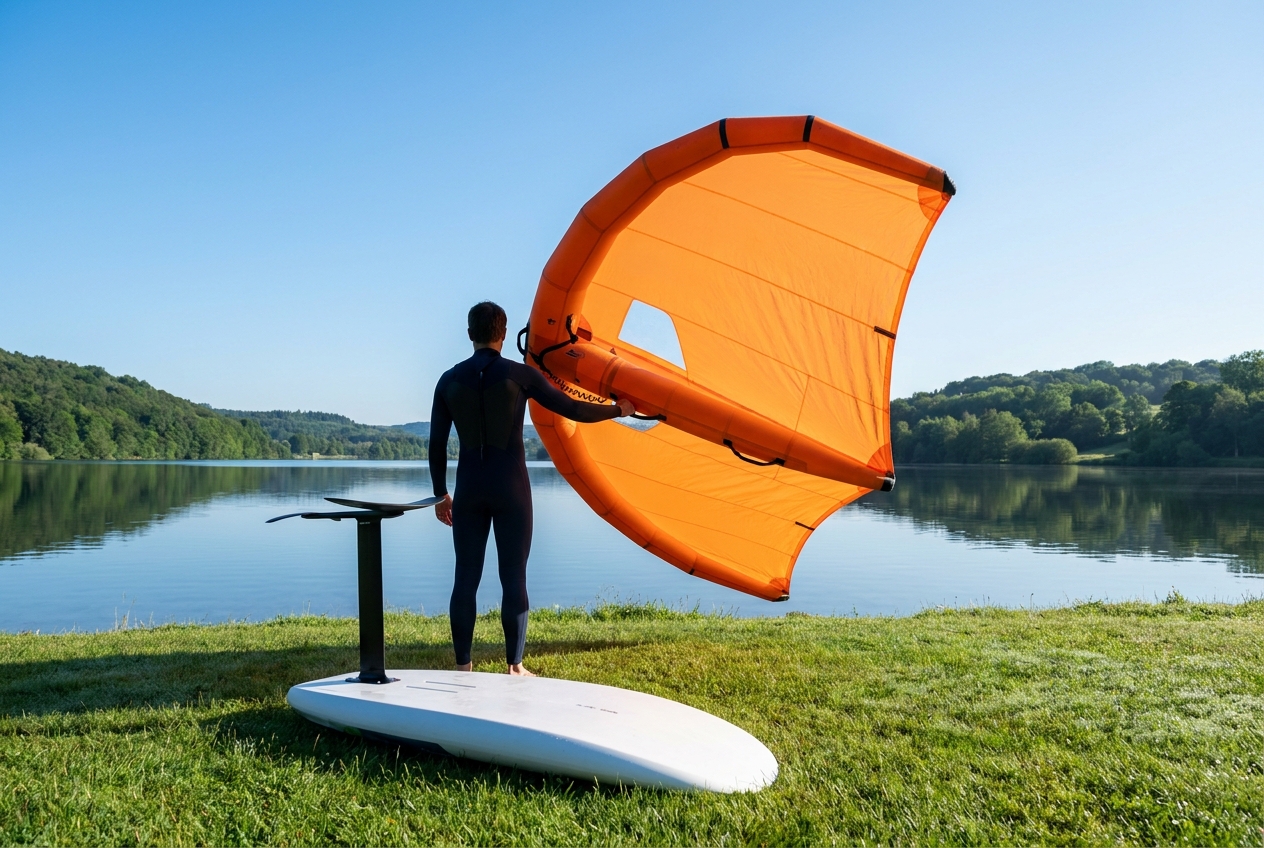
The best lakes combine a reliable daily wind with a long fetch and an easy launch. Four stand out for very different reasons.
| Lake | Country | Wind | Season | Why it works |
|---|---|---|---|---|
| Garda | Italy | Ora in the afternoon, Vento in the morning | Ora blows almost daily April to June | Two usable winds a day, and a dense strip of schools and hire around Torbole and the north shore |
| Silvaplana | Switzerland | Maloja, 15 to 25 knots on most summer days | June, July and August | Alpine thermal at 1,800 metres, with a dedicated windsurf and wingfoil station and its own harbour |
| Neusiedl | Austria | Prevailing north-westerly, with summer south-east to south-west | Warm months | Under 2 metres deep across the lake, so beginners can stand up almost anywhere |
| Michigan | USA | Summer thermals, 10 to 20 knots | Summer, water 60 to 75°F | Montrose Beach and 63rd Street Harbor in Chicago give city-accessible thermal wind and flat water |
Picking a lake by what you want out of it
- First ever sessions: Neusiedl. Standing depth removes the worst part of learning, which is the swim back to your board.
- A week that guarantees water time: Garda in spring. If you miss the Ora you still have the next morning’s Vento, and our Lake Garda wing foiling guide walks through the individual spots along the shore.
- Scenery and strong steady wind: Silvaplana in July. Bring more rubber than you think, because 1,800 metres of altitude is felt in the water temperature.
- Riding without travelling: the Great Lakes, if you are anywhere near them. Chicago has genuine thermal wind inside the city limits. Out West, Seattle’s Lake Washington, Lake Union and Green Lake play the same city-lake role; see our Pacific Northwest guide.
What are the risks of wing foiling on a lake?
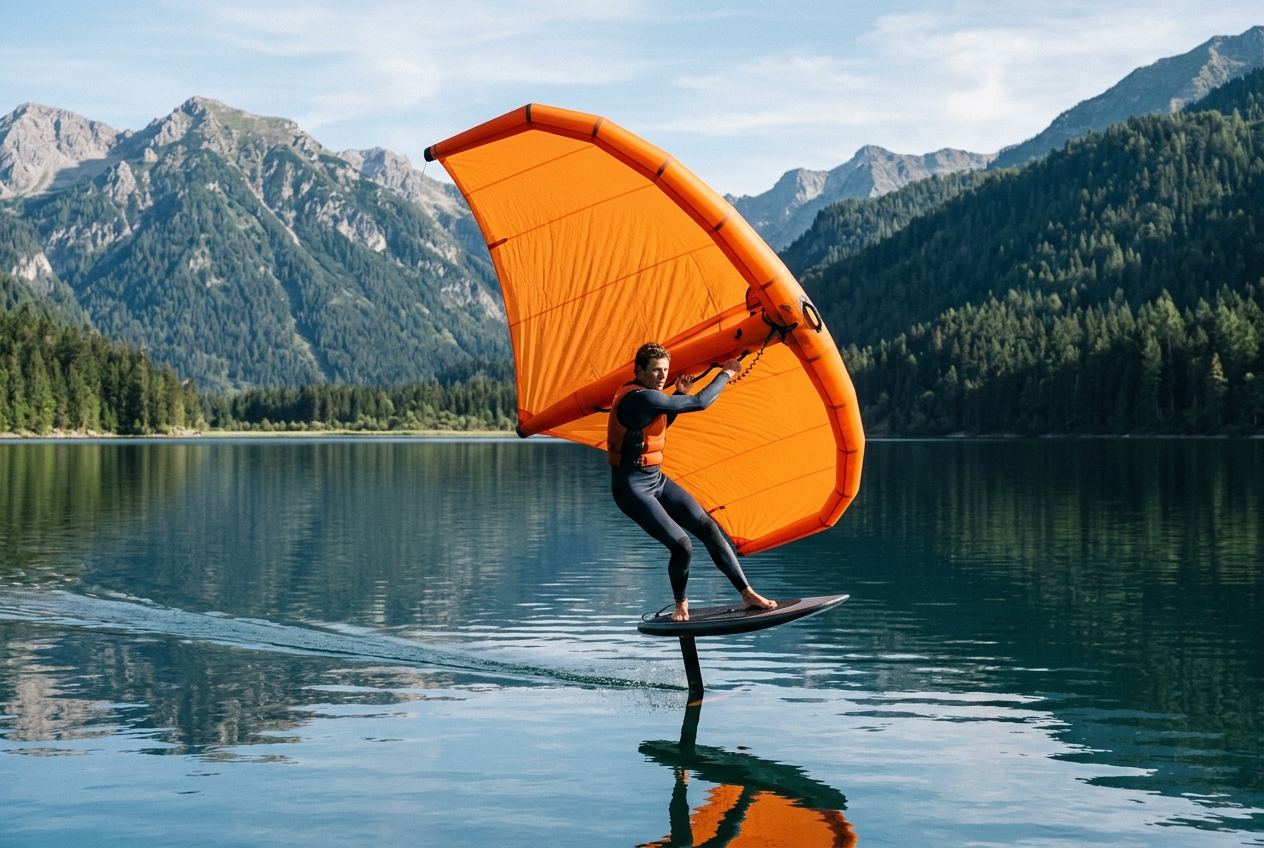
The flat water hides real hazards. Lakes remove the waves but they add offshore wind, wind shadows and weather that turns faster than at the coast. The broader picture in our guide to whether wing foiling is dangerous still holds inland, but the specific hazards swap around.
- Offshore wind. The San Francisco Boardsailing Association’s wing safety guide is blunt about it: “Do not sail in offshore winds.” On a narrow lake the wind is offshore from somewhere almost by definition, so pick your launch by the day’s direction.
- Wind shadows. A headland, a stand of trees or a hillside can switch the wind off for a hundred metres. Learn where they sit before you ride downwind of one.
- Sudden storms. Windfinder’s Podersdorf spot guide warns that on hot, humid summer days thunderstorms form suddenly and the wind can intensify to “6 to 10 Beaufort within a few minutes”.
- Cold water. Alpine and northern lakes stay cold well into summer, and altitude lakes never really warm up. Dress for the swim, not the ride.
- Nobody watching. Most lake launches have no lifeguard and no rescue boat. The SFBA guide’s advice applies inland too: use the buddy system and stay within sight of the pack.
The SFBA also recommends carrying a hard-shelled helmet, strobe light, whistle, and an impact vest or lifejacket for extra safety and visibility. On a lake the whistle matters more than you would think, since sound carries across flat water when a shout will not.
Lake wing foiling FAQ
Can you wing foil on a lake as a complete beginner?
Yes, and it is the ideal place to start. Flat water lets you spend the session on balance instead of on chop and shorebreak, and shallow lakes such as Neusiedl in Austria, which is under 2 metres deep, let you stand up and reset after every fall. Aim for 15 to 20 knots.
How big should a lake be to wing foil on it?
Big enough to give the wind a clean run at you and to let you ride a reach without turning constantly. Fetch matters more than surface area: a long, narrow lake aligned with the prevailing wind works better than a wide round one ringed by trees, because the shoreline is what breaks wind into gusts and holes.
Is lake wind gustier than sea wind?
Usually, yes. Wind arriving over land has been broken up by trees, buildings and terrain before it reaches the water, so it comes in pulses rather than as a steady flow. Thermal lakes are the exception once the thermal is properly established, which is why the middle of the afternoon is the reliable window inland.
Do you need different gear for lake wing foiling?
Not different, just larger. Stoke Riders’ Lake Michigan guide suggests a 4m to 5m wing in typical conditions and 5m to 6m in light summer wind, with 120L to 140L of board volume for beginners. A bigger front wing helps too, since low-speed lift is what marginal inland wind rewards.
When is the best time of day to wing foil on a lake?
The afternoon, on most thermal lakes. Lake Garda’s Ora is an afternoon southerly, and the Maloja at Silvaplana starts building around early afternoon and holds until the sun drops behind the mountains. Mornings inland are often glassy, with Garda’s early Vento being a notable exception.
Wrapping up
Lakes are not the consolation prize for riders who live inland. Flat water, standing depth and a wind that runs to a predictable daily schedule add up to the fastest learning environment in the sport.
Size up, watch the clock rather than the synoptic chart, and treat offshore direction as the one hard no. If you are still working out how many sessions this will take, our guide to how long wing foiling takes to learn sets realistic expectations.
