
A wing foil downwinder is a one-way run where you ride wind swell rather than the wind itself, launching upwind of your car and finishing kilometres downwind. Most riders start in steady 15 to 25 knot conditions on a long, narrow board and a high-glide foil. The skills that matter are bump reading and efficient pumping.
Downwinding is the discipline that changes what wing foiling is for. Instead of lapping a beach, you point the board at the horizon and let the ocean do most of the work. This guide covers the planning, the two core skills, the gear that actually helps, and four runs you can go and do.
What is a wing foil downwinder?
A downwinder is open-water hydrofoiling where you travel with the wind direction and use wind swell and rolling ocean bumps as your track. The wing gets you flying and then spends most of the run sheeted out. Your speed comes from gravity, not from the wing.
That single difference changes everything else about the session. You are point-to-point rather than looping, so you need a shuttle. You are also committed: once you are 3 km down the coast, the only way back is forward or a long walk.
| Element | Normal wing session | Downwinder |
|---|---|---|
| Course | Laps up and back from one launch | One-way, point to point |
| Power source | The wing, most of the time | Wind swell, with the wing depowered |
| Bail-out | Ride or drift back to the beach | Reach the next headland, or a long walk |
| Board shape | Short and wide for stability | Long and narrow for glide |
| Key skill | Wing handling and upwind riding | Bump reading and pumping |
| Logistics | Park and rig | Two cars, a shuttle, or a lift |
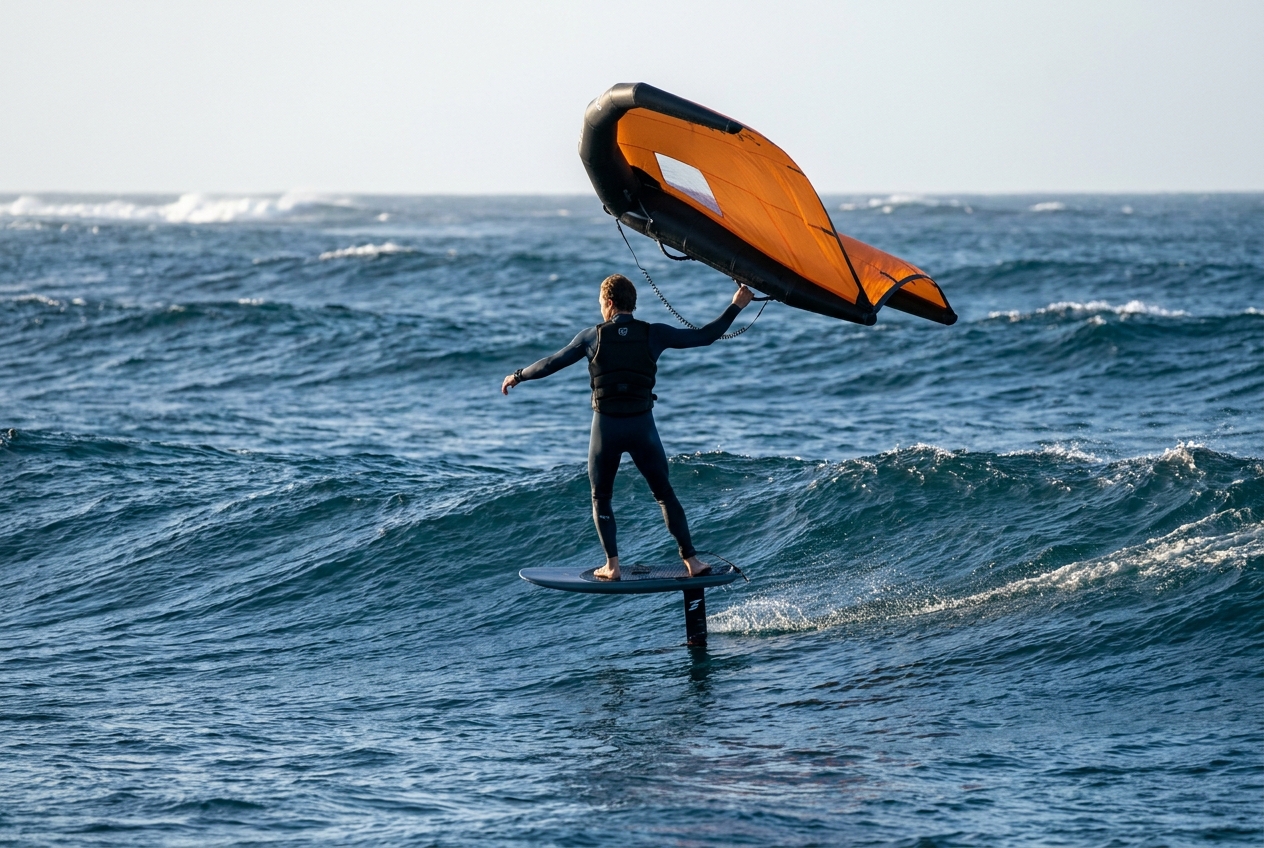
How do you plan your first downwind run safely?
Plan it so the walk of shame is impossible, then work backwards. Pick a short run with a beach you can land on at any point, sort the shuttle before you rig, and carry the means to call for help. Downwinders punish optimistic planning more than any other kind of session.
What you should be able to do first
- Water start in chop, repeatedly. You will fall on a downwinder, and each restart happens in worse water than the beach you learned on.
- Ride toeside or transition both ways. Bumps rarely run exactly with the wind, so you will be angling across them on both tacks.
- Hold a flight for several minutes. If you are still touching down every 30 seconds, a run becomes an endurance event. Our realistic learning timeline puts this well past the first few sessions.
- Self-rescue. Pack the wing down on the water, lie on the board, and paddle. Practise it somewhere boring before you need it somewhere interesting.
What conditions to look for
A steady 15 to 25 knot range is the common sweet spot for early downwind riding, because it builds organised bumps without demanding expert speed management. That sits neatly inside the normal wing foiling wind range, so you are not waiting for a freak day.
Direction matters more than strength. You want the wind running roughly parallel to the coast or straight down a fetch, so the swell lines up with your intended course. Cross-shore-ish is usable, dead onshore is not a downwinder.
What to carry
The non-negotiables are a leash system suitable for open water, flotation appropriate for your location, exposure protection for immersion, and a way to communicate or signal. Our dry bag packing list for downwind foilers covers the full kit, including a personal locator beacon and a high-visibility bag that doubles as a float.
Tell someone your start point, finish point, and expected time. A wing foiler in the water is small, dark and very hard to see from a boat, which is the same reason visibility and comms dominate the honest safety picture for the sport generally.
How do you read bumps and link them together?
Stop looking downwind and start looking downhill. Wind swell arrives in moving lines, and the job is to find the sloping face in front of you, ride it, and use the speed it gives you to reach the next one. The goal is continuous energy transfer, not staying on any one bump.
Maui riders Finn and Jeffrey Spencer put the core of it simply in Duotone’s downwind breakdown: maximise your time on the steepest part of a bump, and use that energy to propel yourself into the next one. Their piece is written for paddle-powered downwinders rather than wingers, but bump reading is the part of the discipline that carries straight across. They also make the unglamorous point that it takes time and experience, because conditions and bumps vary run to run.
A few habits shorten that learning curve.
- Ride lower and faster, not higher and slower. Keeping the foil low preserves glide through messy water, and glide is what carries you across the flat gap between bumps.
- Look two bumps ahead. Your eyes set your line. If you are staring at the water under the nose, you will always arrive at the next bump late and in the wrong place.
- Angle across, do not point straight downwind. Running square to the swell means you catch it and it rolls under you. A slight angle lets you stay on the face and travel along it.
- Try a no-pump drill. Set yourself the task of linking three bumps with no pumping at all. It forces you to fix positioning and timing rather than papering over them with effort.
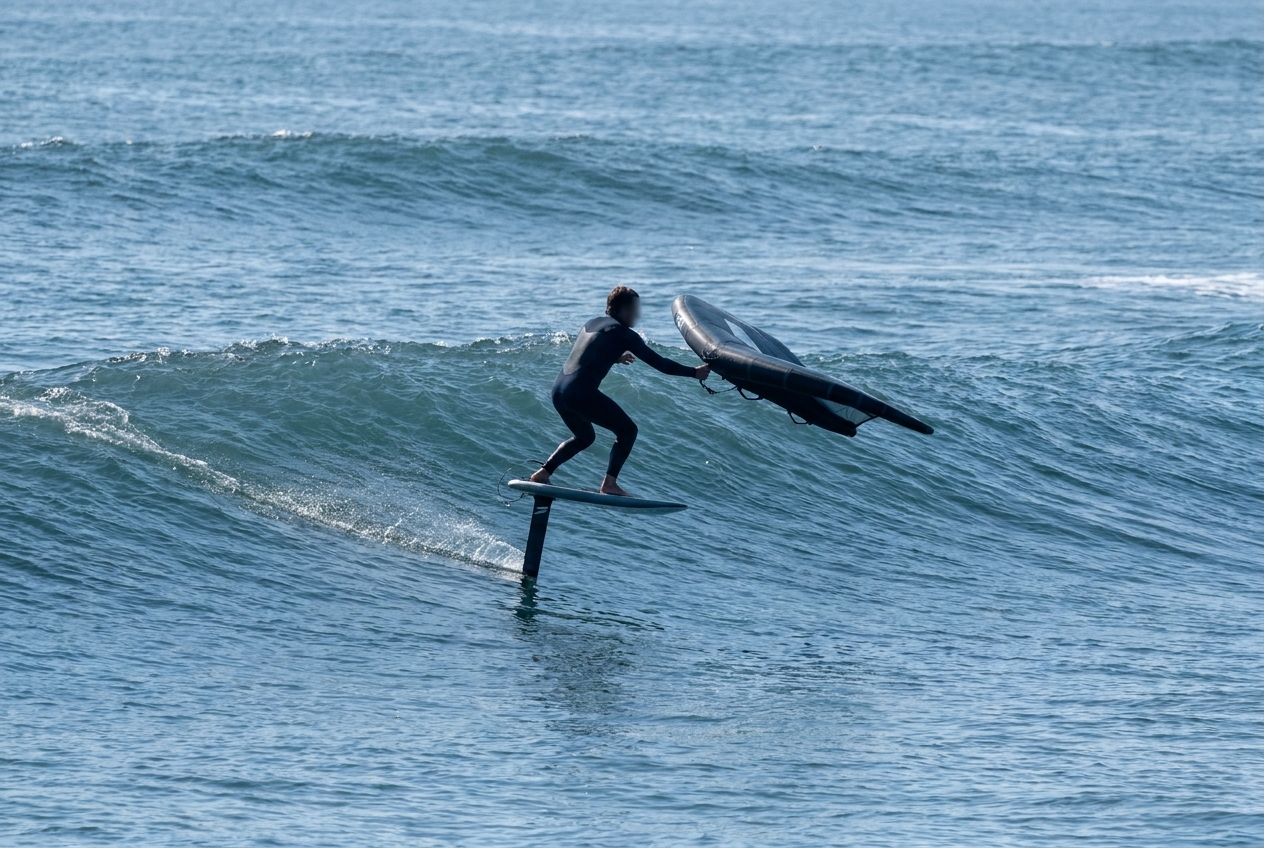
How do you pump between bumps without burning out?
Use short, fast pumps rather than big ones. Once the foil is already flying, MACkite’s coaching is blunt that the deep, grunty pumping motion is ineffective, and that quick pumps are what keep a foil alive. Big pumps feel productive and mostly just cost you speed and breath.
The wing is part of the pump, not a passenger. The same coaching describes pairing the leg movement with sheet control: as you push up and back you are less sheeted in, and as you pull down and through you sheet in more. The coach making that point credits the technique with about 3 knots off the bottom end of his own wind range.
| Situation | Pump style | What the wing is doing |
|---|---|---|
| Getting up from a water start | Large, slower rhythm | Powered up and driving |
| Already flying, crossing a gap | Short, fast pumps | Sheeting in and out with the pump cycle |
| Dropping down a bump face | None, just stay low | Sheeted out, held quiet |
| Overpowered on a steep face | None | Depowered, front hand in |
The endurance trick is to pump only in the gap, never on the face. Riders who burn out on their first run are usually pumping continuously because they have not trusted the swell to carry them.
What gear should you use for a wing downwinder?
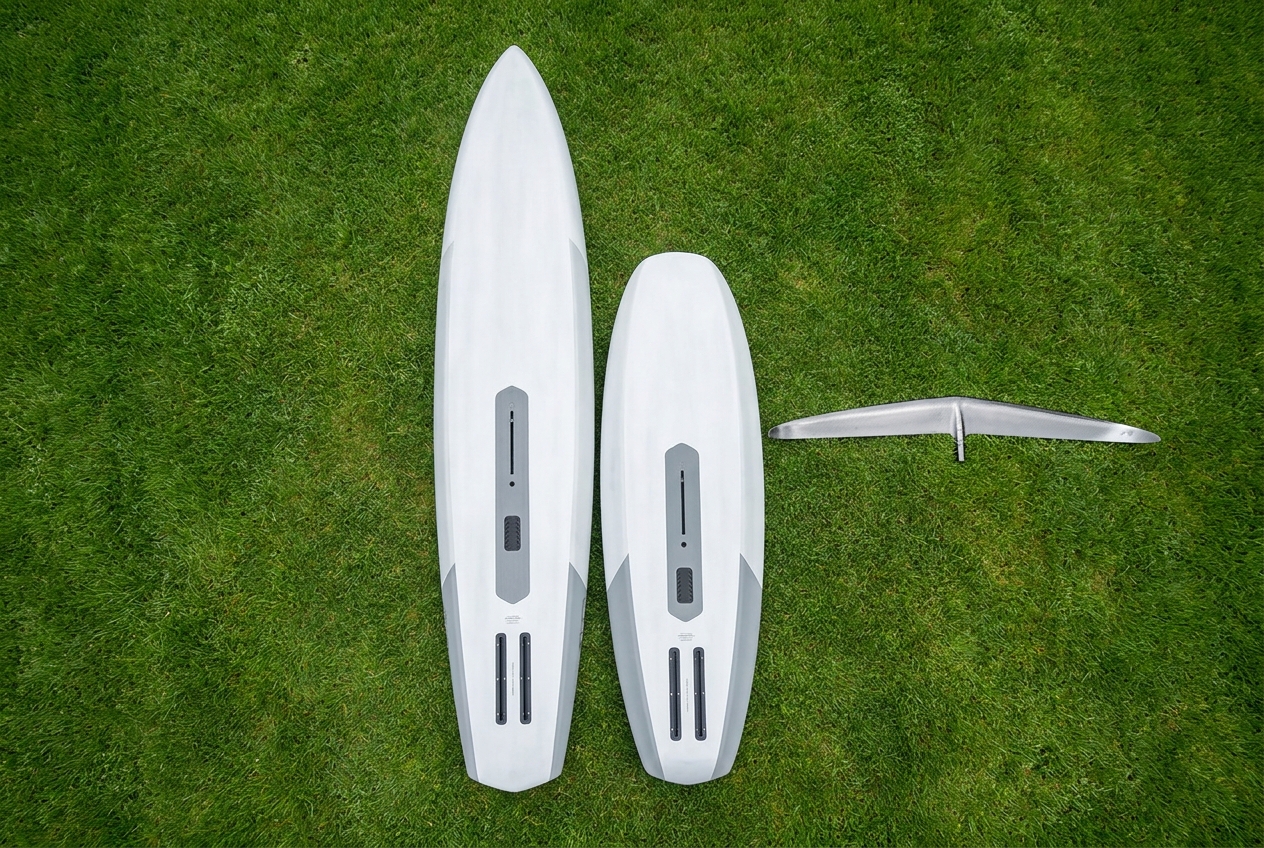
Everything shifts towards glide. A downwind board is longer and narrower than your normal wing board rather than smaller, and the foil trades top-end speed for the ability to stay flying at low speed. Your wing can stay the size you would normally ride, or drop half a metre.
| Component | Typical downwind spec | Why |
|---|---|---|
| Board length | 6’6″ to 9’0″ | Length carries glide and makes take-off easier |
| Board width | 19″ to 24″ | Narrow cuts drag and lets the board slice bumps |
| Board volume | 85 L to 145 L, by rider size | Enough flotation to stand and start in open water |
| Front wing area | Roughly 1200 to 1600 cm² | Area keeps you flying between bumps |
| Front wing aspect | Mid to high aspect | Glide and efficiency over long distances |
| Mast length | 75 to 85 cm | Clears bump troughs without feeling unwieldy |
Those ranges come from Foiling Freaks’ downwind discipline breakdown. Treat them as the shape of the category rather than a prescription, and size within them using your weight. Our wing foiling gear calculator gives you a baseline board and foil size to adjust from.
The volume figure is the one that surprises people coming from normal winging. Our board size guide has advanced riders dropping below their body weight in litres, but a downwind board keeps volume near body weight and buys performance through length and narrowness instead.
You do not need any of it to start. A normal wing board and your existing light-wind foil will get you down a short, sheltered run, and that is the sensible way to find out whether the discipline grabs you before you spend on a dedicated board.
Where are the best wing foil downwind runs?
The best runs share three things: reliable wind, a shoreline you can bail onto, and a shuttle that already exists. Maui, the Columbia Gorge and the Perth metro coast all qualify, and each offers a short version you can use as a first run.
| Run | Where | Distance | Suits |
|---|---|---|---|
| Hatch Laps | Columbia Gorge, Oregon | 0.75 to 1.0 miles | First-timers, though traffic is heavy |
| Swell City | Columbia Gorge, Oregon | 1 to 1.5 miles | Short run, wing and parawing friendly |
| Viento to Hood River | Columbia Gorge, Oregon | 7.5 miles to the Hook | The classic Gorge wing run |
| Swanny Run | Perth, Western Australia | 10 km | Intermediates |
| Maliko Run | Maui, Hawaii | 15 km | Experienced riders in open ocean |
| Gage Roads Run | Perth, Western Australia | 27 km | Fit, seasoned downwinders |
The Columbia Gorge, Oregon
The Gorge is the most accessible downwind hub in the world because the runs stack by length on one westerly wind. The Gorge Is My Gym’s run list puts Viento to Hood River at 7.5 miles to the Hook and 7.9 miles to the Event Site, and names wing foiling among the craft that use it.
Start shorter. Hatch Laps run about 0.75 to 1.0 miles and are described as beginner friendly with heavy traffic from every other watersport, while Swell City is about 1 to 1.5 miles but requires a CGW2 membership and a launch pass listed at $80. Note also that the Viento launch is slippery river rock.
If you are planning a trip around it, our Hood River destination guide covers the wider scene and season.
Maliko, Maui
Maliko is the run the whole discipline is measured against. The Downwindable database lists it at 15 km from Maliko Gulch to Ho’Aloha Park at Kahului Harbor, with a 17 km shuttle back to the start.
It is genuine open ocean and not a first downwinder. The same listing warns you to stay offshore to avoid the reef before the harbour, and flags a 100 m exclusion zone around some vessels inside the harbour under DHS security restrictions.
Perth, Western Australia
Perth has one of the best-graded run ladders anywhere, with named runs at every distance. Foil Seeker’s WA guide calls the 10 km Port Beach to Swanbourne Beach Swanny Run the best intermediate distance run on the Perth coast, and the 27 km North Mole to Sorrento Gage Roads Run the longest on the metro coastline.
There is a winter option too. The same guide notes the Swan River between Point Walter and Applecross Jetty produces good bumps in a westerly storm when the wind is blowing over 25 knots, over a short 4 km stretch of protected water.
Our Perth wing foiling guide has the seasonal detail on when that sea breeze switches on.
Frequently asked questions
How much wind do you need for a wing foil downwinder?
A steady 15 to 25 knots is the common sweet spot for early downwind riding. That range builds organised bumps without demanding expert speed management. Direction matters as much as strength: you want the wind running down the coast or along a long fetch so the swell lines up with your course.
Do you need a special board for wing downwinding?
Not to start. A normal wing board and a light-wind foil will get you down a short, sheltered run. Dedicated downwind boards run roughly 6’6″ to 9’0″ long and 19″ to 24″ wide, trading width for length so they glide further between bumps. Try the discipline before you buy one.
How do you avoid burning out on a downwind run?
Pump only in the gaps between bumps, never on the face. Once the foil is flying, deep grunty pumping is ineffective, so switch to short fast pumps. Ride lower and faster rather than higher and slower, because glide carries you across flat water far more cheaply than effort does.
What is the best downwind run for a first attempt?
Something under 2 km with a landable beach the whole way. In the Columbia Gorge, Hatch Laps at 0.75 to 1.0 miles are described as beginner friendly, though traffic is heavy. The principle matters more than the location: pick a run where quitting halfway is easy.
What safety gear do you need for a downwinder?
Four non-negotiables: a leash system suitable for open water, flotation appropriate for your location, exposure protection for immersion, and a way to communicate or signal. In practice that means a high-visibility dry bag, a waterproof phone pouch, a whistle and ideally a personal locator beacon clipped to your person, not stowed.
How is a wing downwinder different from a SUP downwinder?
The wing solves the hardest part of downwind SUP foiling, which is getting onto foil from a paddle. With a wing you can water start almost anywhere and restart easily after a fall, so you can attempt runs in conditions a paddler could not. Once flying, the bump reading is much the same.
