
Florida wing foiling splits into two coasts and two wind engines. The Atlantic side, Cocoa Beach to Miami, rides steady northeast trade winds all winter. The Gulf side, Tampa Bay to the Panhandle, depends on cold fronts and sea breezes instead, and October through May is the reliable window on both.
Six regional scenes make up the full picture: the Space Coast, the Treasure Coast, Jupiter and the Palm Beaches, and Miami on the Atlantic side; Tampa Bay and Sarasota, plus the Panhandle, on the Gulf side. This guide covers what each is actually like on the water, then why the two coasts behave so differently.
Where Do You Wing Foil in Florida?
Six regions cover almost all of Florida’s wing foiling scene. Pick a coast first: the Atlantic side for winter trade-wind consistency, the Gulf side for a wider spread of launches that each favour a different wind direction.
| Scene | Coast | Signature launch | Typical wind | Best season |
|---|---|---|---|---|
| Space Coast (Cocoa Beach) | Atlantic | Jetty Park, Cape Canaveral | NE/ENE/E/ESE; north wind is gustiest | Oct-May, peak Jan-Mar |
| Treasure Coast (Fort Pierce, Stuart) | Atlantic | Fort Pierce Inlet, Stuart Causeway Park | ENE/E/SE, most consistent in winter | Winter (Nov-Mar) |
| Jupiter & the Palm Beaches | Atlantic | Carlin Park, Jupiter Beach Park | NE, most consistent in winter | Winter (Nov-Mar) |
| Miami & Biscayne Bay | Atlantic | Key Biscayne, Virginia Key | NE, most consistent in winter | Winter (Nov-Mar) |
| Tampa Bay & Sarasota | Gulf | Fort De Soto North Beach | Varies by launch (N/NW/W/SW covered across the bay) | Late Sept-June, peak Oct-Nov & Mar-May |
| The Panhandle (Pensacola, Navarre, Destin) | Gulf | Navarre Sound, Sabine Bay | Cold-front driven; sheltered bay options | Fall through spring |
The Atlantic scenes read almost identically to each other: northeast wind, most reliable in winter, choppier water the further you get from a sheltered bay or lagoon. The Gulf scenes are more varied, since Tampa Bay’s shape means a rider can usually find a launch that matches whatever direction the wind is blowing that day.
What’s the Difference Between Florida’s Gulf Coast and Atlantic Coast for Wing Foiling?
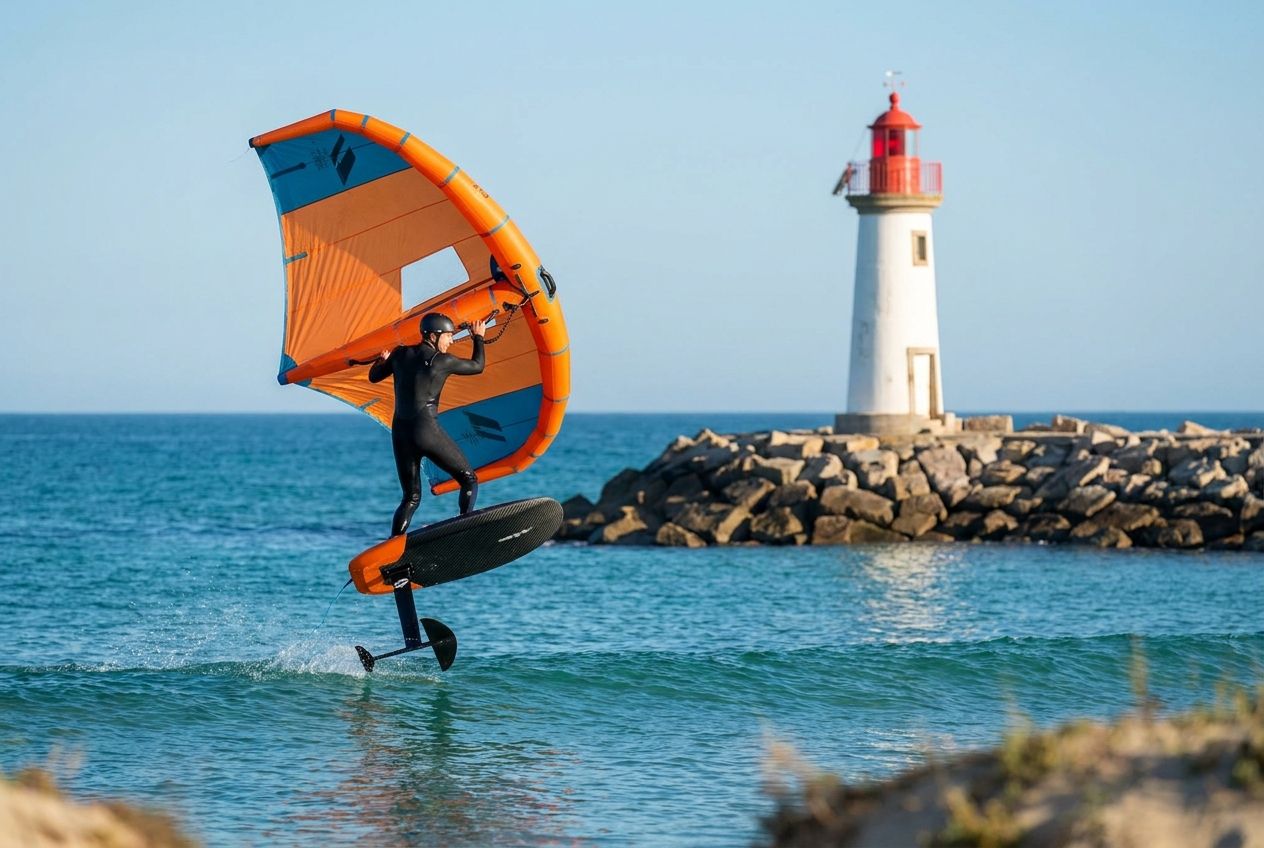
The Atlantic coast gets steadier northeast wind because it’s more directly exposed to winter trade flow, while the Gulf coast depends on cold fronts passing through and afternoon sea breezes filling in behind them. That’s why every Atlantic spot in the table above lists the same NE winter pattern, and every Gulf spot lists a different direction depending on its local geography.
A Gulf coast cold front moves through Florida in a predictable sequence. As it approaches from the north or northeast, wind builds from the south or southwest first; the front’s actual passage brings the strongest, gustiest northerly wind; then, as it clears further south, the wind backs around to the east.
- Front approaching: south or southwest wind builds
- Front passing: strong, gusty northerly wind, often the windiest part of the sequence
- Front cleared: wind backs to the east
- Northwest wind: generally the least favourable direction on the Gulf side, cold and gustier than the rest of the sequence
On days without a front, both coasts fall back on the daily sea breeze, a thermal wind driven by the temperature difference between land and water. It’s strongest on hot, sunny afternoons and can produce 15 to 25 knots on its own, which is why summer sessions on either coast tend to be an afternoon game rather than an all-day one.
What’s Wing Foiling Like on Florida’s Atlantic Coast?
Space Coast (Cocoa Beach, Cape Canaveral)
Jetty Park in Cape Canaveral is the Space Coast’s main wing foiling launch, working best on NE, ENE, E and ESE wind and worst on due north, which turns it into the gustiest spot in Cocoa Beach. The season runs October through May, with January through March the most dependable stretch, over a smooth, hard-packed sandy bottom.
For flatter water, riders cross A1A to the Banana River Lagoon, which offers waist-deep, wave-free flats with room to practise, or head down to the Indian River Lagoon near Melbourne, where wind funnels through for a steadier, less choppy session than the open Atlantic. Kelly Park, further along the Space Coast, is another accessible, all-levels launch.
Treasure Coast (Fort Pierce, Stuart, Jensen Beach)
Fort Pierce Inlet State Park sees east-northeast wind prevail, especially in winter, over smoother, inlet-protected water that suits beginners. Stuart and Jensen Beach run on the same east-to-southeast pattern, with Jupiter Watersports basing lessons at Stuart Causeway Park specifically for its sandy beach and flat water.
Jupiter & the Palm Beaches
Jupiter is one of the windier, wavier spots in South Florida, with an outer sandbar known locally as the Jupiter cloud break. Northeast wind is most consistent through winter, launching from Carlin Park, the Jupiter Civic Center or Jupiter Beach Park, and the water runs choppier here than the sheltered bays further north.
Miami & Biscayne Bay
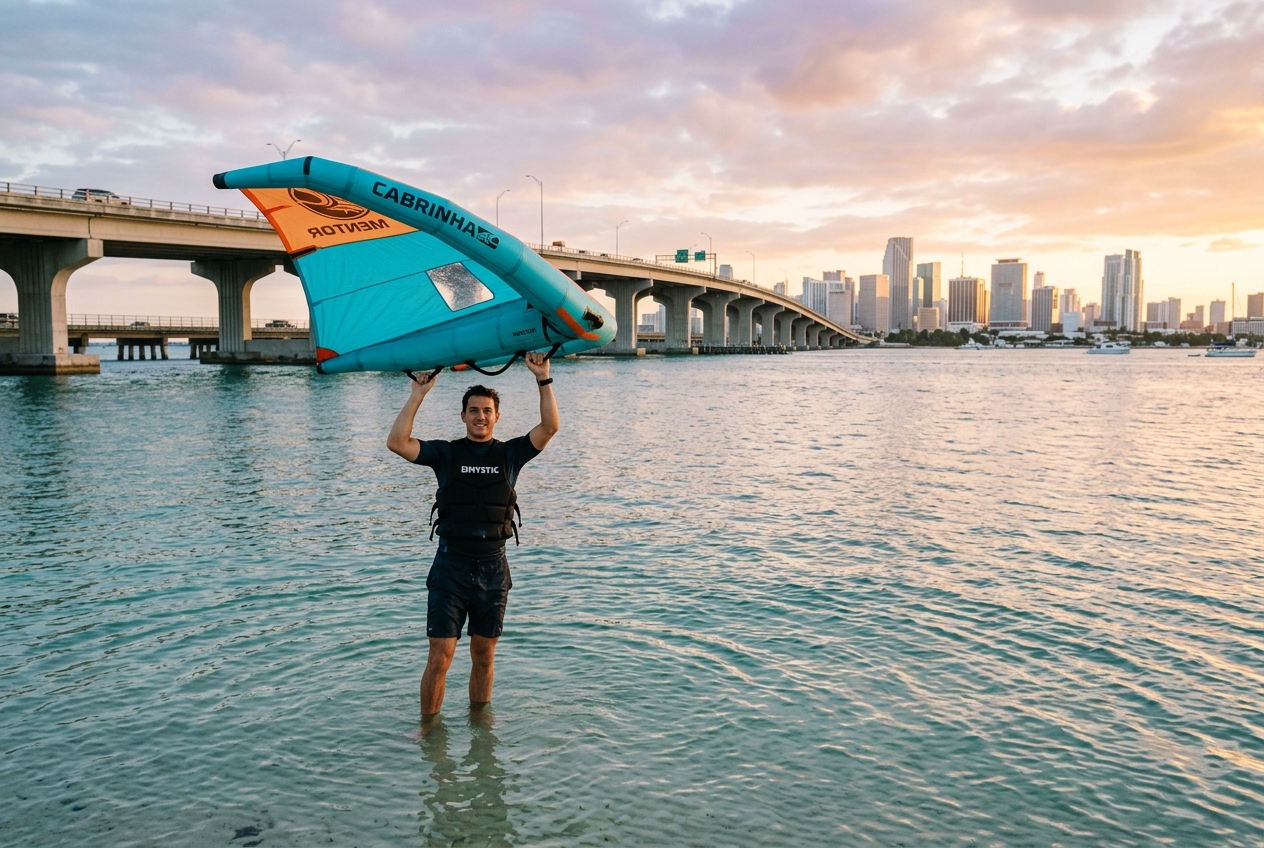
Biscayne Bay around Key Biscayne and Virginia Key is one of the most beginner-friendly launches on the Atlantic side: calmer, protected water, with the Bahamas blocking much of the ocean energy that hits the rest of the coast. Northeast wind is most consistent in winter, same as further up the coast, though it turns choppier and more dynamic than the calm inshore water suggests.
What’s Wing Foiling Like on Florida’s Gulf Coast?
Tampa Bay & Sarasota
Tampa Bay’s peninsula shape is the region’s real advantage: because the coastline curves around, there’s almost always a launch somewhere in the bay that matches the day’s wind direction, even when the wind itself is unremarkable. Fort De Soto North Beach is the flattest of the bunch, working on north, northwest, west and southwest wind over a knee-to-waist-deep lagoon with a hard-packed sand bottom.
| Launch | Best wind directions |
|---|---|
| Fort De Soto North Beach | N/NW/W/SW |
| Fred Howard Park | N/NW/SW/S |
| Clearwater CCSC | N/NE/NW and W/NW/SW |
| Palma Sola Bay | N/NW, S/SE/SW and E/SE |
| Ken Thompson Park (Sarasota) | W/NW/SW (windsurfing-focused; no kite launch) |
| Shell Key Preserve / Pass-a-Grill | W/NW/SW |
The season here runs late September through June, averaging around 14 knots, with October-November and March-through-May the most reliable stretches; December through February is also solid. Summer sea breezes get lighter and less predictable, so riders start watching for tropical low-pressure systems instead of fronts once the season turns.
The Panhandle (Pensacola, Navarre, Destin)
The Panhandle is Gulf coast, not Atlantic, and its scene is smaller but genuine: Pensacola hosted its first international Foiling Week regatta in early 2025, drawing a foil racing community to the area. Sabine Bay on Pensacola Beach is typically calm and sheltered, a reasonable option for newer riders, though boat traffic picks up in summer.
Navarre Sound, between Pensacola and Destin near Juana’s Pagodas, suits intermediate and advanced riders better: westerly wind kicks up waves that reverberate off the shoreline and seawalls, which is fun once you’re past the beginner stage but can be a handful before that. Destin itself works as a coastal-waterway entry point, though it’s worth a heads-up that riders there mention shark sightings as a genuine local consideration.
When Is the Best Season to Wing Foil in Florida?
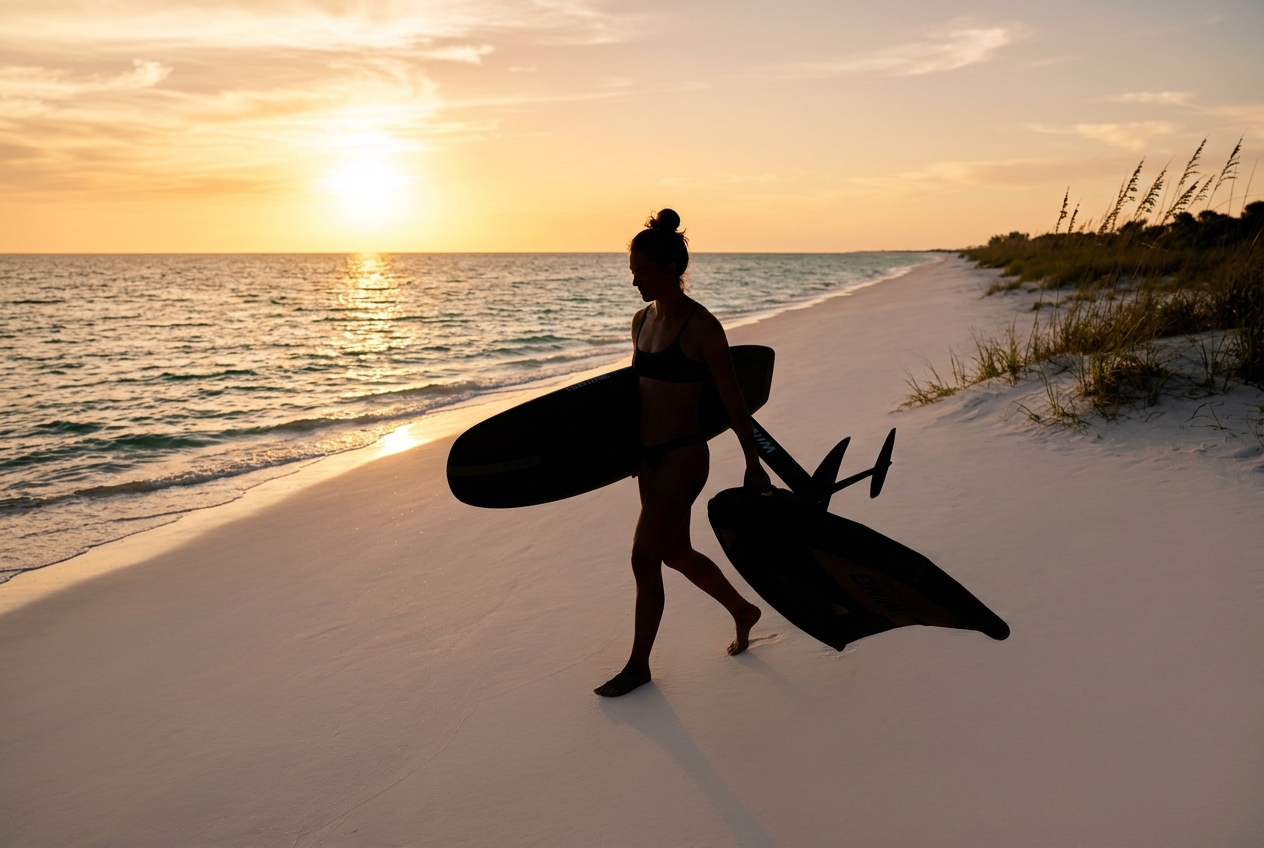
October through May is the reliable season on both coasts, driven by cold fronts moving through roughly every week and daily sea breezes filling the gaps between them. Summer still works, but it’s an afternoon-thermal game rather than an all-day one, and hurricane season overlaps most of it.
| Period | Air temp | Water temp | What drives the wind |
|---|---|---|---|
| Winter (Nov-Feb) | 16-22°C (60-72°F) | ~16°C (60°F) | Cold fronts, strongest and most frequent wind of the year |
| Spring (Mar-May) | 18-27°C (65-80°F) | ~21°C (70°F) | Late-season fronts plus building sea breezes |
| Summer (Jun-Aug) | ~31°C (87°F)+ | ~26°C (78°F) | Afternoon sea breeze only; often light or absent |
| Hurricane season | Jun 1 – Nov 30 | – | Risk of sudden strong wind and dangerous swell; not a season to plan around |
Wetsuit needs track the water temperature table above: winter on either coast calls for at least a 3/2mm suit, since Gulf water sits around 18°C (65°F) into December through March. By summer, water on both coasts warms into the mid-20s Celsius (upper 70s Fahrenheit) and most riders go bare-skinned or add just a rash guard.
Wrapping Up
Florida isn’t one wing foiling destination, it’s six: four Atlantic scenes running on a shared northeast winter trade wind, and two Gulf scenes running on cold fronts and sea breezes instead. Pick a coast based on how much you want the wind pattern to repeat itself day to day, then pick a scene based on how sheltered or open you want the water.
Frequently asked questions
Is Florida good for wing foiling?
Yes, across six distinct regional scenes. The Atlantic coast, from the Space Coast down through Miami, gets steady northeast trade wind all winter. The Gulf coast, from Tampa Bay to the Panhandle, relies more on passing cold fronts and afternoon sea breezes, giving riders a wider spread of launches that each favour a different wind direction.
What's the difference between wing foiling on Florida's Gulf coast and Atlantic coast?
The Atlantic coast is more directly exposed to winter trade flow, so almost every spot shares a northeast wind pattern. The Gulf coast depends on cold fronts (south or southwest wind ahead of the front, gusty northerly during passage, then easterly after) plus daily sea breezes, so wind direction varies more by location and day.
What's the best time of year to wing foil in Florida?
October through May, on both coasts. That's when cold fronts move through roughly every week, backed up by daily sea breezes on the days between fronts. Summer still has wind, but it's limited to afternoon thermals, and hurricane season (June 1 to November 30) overlaps most of it.
Where's the best place to wing foil in Florida for beginners?
Biscayne Bay around Key Biscayne and Virginia Key in Miami is calm and protected, with the Bahamas blocking much of the ocean energy. On the Gulf side, Fort De Soto North Beach in Tampa Bay is the flattest launch in the bay, a knee-to-waist-deep lagoon over a hard-packed sand bottom.
Do you need a wetsuit to wing foil in Florida?
In winter, yes. Winter water sits around 16°C (60°F), and Gulf water stays around 18°C (65°F) from December through March, which calls for at least a 3/2mm suit. By summer, water on both coasts warms into the mid-20s Celsius (upper 70s Fahrenheit) and most riders go without one, or add just a rash guard.