
San Diego wing foils in two different modes: Mission Bay’s Fiesta Island for sheltered, flat-water learning, and ocean beaches like La Jolla Shores, Tourmaline and Cardiff for swell-assisted riding once you have the basics down. Wind is genuinely inconsistent here, mostly a light 8-10 knot northwesterly sea breeze that builds through the afternoon.
The bay and the ocean serve different riders. Two schools, MANTA Water Sports and Mission Bay Aquatic Center, teach out of Mission Bay, while riders past the basics migrate up and down the coast chasing swell instead of wind. This guide covers where to launch, what the wind actually does month to month, and the wetsuit thickness San Diego’s chilly Pacific water demands.
Where Do You Wing Foil in San Diego?
Mission Bay and Fiesta Island: the learning ground
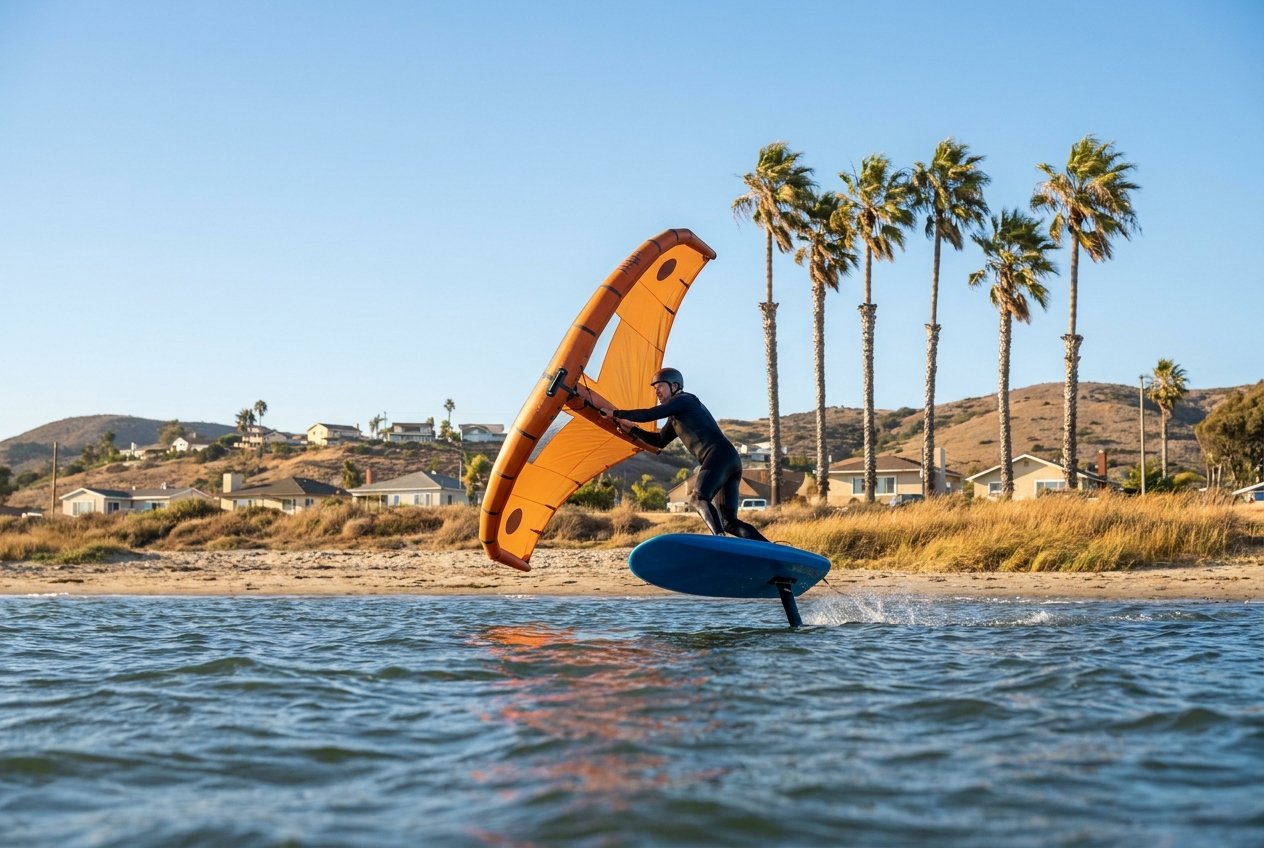
Fiesta Island, inside Mission Bay, is where nearly every San Diego wing foiler starts. The bay is sheltered from ocean swell, so the water stays flat. MANTA Water Sports runs its beginner wing foil lessons from the southwest corner of Enchanted Cove, with its kiteboarding lessons at the northwest corner, and the school tells students riding is not permitted anywhere else in the bay or ocean.
The island itself carries a 5 mph zone on its east side, so the usable water for wing foiling is narrower than the bay’s overall size suggests. That is exactly why it works for lessons: flat water, a defined box, and rescue boats never far away.
The ocean spots: La Jolla Shores, Tourmaline, Cardiff and Del Mar
La Jolla Shores is a sheltered, gentle beach, which makes it a safe option to learn on but not a windy one. Tourmaline Surf Park, near Pacific Beach, is a popular local surf spot and a realistic wing foil option on the right wind day.
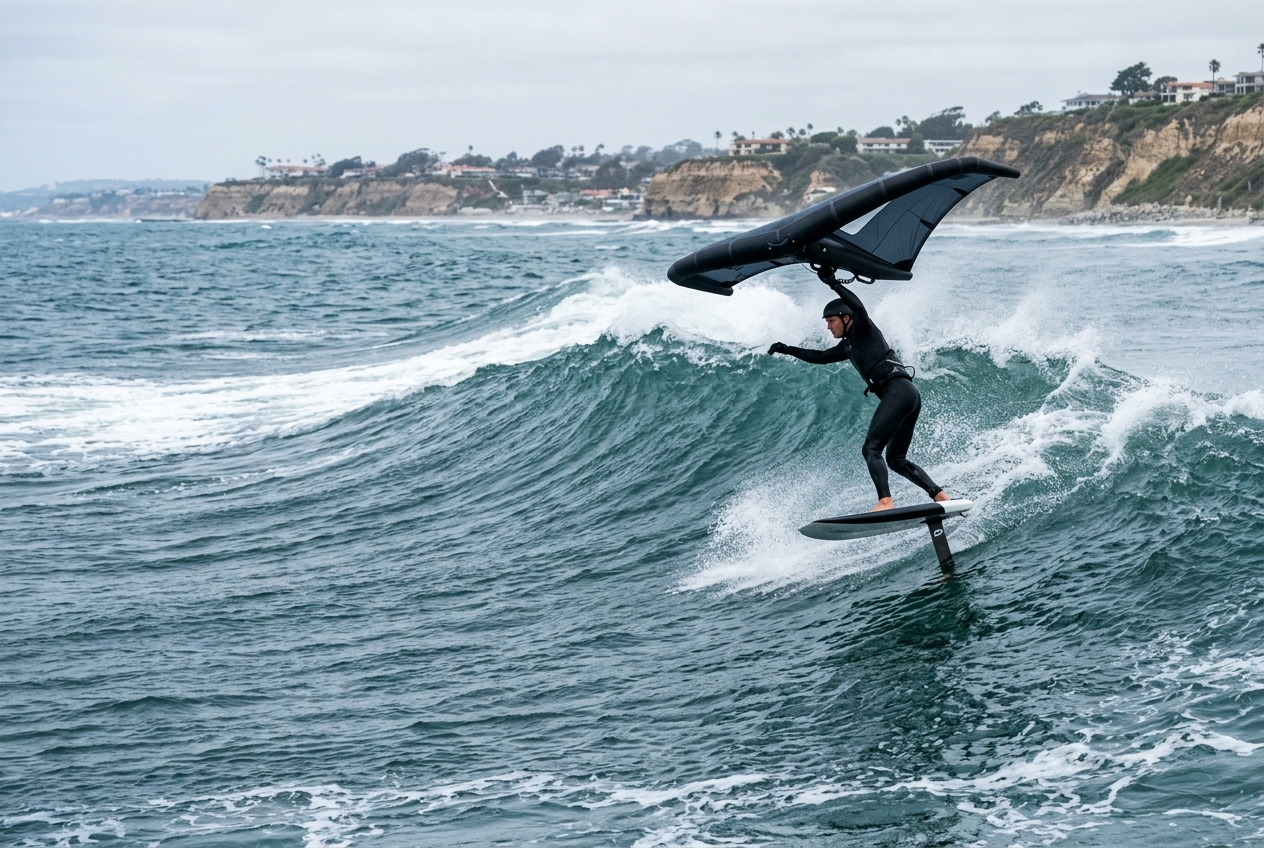
Further north, Cardiff-by-the-Sea in Encinitas sits at the exit of the San Elijo Lagoon, breaking over reef and sand with lefts and rights that work best on a southwest swell. A higher tide fills the waves out, and there is space north and south of the main surf peak for foilers to spread out. Del Mar’s river mouth, at the San Dieguito River, offers multiple peaks and longer, softer rides into deeper water, with more room than the crowded breaks just south of it.
| Spot | Water | Best for |
|---|---|---|
| Fiesta Island (Mission Bay) | Flat, sheltered | Lessons, beginners, no-swell days |
| La Jolla Shores | Gentle, wind-protected | Easy sessions, light wind |
| Tourmaline Surf Park | Beach break | Beginner-to-intermediate wave riding |
| Cardiff-by-the-Sea | Reef/sand break, SW swell | Intermediate-advanced wave riding |
| Del Mar River Mouth | Sand/rock, multiple peaks | Intermediate-advanced, more space |
What’s the Wind Like in San Diego?
San Diego’s default condition is a light 8-10 knot northwesterly sea breeze, which is a genuine onshore flow rather than a dramatic weather system. It builds in the late morning, peaks through the afternoon, and weakens toward evening as the temperature difference between land and water flattens out. That diurnal pattern is reliable in its shape even when its strength is not, which pushes most sessions into light-wind territory.
The broader wind season runs March through October, with spring and fall the strongest windows and high-season days reaching around 18 knots. June and July, despite sitting inside that season, are notoriously light, so do not plan a trip around early summer expecting consistent wind. Because the wind runs light most of the year, use our wing foil calculator to size a wing for San Diego’s range before you book gear. Locals are blunt about it: San Diego gets good wind days, it just does not get predictable ones the way classic wind destinations do.
One pattern worth knowing for safety rather than performance: Santa Ana events, mostly a fall phenomenon, bring dry offshore wind out of the inland mountains. It usually weakens to near nothing by the coast, but strong systems can turn it into a hazardous offshore breeze with larger surf, which is the wrong direction to get blown out to sea in.
Do You Need a Wetsuit for Wing Foiling in San Diego?
Yes, year-round. San Diego’s ocean is cold by wing foiling standards, bottoming out around 57-58°F (14°C) in February and peaking near 67-68°F (20°C) in August. Even the warmest month here is cooler than most tropical destinations’ coldest month, so there is no boardshorts season at any point on the calendar.
- Winter (Dec-Feb), roughly 55-61°F: a 4/3mm or 5/4mm steamer, and most riders add boots and a hood.
- Spring (Mar-May), roughly 57-64°F: a 4/3mm is still the safe default as water lags air temperature.
- Summer (Jun-Aug), roughly 64-68°F: a 3/2mm covers most sessions; some riders go thinner on the warmest days.
- Autumn (Sep-Nov), roughly 61-66°F: similar to spring, a 3/2mm to 4/3mm depending on the week.
Pack for the water, not the air. San Diego’s famously mild air temperature can trick visitors into underestimating how cold the Pacific actually is once you are standing in it for an hour-long lesson.
Which Wing Foil Schools Teach in San Diego?
San Diego has two operators teaching wing foiling, both inside Mission Bay but at different corners of it. MANTA Water Sports teaches from Fiesta Island’s Enchanted Cove, running a 2-hour Discover Wing Foil lesson for ages 12 and up, no experience required, capped at four students, taught by John Arthur, described by the school as San Diego’s most experienced wing foil instructor. Mission Bay Aquatic Center, an SDSU-affiliated facility at Santa Clara Point in Mission Beach, offers a private winging lesson that starts with land-based instruction before moving into on-water coaching.
| School | Base | Format | Price |
|---|---|---|---|
| MANTA Water Sports | Fiesta Island, SW corner of Enchanted Cove | 2h Discover Wing Foil lesson, max 4 students | $159 group / $179 semi-private / $199 private per student |
| Mission Bay Aquatic Center | Santa Clara Point, Mission Beach | Private lesson, land-based intro + on-water coaching | Contact for rates (858-488-1000) |
Both schools keep lessons inside Mission Bay’s sheltered water rather than the open ocean, which is the main reason the bay, rather than any beach, is where every San Diego wing foiler actually learns. If you are completely new to the sport, our complete beginner’s guide to wing foiling covers the fundamentals before your first lesson.
When’s the Best Time to Wing Foil in San Diego?
Spring and fall are the best bet for wind, sitting inside the broader March-to-October season with the most consistent afternoon sea breeze and occasional days near 18 knots. June and July fall inside the same season on paper but are widely known locally as the flattest stretch, so treat them as a bonus if the wind shows up rather than a plan.
Whatever month you pick, the water temperature barely moves the needle on your decision. It swings from a cold 57°F in February to a still-brisk 68°F in August, so the wetsuit conversation above applies no matter when you book. If you are chasing warmer water and steadier wind on the same trip, that combination lives elsewhere on this coastline, not in San Diego. For a much steadier US wind engine, see our Hood River, Oregon guide.
Wrapping Up
San Diego is not a destination you book for guaranteed wind. It is a place with a real, teachable flat-water bay at Fiesta Island, a genuine ocean-riding scene once you are ready for swell at spots like Cardiff and Del Mar, and two schools capable of getting a total beginner upright. The trade-off is honesty about conditions: light, inconsistent wind most of the year and cold water every single month, wetsuit required.
Frequently asked questions
Is Mission Bay good for beginner wing foiling?
Yes, it is the default beginner spot for the whole city. Fiesta Island is sheltered from ocean swell so the water stays flat, and both local schools keep lessons inside the bay's sheltered water rather than the open ocean, with rescue boats never far away.
Do you need a wetsuit to wing foil in San Diego?
Yes, year-round. Water temperature ranges from around 57-58°F in February to 67-68°F in August, so a 4/3mm to 5/4mm suit is standard in winter and a 3/2mm covers most summer sessions. There is no boardshorts window on this coast.
How windy is San Diego for wing foiling?
Modest and inconsistent. The default is an 8-10 knot northwesterly sea breeze building through the afternoon, with a March-to-October season and occasional 18-knot days in spring and fall. June and July are the flattest stretch despite sitting inside that season.
Where do wing foilers go once they outgrow Mission Bay?
Ocean spots up and down the coast: La Jolla Shores for a gentle, wind-protected session, Tourmaline Surf Park for beginner-to-intermediate wave riding, and Cardiff-by-the-Sea or the Del Mar river mouth for more committed reef and beach-break sessions.
How much do wing foil lessons cost in San Diego?
MANTA Water Sports' 2-hour Discover Wing Foil lesson runs $159 per student in a group, $179 semi-private, or $199 fully private, for ages 12 and up with a maximum of four students. Mission Bay Aquatic Center offers private winging lessons; contact the center directly for current rates.