
Wing foiling uses a handheld wing to turn wind into speed, so you can fly on flat water in roughly 16 to 20 knots. Prone foiling uses a wave: you paddle in lying down, pop up and pump. Most riders find winging the easier start, because the paddle-in and the pop-up make prone harder to get into.
What is the difference between wing foiling and prone foiling?
The difference is where the energy comes from. A wing foiler carries their power source in their hands, and a prone foiler has to go and find it in the ocean.
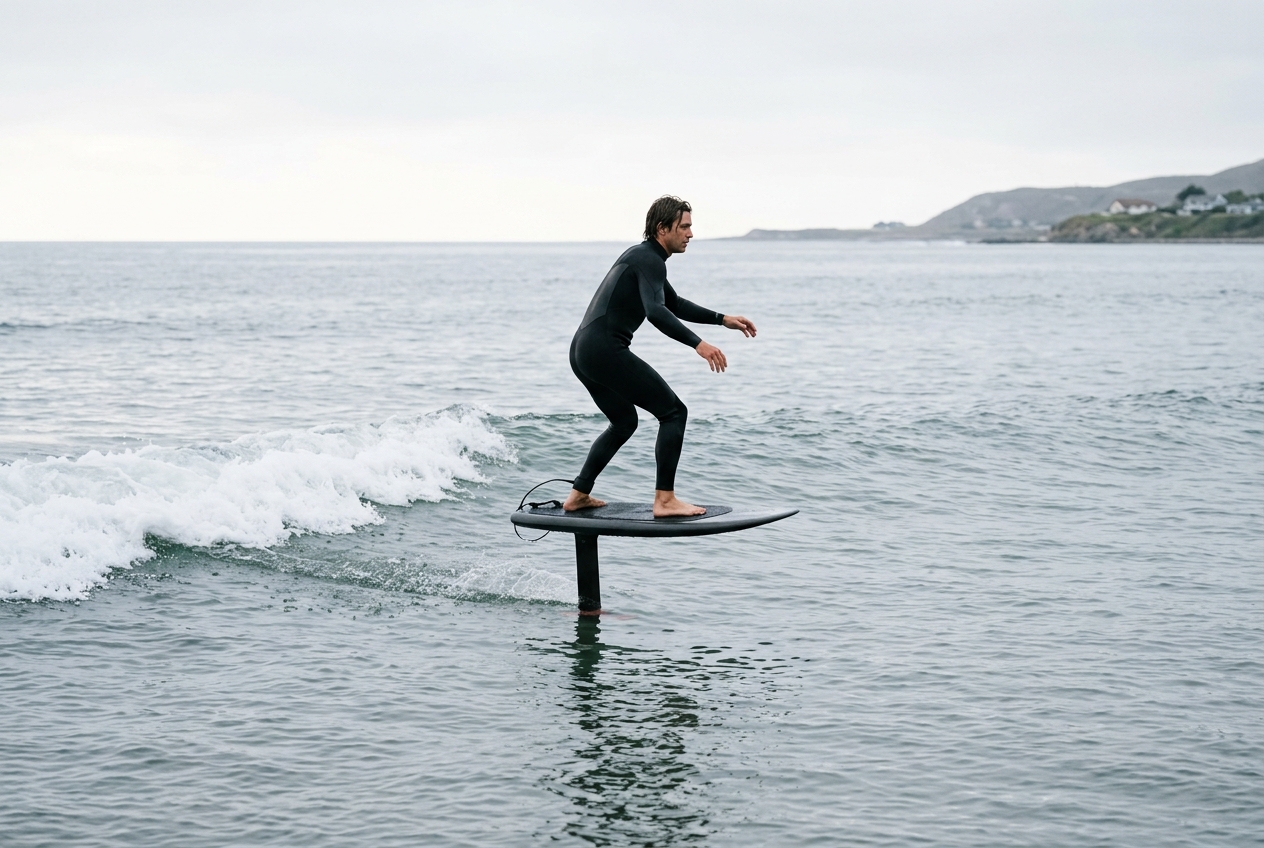
Prone foiling, also called surf foiling, “means to lay on the foil like a surfboard and paddle into a wave”, as the HALF/LIFE foil surfing guide puts it. There is no wing, no paddle and no engine. Once you are up, you keep flying by pumping and by linking one bump to the next.
Wing foiling hands you an inflatable wing that works whether or not there is any swell, which is why it dominates lakes, bays and flat lagoons. If you are weighing it against other wind sports rather than against prone, our wing foil vs kitesurfing comparison covers that side.
| Wing foiling | Prone foiling | |
|---|---|---|
| Power source | Wind, via a handheld wing | The wave only, plus your own pumping |
| What you need | Wind. Flat water is a bonus | Rideable swell, ideally soft |
| Kit to carry down the beach | Board, foil, wing, pump, leashes | Board and foil |
| Ride length | Continuous, you ride back out | Wave by wave, with a paddle back out |
| Hardest early skill | Wing handling and the water start | The paddle-in and pop-up |
| Works inland? | Yes, on any windy lake or bay | No, unless you use a motorised assist |

Which is harder to learn, wing foiling or prone foiling?
Prone is harder, and the industry says so openly. The Hydrofoil Store prone and assist guide calls prone surf foiling “widely regarded as one of the most technically demanding forms of hydrofoiling”, because “unlike SUP or wing foiling, the prone rider must rely entirely on paddling speed, wave positioning, and precise timing to generate lift”.
The pop-up is the wall
Prone boards are short so they pump and turn well, and the same guide notes that this “makes the transition from paddling to standing much more challenging. Precise timing and a quick pop-up are essential.”
Surfers do not get a free pass either. On the Progression Project forum thread “Learn to prone?”, rider Meow told a winger with no surf background: “I feel like you need a surfing background, because the prone paddle technique and popup are so essential. Foil popups are way more technical than surf popups.”
Foot pressure is inverted too. HALF/LIFE warns: “When you pop up, you want to make sure that your weight is forward. It’s counterintuitive to surfing because in surfing everything comes off your back foot to engage the fins. In foiling it’s your front foot that controls the board.”
What the wing asks of you instead
- Wing handling before anything else. Sheeting, flagging and holding an edge while a wing pulls at you is the first hurdle, and it is learnable on land and in waist-deep water.
- A water start on a floaty board. You are standing on something that supports you at rest, so the failure mode is a splash rather than a missed wave.
- Unlimited attempts. If it is windy, you get another go in seconds. Our guide to how long it takes to learn wing foiling breaks the milestones down.
The original poster in that thread, a kiter turned winger with no surfing background, came to his own conclusion after the replies landed: “Prone foil surf is harder than surfing and not the best way to increase my time on the water. I’m loving my time wing foiling and will keep at it.”
What conditions do you need for each?
Wing foiling needs wind, prone needs a wave, and the two rarely peak on the same day at the same spot. That single fact decides the answer for most people before any gear discussion starts.
Wing: how much wind
MACkite’s beginner wind guide puts it plainly: “The general consensus, especially for those new to the sport, is that the ideal wind speed lies between 16 to 20 knots, preferably in flat water.” That matches the 12 to 20 knot beginner band in our own wing foil wind range guide.
Ignore the light-wind bragging. On riders claiming sessions in “minimal wind conditions, like 6 knots”, MACkite says it is “essential to take such claims with a grain of salt”, since experience, technique, gear and rider weight all move that number.
Prone: what kind of wave
Smaller and softer than you would pick for surfing. HALF/LIFE describes the beginner target as “something that is not too intimidating, not too big and where the wave has already broke with a little white water”, a practice they call roughing in.
Heavy surf is a liability, not a prize. Responding to the original poster’s home break in that same forum thread, rider TooMuchEpoxy wrote that “OBX is a pretty crappy surf foil location. Too much power and energy. Good surf = crappy foiling”. Another reply pointed out that a brutal shore break “sounds like the worst possible place to learn to surf, let alone prone”.
How much gear crosses over between wing and prone?
The mast, fuselage and stabiliser usually carry straight over. The board does not, and the front wing often does not either.
| Item | Wing foiling (beginner) | Prone foiling (beginner) |
|---|---|---|
| Board volume | Body weight in kg plus about 30 L as a starting point | About 38 L on a 4’8″ for a beginner to mid-level surfer |
| Front wing area | Around 1900 cm² or more for beginner-friendly lift | 1200 to 1400 cm² as a first prone front wing |
| Wing or sail | 3.0 to 4.5 m² under 60 kg, 4.5 to 6.0 m² at 60 to 80 kg, 6.0 to 7.0 m² over 80 kg | None |
| Mast, fuselage, stabiliser | Generally shared, subject to brand compatibility | Generally shared, subject to brand compatibility |
The wing figures come from the Hydrofoil Store wing foil guide, which gives “board volume ≈ body weight + 30L” and “front foil wing ≈ 1900 cm²+” as starting points. Our wing foil board size calculator goes further into how wetsuit weight and chop shift that number.
The prone volumes come from Wieger, co-founder of Appletree Surfboards, who advises a beginner to mid-level surfer to “go for the 4’8″ kind of size, which will have about 38 liters of volume”. An advanced surfer “can definitely start on something like a 36 liter board”, and he adds: “I wouldn’t advise to go much smaller than that.” A very inexperienced surfer going straight into foiling is pointed at “around 40 liter kind of shape”, roughly five foot.
Why the prone front wing is smaller
The 1200 to 1400 cm² figure comes from The SUP HUT hydrofoil guide, which explains that “a prone foiler is paddling into the steeper power zone of the waves energy and therefore foil wing sizes are generally smaller than a SUP foil board riders who can use a paddle to generate speed”.
Note that this reasoning is a prone-versus-SUP comparison, not prone versus wing. The practical upshot is the same either way: a big high-lift front wing bought for learning to wing is not automatically the right wing for your first prone sessions.
Should you learn to wing foil before you learn to prone?
For most people without a surfing background, yes. Winging gets you flying sooner, and the foil control you build transfers to prone even though the take-off does not.
- Learn to wing first. Wind is more predictable than swell for most riders, and a floaty board forgives mistakes. Start with our wing foiling beginners guide.
- Build a pump. Being able to pump the foil is the skill that turns one prone wave into a linked ride, and it is far easier to practise while powered up.
- Ride waves on the wing. Wave positioning, foil pitch control and staying off the back foot are all rehearsable with a wing in your hands, which is one reason swell-and-wind spots like Maui suit riders working towards prone.
- Add paddling fitness. This is the piece winging does not give you, and it is the piece prone lives on.
- Then go prone, on a soft, already-broken wave.
The assist shortcut
Motorised assist systems such as Foil Drive are now a common bridge, and our Fliteboard vs Foil Drive comparison covers how the main assist options differ. The Hydrofoil Store guide frames them as a progression tool rather than a replacement: “Electric assist systems reduce many of these early barriers. Rather than replacing traditional prone foiling skills, assisted systems act as a progression tool.” Its list of who this helps most runs to four groups: riders “transitioning from other foil disciplines”, “older riders or those managing injuries”, locations “with inconsistent or weaker waves”, and “anyone looking to shorten the learning curve”.
Riders describe the same route. In the forum thread “Winging worth it?”, tangogeoff wrote: “I’m coming from winging to prone via FoilDrive.” In the other thread, Meow suggested assist as the way to “cut out the paddle technique part and just work on the popup part”.
Can one board do both wing and prone?
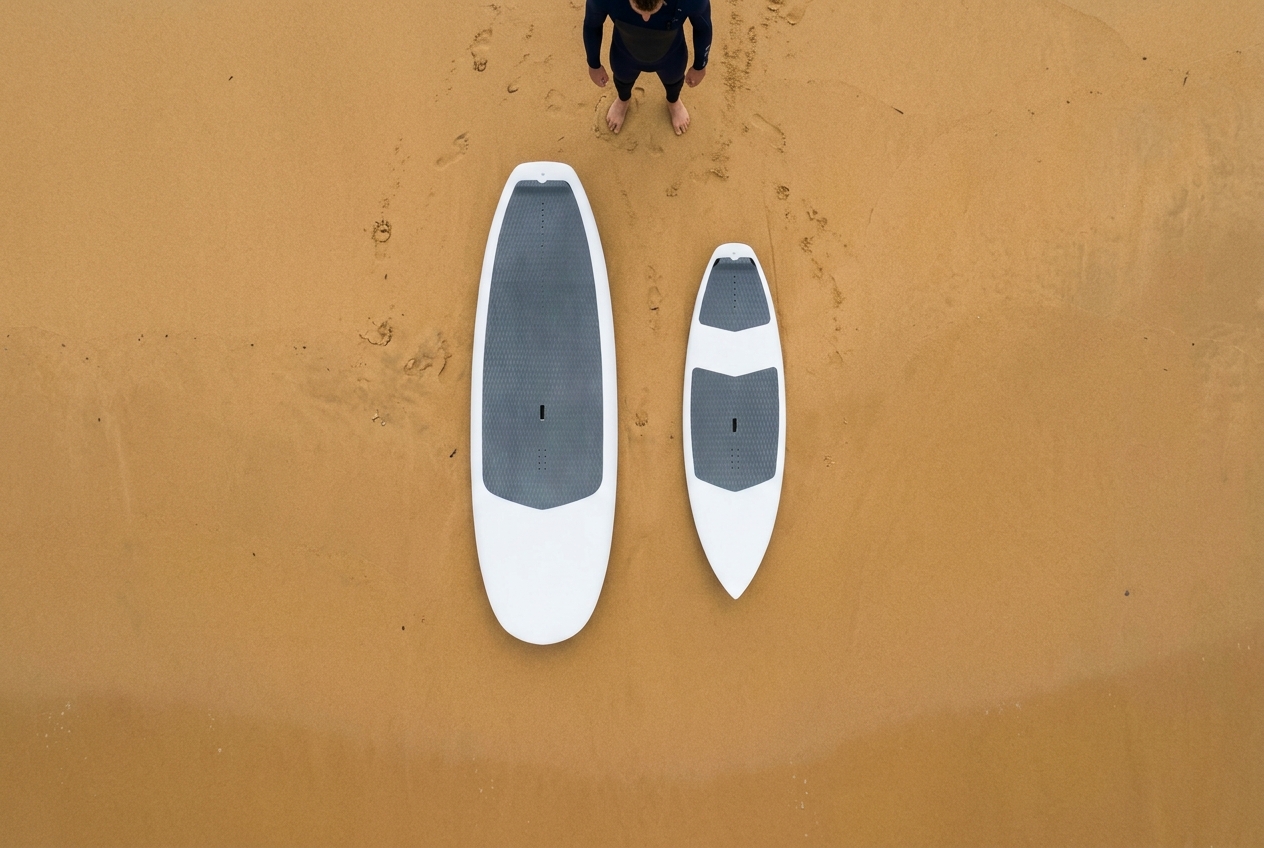
Partly. Crossover and mid-length shapes will prone into a wave, but they do it at a size a dedicated prone rider would never choose.
MACkite’s review of the 2025 F-One Rocket Wing Crossover describes the demo board as “74 liters and measures 5’4 x 21.7″ x 4.7″”, and says that “although it’s got ‘wing’ in the name and it is an excellent wing board, you can easily cross over into other disciplines with it. It’ll work well for Foil Driving, prone surfing, and even parawing.”
Set that 74 L next to Appletree’s 38 L beginner prone board and the compromise is obvious. You are proning something roughly twice the volume, which is why these shapes suit a winger who wants occasional waves rather than a rider chasing prone performance.
There is a second cost. To keep the volume while cutting length, MACkite notes, “F-One had to make the Crossover a bit thicker. That puts your feet a little further from the foil.” The same review pins its sweet spot at “15 knots and up”, so it is a wind-first board that tolerates waves.
What riders who do both actually say
- Wave quality favours prone. Rad_Duke: “Yes I think it is probably less satisfying to ride a wave winging than prone, but the tradeoff is that you ride 10x more waves so it evens out.”
- Water time favours the wing. radair: “Winging is king for time on foil and maximizing wave riding time.”
- The trade is downtime. Hdip, who lists five years prone and one and a half winging, puts the prone con as “Sitting around waiting for minutes at a time. Paddling”, against the wing’s “No down time. All riding all the time.”
- It goes both ways. TooMuchEpoxy, who describes himself as “a long time prone foiler who was super anti-wing”, has now been winging for a year and a half and rates it highly, though he credits five years of prone, five of kite foiling and a windsurf background for how fast he progressed.
Wing foil vs prone foil FAQ
Is prone foiling harder than wing foiling?
Yes. Retailers describe prone surf foiling as one of the most technically demanding forms of hydrofoiling, because the rider relies entirely on paddling speed, wave positioning and timing for lift. Wing foilers carry their power source, so a failed attempt costs seconds rather than a whole wave.
Do you need to surf before you learn to prone foil?
It helps a lot. Experienced riders advise that the prone paddle technique and pop-up are essential, and that foil pop-ups are more technical than surf pop-ups. Without a surf background, the usual advice is to build paddling and pop-up skills on a minimal or longboard first, or to use a motorised assist.
How much wind do you need to wing foil?
For learning, the common recommendation is 16 to 20 knots, preferably in flat water. Our own wind range guide puts the workable beginner band at 12 to 20 knots, with 15 to 18 as the sweet spot. Prone foiling needs no wind at all, only a rideable wave.
Can you use the same foil for wing and prone foiling?
The mast, fuselage and stabiliser usually transfer within one brand’s system. The front wing often does not. Beginner wing setups are commonly sized around 1900 cm² or larger for lift, while a typical first prone front wing sits nearer 1200 to 1400 cm². Check your brand’s compatibility before assuming anything swaps.
What size board do you need for prone foiling?
Appletree Surfboards suggests about 38 litres on a 4’8″ for a beginner to mid-level surfer, around 36 litres for an advanced surfer, and roughly 40 litres near five foot for someone who barely surfs. That is a fraction of a beginner wing board, which typically runs at body weight in kilograms plus about 30 litres.
Does a crossover board work for both wing and prone?
It works as a compromise. Mid-length crossover shapes such as the F-One Rocket Wing Crossover are pitched at wing, Foil Drive, prone and parawing use, but at 74 litres in the tested size they are far larger than a dedicated prone board. They suit wingers who want occasional waves, not prone-focused riders.
