
There are wind spots, and then there are wind spots with a name. Vassiliki, on the southern tip of the Greek island of Lefkada, has one. Every afternoon through the summer, a thermal breeze the locals call “Eric” comes pouring off the mountain that hangs over the bay, switches on like clockwork, and turns a sleepy fishing harbour into one of the most reliable flat-water playgrounds in the Mediterranean. Windsurfers have known about it for decades. Wing foilers are now very much in on the secret.
What makes Vassiliki special isn’t just that the wind blows. Lots of places have wind. It’s the rhythm of it. Mornings are gentle and glassy, ideal for getting your first taxi rides on the foil without the chop trying to murder you. Then, somewhere around the middle of the day, Eric clears his throat, the bay fills with cross-shore breeze, and the advanced crowd comes out to play on the flattest water you’ve ever seen at that wind strength. It’s a two-shift operation, and there’s a slot for almost every skill level.
Add to that the warm, almost cartoonishly turquoise Ionian water, a backdrop of green Lefkada hills, fish tavernas a short walk from the launch, and an airport you can reach with a single short-haul hop, and you start to understand why the same windsurfers keep coming back year after year. This guide breaks down the conditions, the spots, the schools, the off-water stuff, and the logistics of getting yourself onto the water at one of Europe’s classic thermal venues.
Wing Foiling Conditions
Wind Patterns and Seasonality
The wind in Vassiliki is a thermal, not the famous Meltemi you’ll read about in the Cyclades. A westerly sea breeze develops as the land heats through the day, and the mountain ridge overlooking the bay accelerates and funnels it, which is why the spot has such a deserved reputation for reliability. The pattern is beautifully predictable: a gentle onshore breeze in the morning, often only a soft Force 1 to 2, then a building, strong cross-shore wind in the afternoon.
That afternoon delivery has a name and a roughly scheduled arrival. “Eric,” as the local thermal is known, tends to fill in from around mid-afternoon, picking up over the mountain and sweeping across the bay. When it’s on, afternoon strength commonly ranges from the low twenties up to 30-plus knots cross-shore, which is exactly the flat-water, fully-powered playground advanced riders dream about. The morning lull, by contrast, is the beginner and light-wind window, and it’s also prime foiling time for anyone who wants to fly in marginal breeze before the afternoon goes full send.
The season runs broadly from May to October, with the thermal at its most dependable through the high-summer months. Just up the coast, Milos Beach is one of the best thermal spots in the Ionian: a long stretch of Caribbean-coloured water where the day again starts light and the wind clocks round to the west around midday. A typical Milos forecast of eight to twelve knots from the west often translates to twelve to twenty knots on the water from midday into the evening, the kind of light-to-moderate range that’s tailor-made for foiling.
Water Conditions
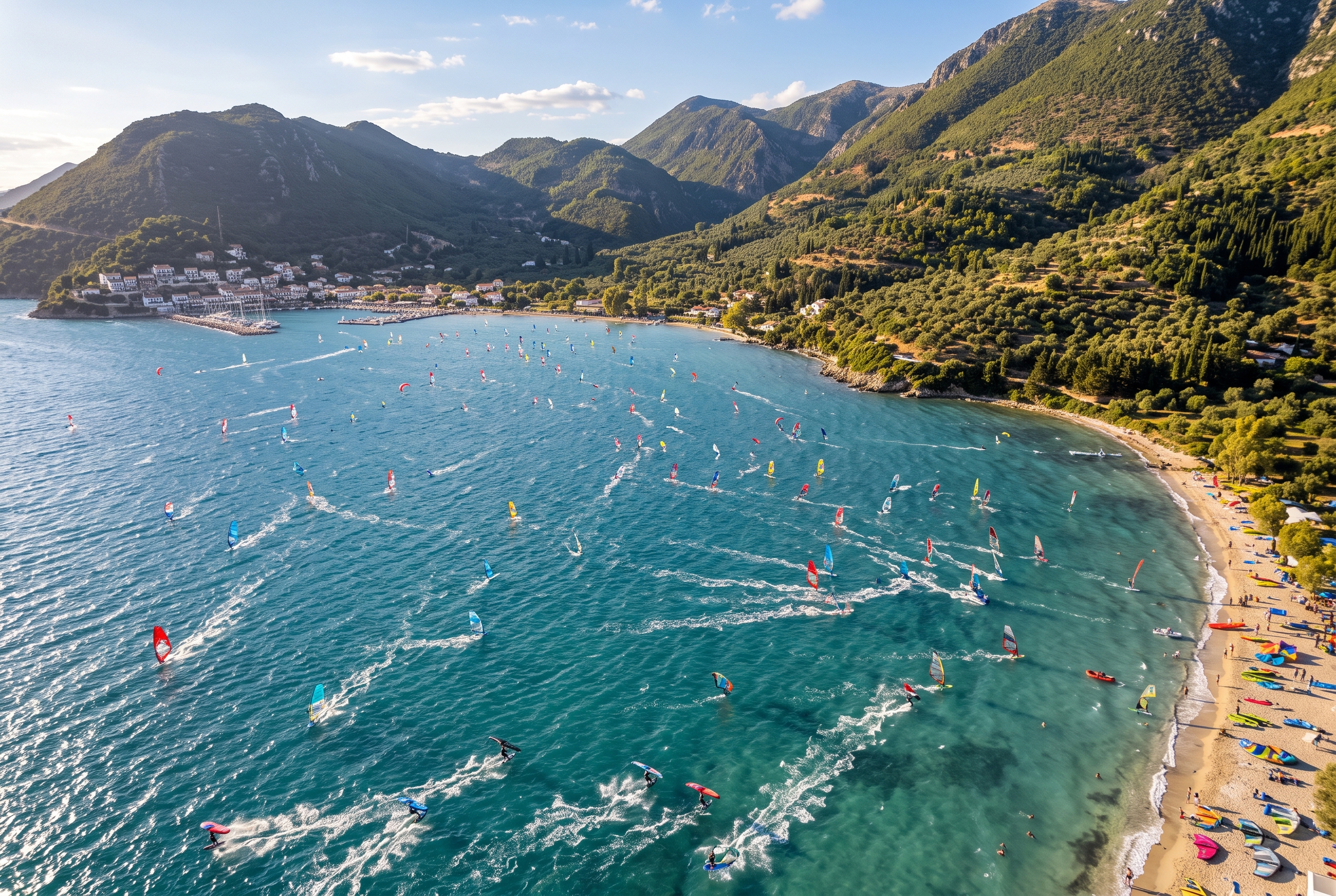
This is where Vassiliki really earns its keep. Because the strong wind blows cross-shore off the land, the bay stays remarkably flat even when it’s honking. There’s no big swell rolling in to knock you off the foil; you get wind strength without the wave drama, which is the holy grail for anyone learning to ride or working on transitions and freestyle.
The shoreline helps too. A shallow, sandy bar runs off the main beach, so the inside is waist-deep and friendly for waterstarts, schooling, and the inevitable swims of the learning phase. The water itself is warm Ionian sea: typically peaking around 26 to 27°C in the height of summer. In practice that means most riders are perfectly happy in a rash vest and boardshorts through July and August, with a shorty wetsuit a sensible call for early or late season, long afternoon sessions, or anyone who simply runs cold.
Best Spots for Different Skill Levels
Beginners: The inside of Vassiliki Bay during the morning breeze is about as forgiving as a real wind spot gets. Shallow, sandy, waist-deep water and a light onshore wind mean you can practise wing handling, balance, and your first foil flights without deep water or chop adding to the stress. The shallow bar means a tumble usually ends with your feet finding the bottom rather than a long swim home.
Intermediates: As Eric fills in through the early-to-mid afternoon, the bay offers a steadily building, predictable cross-shore breeze on flat water, which is the ideal place to lock in consistent flight, work on jibes and tacks, and get comfortable being properly powered up. Milos Beach is also a superb intermediate option in its lighter, steady westerly, especially on days you want moderate wind rather than the full afternoon blast.
Advanced: When Eric is fully lit at 25 to 30-plus knots, the outer bay becomes a high-performance flat-water arena: think freestyle, big jumps, fast carving, and foil sessions where the only limit is your nerve. The genuinely adventurous chase more exotic missions around the island, including foiling out near the dramatic Lefkada lighthouse, though that’s strictly experienced-rider, know-the-conditions territory rather than a casual cruise.
Local Wing Foiling Scene
Schools and Lessons
Vassiliki has been a watersports town for a long time, which means the teaching infrastructure here is excellent and genuinely wing-foil literate. Club Vass, the long-running beach club, runs structured wing foil clinics for beginners and intermediates, typically as week-long courses with weekday tuition and kit included; their instructors are experienced and the operation is slick. Surf School Vasiliki, on the southernmost bay, offers wingfoiling, windfoiling, windsurfing, and SUP lessons and rental, and is another well-regarded option for booking a progression-focused lesson.
The pitch here is simple: this is one of the easier places in the world to actually learn to wing foil, precisely because of that morning-light, afternoon-strong rhythm. Beginners can drill the fundamentals in calm water before the wind ramps, then graduate into stronger conditions on the same beach as they improve. If you’re brand new to the sport, it’s worth reading up on the basics before you arrive, then letting an instructor sharpen the details on the water.
Gear Rentals
If you’d rather not haul boards and wings across Europe, Vassiliki has you covered. Club Vass alone runs a vast fleet, with hundreds of boards and rigs from major brands plus dedicated wind and wing foil kit, so you can rent gear matched to the day’s conditions and your level rather than wrestling whatever you brought. Surf School Vasiliki also offers rental across wing, wind, and SUP disciplines. Between the centres, you’ll find a range of board volumes, wing sizes, and foil setups, which is exactly what you want at a spot where the wind can swing from a whisper to a full-power afternoon in a few hours.
Clubs and Community
Vassiliki’s identity is bound up with watersports, and the community reflects that. The bay attracts a steady international crowd of windsurfers, wingers, and kiters every summer, many of them returning regulars who treat the place as an annual pilgrimage. The vibe is sporty, friendly, and refreshingly unpretentious; the beach bars double as the social hub, and it’s easy to fall into conversation about foil sizes and the day’s wind with people who were strangers that morning. For a wing foiler, that mix of reliable conditions and an established scene means you’re rarely short of company on the water or beta about where to be when.
Off the Water
Cultural Attractions
Lefkada is unusual among Greek islands in that it’s connected to the mainland by a causeway and a small floating bridge, so it has a slightly different character to the ferry-only islands. Lefkada Town, at the north of the island, is the cultural centre, with its distinctive earthquake-resistant architecture, churches, and a laid-back island-capital atmosphere worth an afternoon’s wander. The island is also famously associated with poetry and myth, and the broader region is steeped in the kind of layered history you’d expect from this corner of the Ionian.
Dining
This is a fish-taverna part of the world, and Vassiliki delivers. The harbour and waterfront tavernas display the catch of the day, and the smaller, less obvious places tucked away from the main strip tend to serve the most genuine food. Expect fresh grilled fish, Greek staples, local olive oil, and the sort of unhurried seaside dinners that taste even better after a long afternoon being thrashed by Eric. After a day on the foil, a plate of fresh fish and a cold drink by the water is not so much a meal as a reward.
Nightlife and Entertainment
Vassiliki’s nightlife is shaped by its surf crowd, which gives it a distinctly sporty, relaxed flavour rather than a thumping-club one. The beach bars along the bay have leaned into that culture: spots known among the athlete crowd screen extreme-sports footage and run windsurf-themed nights, while quieter harbour bars offer a more low-key wind-down with mellow music. If you want full-throttle clubbing, Lefkada Town and the resort village of Nydri up the coast carry more of that energy, but most wing foilers find Vassiliki’s easygoing beach-bar scene fits the rhythm of early starts and tired arms perfectly.
Nature and Sightseeing
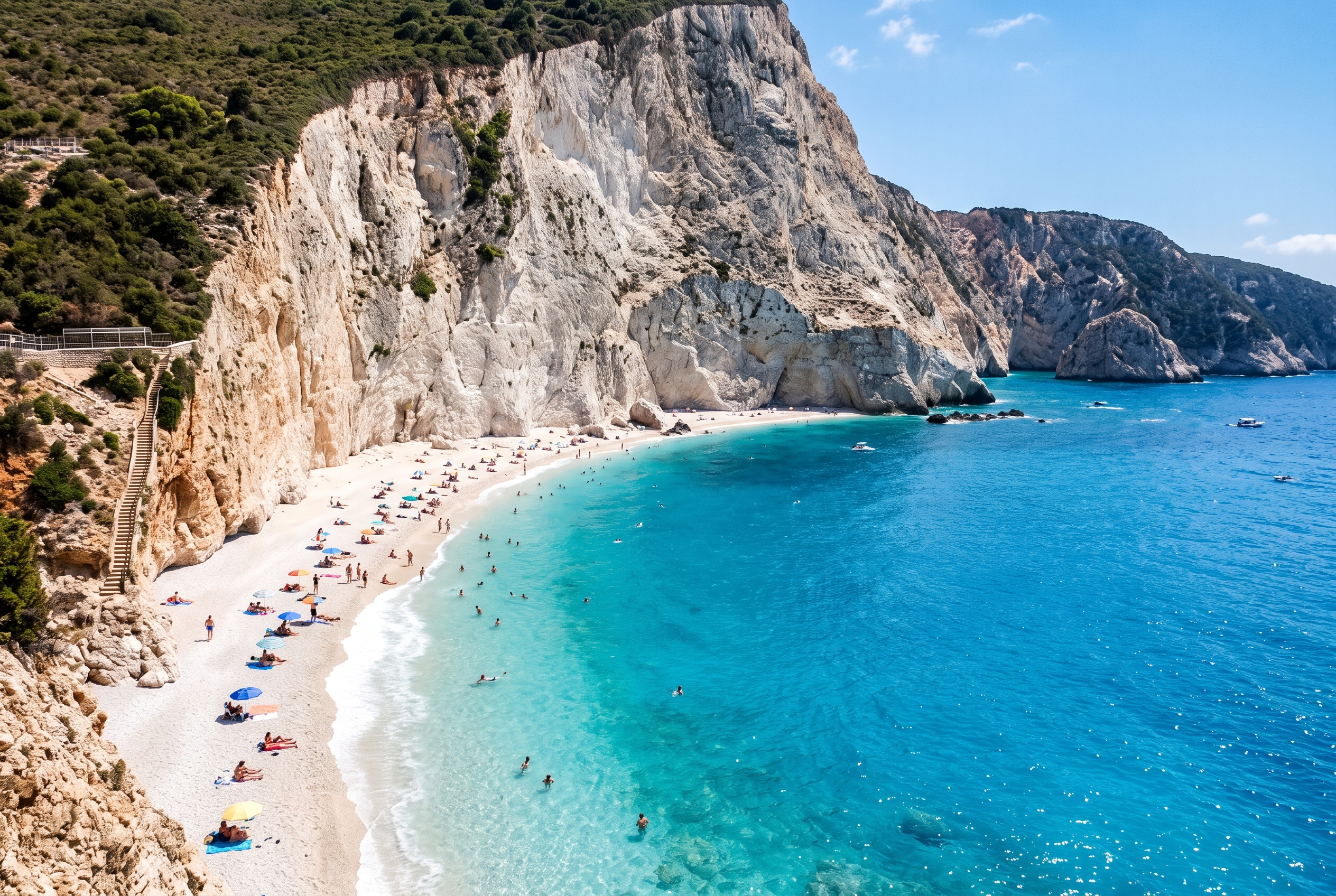
Lefkada’s west coast hides some of the most spectacular beaches in Greece. Porto Katsiki, with its white limestone cliffs plunging into impossibly turquoise water, is one of the most photographed beaches in the country (budget for a hundred-odd steps down, and the considerably less fun climb back up). A little further north, Egremni is longer, wilder, and more remote, reached by a serious staircase that doubles as your leg day. Beyond the beaches, the hills around Vassiliki offer hiking with panoramic Ionian views, and boat trips out to nearby islands like Kefalonia and Ithaca are an easy way to spend a no-wind morning.
Practical Travel Information
How to Get There
The nearest airport is Aktion/Preveza (airport code PVK), on the mainland just across from the island. Because Lefkada is joined to the mainland by a causeway, you don’t need a ferry; you simply drive across. From PVK, Lefkada Town is roughly a 20 to 30 minute transfer, and Vassiliki sits at the far southern end of the island, so allow additional driving time from there down the coast.
For getting from the airport to your accommodation, you’ve got the usual options: a private transfer (the most convenient, and well worth booking ahead during the busy June-to-August window when taxis can be scarce), a taxi (a Preveza-area taxi typically runs in the region of 70 to 85 US dollars, with the run down to Vassiliki costing more given the extra distance), or the budget-friendly KTEL bus, which is cheap but runs on limited hours. Many visitors hire a car at the airport, which is the smart move if you plan to explore the west-coast beaches and chase wind around the island.
Where to Stay
For wing foilers, the most frictionless choice is staying right at Vassiliki, ideally with a watersports centre that bundles accommodation and kit. Club Vass, for instance, offers a beachfront hotel, self-catering studios and apartments set among the olive groves, and a secluded waterfront villa, so you can roll out of bed and onto the beach. Surf School Vasiliki similarly runs a hotel complex geared toward watersports holidays. Beyond the dedicated centres, Vassiliki and the surrounding area have a spread of studios, apartments, and small hotels across budgets, with the village itself putting tavernas and the launch within easy walking distance.
Best Time to Visit
The window is May to October, and the high-summer months deliver the most dependable thermal. If your priority is the strongest, most reliable Eric and the warmest water, aim for the heart of summer. If you’d rather dodge the peak-season crowds and prices while still scoring plenty of wind, the shoulders of the season, late spring and early autumn, are a smart compromise, with the trade-off that you may want a shorty wetsuit for the cooler edges of the season.
Budget Estimates
Costs vary widely with season, how you book, and whether you choose a packaged watersports holiday or piece it together yourself. As rough orientation: airport transfers by taxi sit in the region of 70 to 85 US dollars for the Preveza area (more to Vassiliki), while the KTEL bus is a few euros if your timing lines up. Lessons and gear rental are typically sold as multi-day clinics or weekly packages at the established centres rather than one-off hourly rates, so factor a course-and-kit bundle into your budget if you’re learning. Accommodation runs the full spread from self-catering studios to villas. Where exact current pricing matters, check directly with the schools and your accommodation, since published rates shift year to year.
Wrapping Up
Vassiliki is one of those rare spots that works for almost everyone, and it works because of a single, beautifully reliable trick: gentle in the morning, then strong, flat, and cross-shore in the afternoon when Eric shows up. Beginners get a shallow, friendly bay to find their feet; intermediates get the most progression-friendly flat water imaginable; advanced riders get fully-powered sessions on water that has no business being that smooth. Wrap it in warm Ionian sea, easy airport access, fish tavernas, and a community that’s been doing this for decades, and you’ve got a wing foiling destination that’s very hard to argue with.
If Vassiliki has whetted your appetite for Greek-island foiling, the Cyclades offer a punchier, Meltemi-driven counterpoint over at Paros and the legendary speed-strip of Karpathos. And before you book anything, it’s worth dialling in your kit choices with the wing foil calculator so you turn up with the right wing and board for that two-shift Vassiliki wind. See you on the bay when Eric clocks on.
Frequently asked questions
When is the best season to wing foil in Vassiliki, Lefkada?
The season runs from May to October, with the thermal wind most reliable through the high-summer months. The shoulder season offers fewer crowds but slightly cooler water, so July and August are the safest bet for steady wind.
How much wind does Vassiliki get?
Mornings are gentle, often Force 1-2 onshore and ideal for lessons. The afternoon thermal called Eric commonly blows 20 to 30-plus knots cross-shore, on remarkably flat water, building reliably on sunny summer days.
Is Vassiliki good for beginners?
Yes. The bay has a shallow, sandy, waist-deep inside and a light morning breeze, making it one of the easier places in the world to learn to wing foil. Long-established schools run lessons in the gentle morning window before Eric fills in.
What is the water temperature, and do I need a wetsuit?
Water peaks around 26-27°C in summer, so a rash vest and boardshorts suffice in July and August. A shorty wetsuit is sensible for the cooler early and late season, or for long sessions in the afternoon wind.
How do I get to Vassiliki and what does it cost?
Fly into Aktion/Preveza (PVK); Lefkada is reached by a causeway, so no ferry is needed. Transfers run roughly 70-85 USD by taxi (more to Vassiliki at the far south), or a few euros by KTEL bus. A hire car is handy for exploring the island.
