
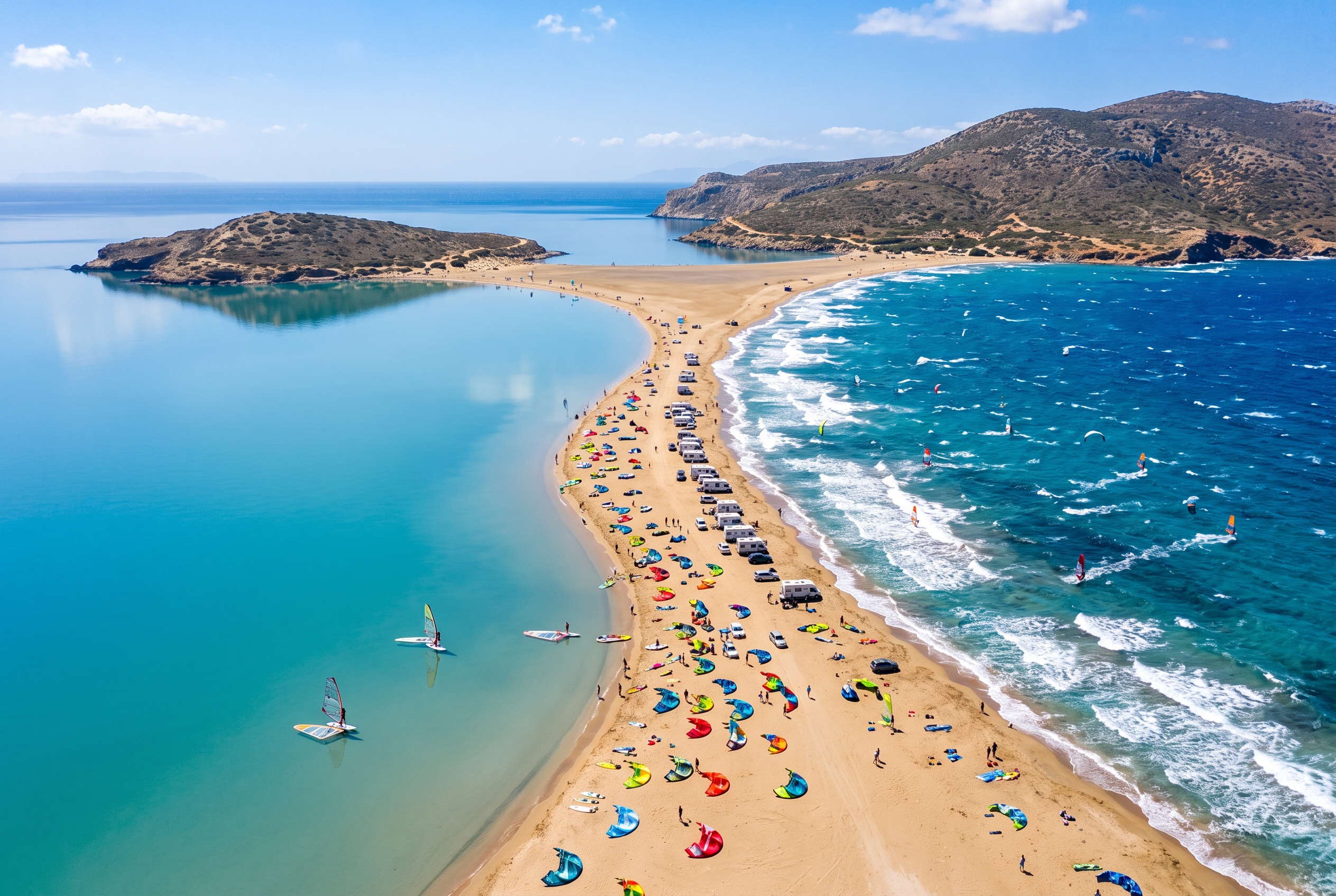
If you could custom-build a wing foiling destination from scratch, you would probably end up with something that looks a lot like Prasonisi. Tucked onto the far southern tip of Rhodes, this is a skinny ribbon of sand where the Aegean meets the Mediterranean, with a flat turquoise lagoon on one side and proper Meltemi swell on the other, just a few hundred metres apart. Add a summer wind that turns up for work six or seven days a week and you have one of the most reliable and beginner-friendly wing spots in Europe.
The headline act is the Meltemi, the strong north-westerly that funnels down the Aegean through the summer. It blows consistently from roughly April to October, ramping up to its peak in July and August when you can realistically expect wind nearly every day. Speeds typically sit in the 15 to 30 knot range during high season, which is exactly the window most wingers dream about. The geography does the rest: the wind comes in offshore and flat on the lagoon side, and onshore with waves on the sea side, so you can pick your playground according to your mood and your skill level.
Who is it for? Honestly, almost everyone. Total beginners get the warm, shallow, flat lagoon and a cluster of long-established, multilingual schools. Improvers get steady wind to nail their first foiling runs without survival-mode gusts. And advanced riders get Meltemi-driven waves on the western side when they want to be thrown around. Pack a thin wetsuit at most, book a flight to Rhodes (RHO), and point yourself south. Here is everything you need to plan the trip.
Wing Foiling Conditions
Wind Patterns and Seasonality
The whole Prasonisi story is really a story about the Meltemi. This is the seasonal north-westerly that dominates the Aegean in summer, and Prasonisi sits in a sweet spot where the wind accelerates around the south of the island. The season runs broadly from May to the end of October, but the engine room is the height of summer: in July and August the Meltemi reaches its climax and blows on something like six or seven days out of seven. By most accounts there are only a handful of genuinely windless days per month during peak season, which is an extraordinary hit rate for a wind sport.
On a typical peak-season day the wind follows a friendly rhythm. Mornings tend to be lighter, often in the 12 to 15 knot range, which is ideal for lessons and gentle sessions. The Meltemi then fills in through the early afternoon, frequently kicking up around 1pm and building steadily into the evening, with speeds commonly between 15 and 30 knots (roughly Beaufort 4 to 7). That predictable build is a gift for planning your day: ease into the water in the calm of the morning, eat lunch, and be rigged and ready when the breeze cranks up.
The shoulder months are a different proposition. May, June, September and October still produce plenty of wind, but the windless days become more frequent and you can hit quieter stretches of a week or so with light air. The strongest winds of all tend to arrive in late summer, with August and September delivering the heaviest hitting Meltemi. The practical takeaway: if you want near-guaranteed wind, target July and August; if you want a little more elbow room and slightly mellower averages, look at June or September.
Water Conditions
This is where Prasonisi earns its reputation. The peninsula is a narrow sand spit, and in summer it is connected to the main island, splitting the water into two distinct arenas that sit only a few hundred metres apart. The eastern, lagoon side is famously flat and shallow butter-water, with offshore wind that lets you carve and practise transitions on a glassy surface. The western, open-sea side catches the Meltemi onshore and serves up the best waves on the island, with an average wave height of just under a metre. Few spots anywhere let you swap from flat-water cruising to wave riding by simply walking across a sandbar.
The water is warm and welcoming. Sea temperatures climb through the summer, with July averaging around 25°C and the peak typically nudging into the mid-to-high 20s°C by mid-August. In practical terms that means minimal rubber: a rash vest and boardshorts will do for many, while a shorty or a thin summer wetsuit is mostly about cutting UV and a little wind chill on long evening sessions rather than keeping you warm. One genuine word of caution: the lagoon is shallow, so foiling there demands a sensible eye on water depth, and beginners should respect the offshore wind on the flat side, which is precisely why staying within a school’s safety setup matters.
Best Spots for Different Skill Levels
Beginners should plant themselves firmly on the flat lagoon side. The shallow, warm, predictable water is about as forgiving an environment as wing foiling offers, and the gentler morning wind window is tailor-made for getting comfortable with the wing, the board and eventually the foil. Because the wind here blows offshore, do your early sessions through one of the schools so there is always a safety boat and an experienced eye on you; that single decision removes most of the stress from learning.
Intermediates are arguably the biggest winners at Prasonisi. The steady, building Meltemi gives you the consistent power needed to lock in your first proper foiling runs and clean up your tacks and gybes, all on flat water where a fall costs you nothing but a giggle. As your confidence grows you can edge further out into the lagoon or start dipping a toe onto the sea side in lighter wave conditions.
Advanced riders will gravitate to the western, open-sea side when the Meltemi is honking. Onshore wind and sub-metre waves make for playful, punchy conditions that reward jumping, wave riding and high-wind handling. On the biggest days this side gets demanding, so it is best treated as a reward for solid water skills rather than a place to push your limits unsupervised.
Local Wing Foiling Scene
Schools and Lessons
Prasonisi has been a windsports magnet for decades, which means the teaching infrastructure here is mature and genuinely good. The longest-running operation, Prasonisi Center, has been on the beach for over three decades and offers structured windsurf and wing foil tuition for all levels. Kite Prasonisi covers the full wind-powered spread, including wing foil, windsurf, kite and surf, while the various ProCenter operations round out the choice. Lessons are typically delivered by experienced VDWS-qualified instructors and come in flexible blocks (think 1, 5 or 10 hours), private or group, with dedicated beginner programmes.
Because the spot draws an international crowd, instruction is usually available in several languages, and there is a long tradition of visiting coaches running structured wing foil clinics, particularly in September. If you are starting from zero, the combination of warm flat water, school safety boats and a deep bench of instructors makes Prasonisi one of the more sensible places in Europe to take your first lesson.
Gear Rentals
You do not need to wrestle a board bag through the airport unless you really want to. The established centres all rent modern wing foil kit, wings, boards and foils, alongside their windsurf fleets, and they keep a spread of wing and foil sizes precisely because the wind range here is so broad. That breadth matters: a light morning and a 28-knot afternoon call for very different setups, and being able to swap down without owning six wings is a real luxury. Rental and lesson packages are common, and many travellers simply book a multi-day deal that bundles the two. Specific 2026 rates are best confirmed directly with each centre, as they vary by package and duration.
Clubs and Community
Prasonisi is not a town so much as a windsports community that happens to have a beach attached. The vibe is relaxed and international, a rotating cast of windsurfers, kiters and wingers from across Europe, all orbiting the same handful of centres, beach bars and tavernas. The shared rhythm of light mornings and windy afternoons creates a natural social structure: people ride, eat, nap and ride again, and the beachfront bars become the unofficial clubhouse by evening. It is the kind of place where you arrive solo and leave with a WhatsApp group, which is half the point of a wing trip.
Off the Water
Cultural Attractions
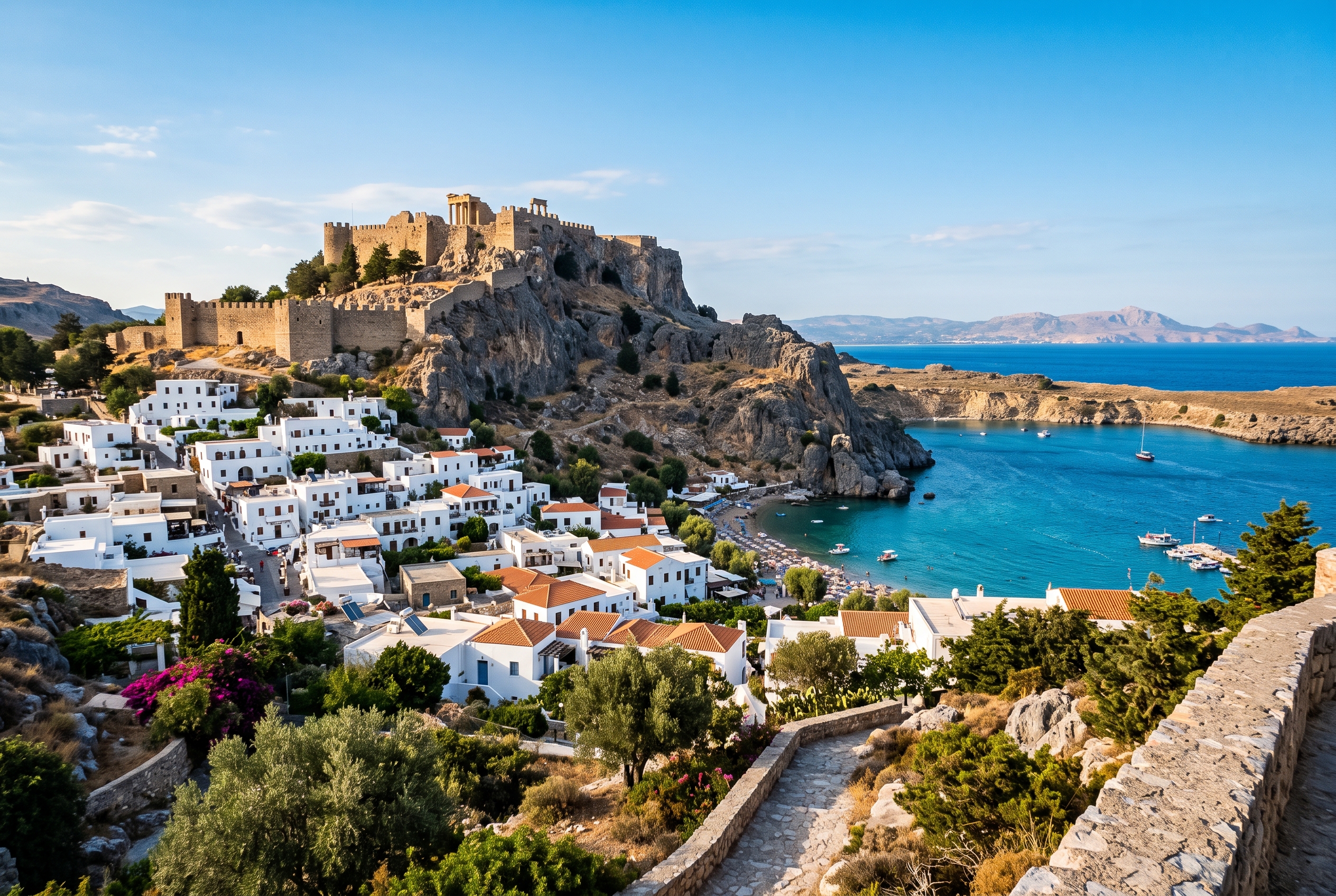
Rhodes is one of the most history-soaked islands in Greece, and that is a genuine bonus on light-wind days. The medieval Old Town of Rhodes, up in the north, is a UNESCO World Heritage Site: a walled warren of cobbled lanes, the famous Street of the Knights and the imposing 13th-century Palace of the Grand Master, built by the Knights of St John. Further down the east coast, the clifftop Acropolis of Lindos rises above a cluster of sugar-cube whitewashed houses and a postcard-perfect bay, with the ancient Temple of Athena at its summit. Both are an easy day trip on a windless day, though be warned, they are a fair drive from the sleepy far south.
Dining
Down at Prasonisi itself, eating is a refreshingly simple affair: the beachside tavernas and bars attached to the hotels and centres serve up Greek staples with a sea view, and after a long afternoon session that is exactly what you want. For something a little more local, the nearest proper village is Kattavia, a short drive inland, where the village square hosts a handful of traditional tavernas and a mini-market. Spots like Louis Restaurant turn out honest Rhodian cooking and notably good seafood, fish platters, sea bream, lobster with spaghetti, at prices that feel fair for the quality. This is rural southern Rhodes, so keep expectations rustic and your appetite for grilled fish and Greek salad high.
Nightlife and Entertainment
Set your expectations correctly: the far south of Rhodes is not where you come to rave. Prasonisi nightlife means a cold beer at a beach bar, a long dinner, and the kind of conversation that only happens between people who have spent all day getting thrashed by the same wind. It is mellow, it is social, and it is exactly right for a wing trip where you want to be back on the water by morning. If you crave bars, clubs and a proper night out, that energy lives up in Rhodes Town and the northern resorts, a significant drive away, which is one more reason some travellers split their stay between north and south.
Nature and Sightseeing
The biggest natural attraction is the spit itself: Prasonisi is genuinely one of the most photogenic beaches in Greece, a thin tongue of sand with two completely different seas lapping either side. Beyond it, the Valley of the Butterflies (Petaloudes) is a famous summer draw, where from roughly mid-June to mid-September hundreds of thousands of Callimorpha butterflies gather among the storax trees, with shaded walking trails, streams and waterfalls. The wider south of the island is quiet, wild and largely undeveloped compared with the resort-heavy north, which is part of its charm: empty roads, scrubby hills and a real sense of edge-of-the-island remoteness.
Practical Travel Information
How to Get There
You fly into Rhodes International Airport (RHO, also called Diagoras), which sits on the north-west coast and is well served by direct flights from across Europe in the summer season. The catch is that Prasonisi is at the opposite, southern end of the island, so you have a transfer of roughly 90 to 100 km ahead of you. By car or taxi that is around 1 hour 35 minutes; a private airport transfer typically runs somewhere in the region of 70 to 90 USD for the trip. There are buses, but they are slow (think several hours with changes) and not really practical with kit, so most travellers rent a car or pre-book a transfer.
Renting a car is the move I would make almost every time. It costs roughly the same as a couple of transfers, takes about 90 minutes each way, and crucially gives you the freedom to reach Kattavia for dinner, to escape to Lindos on a windless day, and to carry gear and groceries without drama. The far south has limited public transport, so wheels turn a good trip into a frictionless one.
Where to Stay
For the full eat-sleep-wing routine, stay right at Prasonisi. The beachfront Hotel Lighthouse sits directly on the sand, roughly a ten-minute walk from the windsurf centre, with bed-and-breakfast or half-board options and its own beachside taverna and bar; there is also a boutique sister property, Lighthouse II, just behind the restaurant area with pool access. Staying on the beach means you are rigged and riding within minutes of waking, which is the whole dream.
If you prefer a little more in the way of villages, shops and restaurants, the nearby settlement of Kattavia offers villas and houses a short drive inland, giving you a quiet local base with the spit just down the road. And if you want to combine wind with sightseeing, some travellers split their stay, a few nights in the buzzier north near Rhodes Town or Lindos, then a stretch down south purely for the wind. With a rental car, mixing it up is easy.
Best Time to Visit
For maximum wind certainty, July and August are unbeatable, the Meltemi is at full tilt, the water is at its warmest, and windless days are rare. The trade-off is that this is also peak tourist season across Greece, so flights and accommodation are pricier and the island is busy. June and September are the smart-money picks for many: still plenty of wind (September in particular can deliver the strongest Meltemi of the year), warm water, and noticeably calmer crowds. May and October are more of a gamble on wind but reward you with cheaper prices and a quieter island. In short: July and August for guaranteed breeze, June and September for the best all-round balance.
Budget Estimates
Rhodes is mid-range by European standards, so a wing trip here is unlikely to bankrupt you. Your big-ticket items are flights (highly variable depending on where you fly from and how early you book), accommodation (beachfront hotels at Prasonisi and villas in Kattavia span a broad range), and gear. A private airport transfer sits around 70 to 90 USD each way, or budget a similar daily figure for a rental car, which is better value across a week. Lessons and rentals are best priced directly with the centres, as they bundle hours, kit and packages in different ways; if you are weighing up bringing your own gear versus renting, a quick play with a wing foil calculator can help you work out exactly which wing and foil sizes you will actually need for the local wind range. Factor in food (cheap and excellent if you stick to tavernas) and you have an affordable, high-value wind holiday.
Wrapping Up
Prasonisi is the rare wing foiling destination that genuinely has it all: dependable summer wind, warm flat water for learning, waves for the brave, a deep bench of schools and rentals, and a relaxed beach-bum community that makes solo trips easy. The unique double-sided geography means a beginner and an advanced rider can share the same sandbar and both leave grinning. Pair it with a few days of Rhodian history and a plate of grilled fish in Kattavia, and you have a trip that works for the whole crew, foilers and non-foilers alike.
If the Meltemi has you in a Greek frame of mind, you are spoiled for follow-up destinations. The legendary flat-water lagoon of Paros is a natural next stop, the wilder, wind-blasted island of Karpathos sits just to the south for those chasing bigger conditions, and if you are still finding your feet it is worth reading our complete beginner’s guide to wing foiling before you book that first lesson. Whichever way the wind blows, Prasonisi is a very good place to follow it.
Frequently asked questions
When is the best time to wing foil in Rhodes?
The season runs roughly May to October, but July and August are the most reliable, when the Meltemi blows on six or seven days out of seven with only a handful of windless days per month. June and September offer a great balance of strong wind, warm water and smaller crowds. September often delivers the strongest Meltemi of the year.
How much wind does Prasonisi get?
During peak summer the Meltemi typically blows 15 to 30 knots (around Beaufort 4 to 7). Mornings are usually lighter, around 12 to 15 knots and ideal for lessons, with the wind building from about 1pm into the evening. The shoulder months see lighter, less consistent wind.
Is Prasonisi good for beginners?
Yes, it is one of the more beginner-friendly spots in Europe. The eastern lagoon side is flat, shallow and warm, with gentler morning wind and a deep bench of long-established schools. Because the lagoon wind is offshore, beginners should always learn through a school with a safety boat.
What water temperature and wetsuit do I need?
Summer water is warm, with July averaging around 25°C and peaking in the mid-to-high 20s°C by mid-August. A rash vest and boardshorts suffice for many; a shorty or thin summer wetsuit is mainly for UV protection and evening wind chill rather than warmth.
How do I get to Prasonisi and what does it cost?
Fly into Rhodes Airport (RHO), then travel roughly 90 to 100 km south, about 1 hour 35 minutes by car. A private transfer runs around 70 to 90 USD each way; renting a car costs similar but gives freedom to reach Kattavia, Lindos and the centres. Buses exist but are slow and impractical with gear.
