
There are wind-sports towns, and then there is Leucate. Tucked onto the Languedoc coast between Narbonne and Perpignan, this stretch of southern France has built its entire identity around the simple, glorious fact that the wind almost never stops blowing. Locals will tell you, with the straight face of people who genuinely believe it, that the Tramontane howls here more than 300 days a year. Stand on the Cap Leucate cliffs in a March gale, hood up and eyes watering, and you will not be inclined to argue.
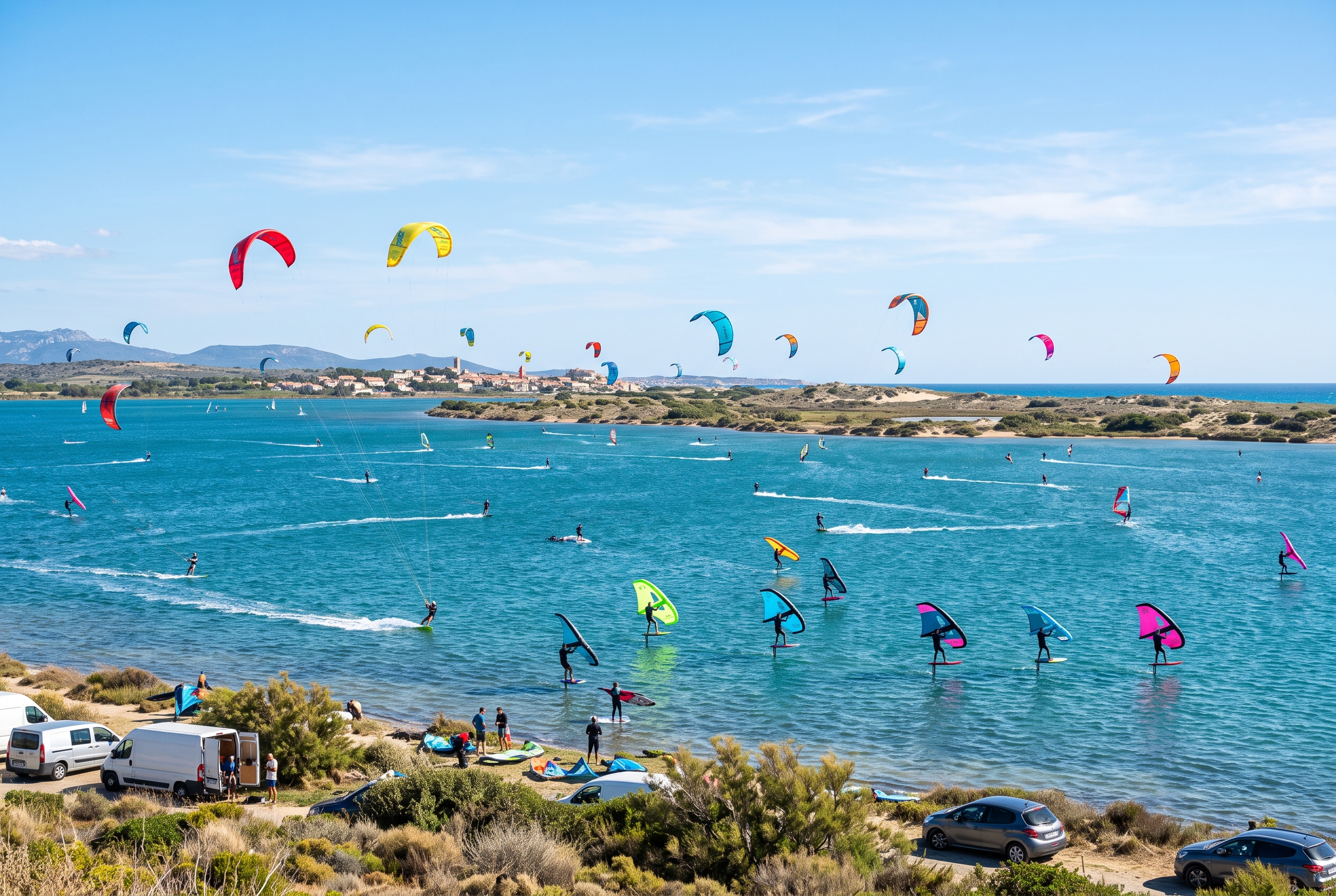
For wing foilers, that reliability is the whole pitch. Leucate and its neighbour La Franqui sit at the meeting point of a flat, shallow lagoon and an open Mediterranean beach, which means you can pick your difficulty like a menu: glassy standing-depth water on one side, lively swell and venturi-charged gusts on the other. It is no accident that the town hosts the Mondial du Vent, the international wind-sports festival that has been pulling the world’s best kiters, windsurfers and, increasingly, wing and pump foilers to these shores every April since 1996.
What follows is a rider’s guide to the place: where the wind comes from and when, which spots suit which skill level, who can teach you or rent you gear, and how to actually get yourself and a board bag to this windy corner of the Aude. We will also talk oysters, because in Leucate you will eat a lot of them, and that is no bad thing.
Wing Foiling Conditions
Wind Patterns and Seasonality
The headline act is the Tramontane, a north-to-northwest wind that funnels down between the Pyrenees and the Massif Central, accelerates as it hits the coast, and arrives at Leucate with serious authority. It is a side-offshore wind here, which freestyle and freeride riders adore, and it regularly powers up past 40 knots. On the Etang de Leucate, the big lagoon behind Port Leucate, force 6 to 9 Tramontane is reported on more than 200 days a year. When it is really switched on it has been clocked toward 100 km/h, which is roughly the moment you want to be on your smallest wing or watching from the beach with a coffee.
The Tramontane is powerful but gusty and a touch irregular by nature, so part of learning to ride Leucate is learning to read it. The secondary wind is the Marin, a thermal southeasterly off the sea. It is gentler and smoother than the Tramontane, more humid, and tends to bring cloud, but it is a useful alternative direction when the northwesterly takes a rare day off. Between the two, the town earns its “more than 300 windy days” reputation honestly.
Seasonally, the wind blows year-round, but the experience changes a lot with the calendar. Spring is prime time, which is exactly why the Mondial du Vent lands in late April. The Tramontane is at its most consistent, the crowds have not yet arrived, and the conditions are world-cup grade. Summer brings warmer water and lighter, more thermal patterns alongside the holiday crowds. Autumn keeps decent warmth and renewed wind. Winter is for the committed: the Tramontane can be ferocious and the air is cold, but the spot empties out and the die-hards have it largely to themselves.
Water Conditions
This is where Leucate genuinely earns its reputation as an all-levels destination. The Etang de Leucate is a long, shallow lagoon, roughly three kilometres of protected water that stays flat even when the Tramontane is tearing across it. Flat, shallow and standing-depth in places is the dream combination for learning to foil: you can fall, stand up, sort yourself out and go again without the open sea adding consequences. The smaller Etang de la Palme to the north is shallower still and standing-depth almost everywhere, a genuinely forgiving classroom.
Out at La Franqui, the open Mediterranean delivers the other half of the package: real swell, chop and side-offshore gusts that reward stronger riders and demand proper kit. One local quirk worth knowing is that the lagoon spots can be affected by seasonal algae, so conditions underfoot vary through the year. Choose your mast length accordingly, especially in the shallows.
Water temperature is firmly Mediterranean rather than tropical. It bottoms out around 11 to 13 degrees Celsius in the depths of winter and early spring, climbs through the mid-teens in spring, and peaks around 21 to 22 degrees in August. In practice that means a proper steamer wetsuit, with boots, gloves and hood, from autumn through spring, and a 2 to 3 mm shorty or summer suit in the warmest months. At the Mondial du Vent in April, expect water around 15 degrees and air in the low to high teens, so a wetsuit is non-negotiable.
Best Spots for Different Skill Levels
Beginners. Start in the lagoon. The Etang de la Palme, with its standing-depth flat water, is the textbook learner’s spot. Within the main Etang de Leucate, the Parc a Huitres (the oyster park) is widely flagged as the safe spot par excellence thanks to shallow water that lets you find your feet, ideally with a shorter mast. This is where most schools will put you for your first lessons, and for good reason.
Intermediates. Le Goulet, on the lagoon, is the natural progression. It offers room to work on tacks, gybes and getting properly onto the foil, plus on-the-water infrastructure: the Wesh Center crew, run by former windsurfing champion Julien Taboulet, sits here with dining and shower facilities, so it is a comfortable base for a full day of laps.
Advanced. Les Coussoules at La Franqui is the marquee spot and the venue for world-championship competition. A venturi effect created by the surrounding geography concentrates the wind here to maximum intensity, and the open-sea swell adds genuine challenge. This is offshore, powered-up, expert terrain. Treat it with respect, ride with others, and keep an eye on your downwind options.
Local Wing Foiling Scene
Schools and Lessons
Leucate is set up for teaching wind sports the way Bordeaux is set up for wine. The town markets itself as an ideal place to learn kitesurfing, wing foiling or windsurfing, with adapted spots in both the sea and the lagoon, certified schools and instructors, and that famous wind to practise in. A handful of established operators run wing-specific courses: Coriolis Foil School specialises in wing, wake and kite foil tuition; Mortefon Watersports runs structured wing foil sessions; and there is a cluster of further schools around the lagoon and Port Leucate offering small-group instruction.
As a rough guide to pricing, group wing foil lessons sit around 60 euros for an hour, 120 euros for two hours and 190 euros for three, with multi-session progression packages also available. Small group sizes, often capped at around three people per instructor, are common, which keeps the coaching personal. If you are completely new to the sport, two or three structured sessions in the flat lagoon will get you a long way before you ever look at the open sea.
Gear Rentals
You do not need to schlep your entire quiver across Europe to ride here. Rental is well established: Directwind Leucate is known for recent, well-maintained kit, the schools generally rent boards, wings and foils to riders who can prove they are autonomous, and operators around the lagoon cover the full range of wind and foil gear. Renting also lets you size sensibly for the day, which matters when the Tramontane can swing from a friendly 18 knots to an eye-watering 40-plus. One practical caveat: equipment theft has historically been a concern in the area. It is less common than it once was, but do not leave gear unattended on the beach.
Clubs and Community
At the heart of the local community is the Cercle de Voile du Cap Leucate, a long-running sailing association of passionate instructors that runs foil courses and rentals out of its base on the Avenue de la Pinede. Beyond the clubhouse, Leucate has a deep wind-sports culture that spans generations and disciplines, and the French national wing foil team has trained here, which tells you something about the level on the water. The social high point is the Mondial du Vent each April, which since 1996 has grown into the reference international event for wing foil, pump foil, e-foil, kite and windsurf, complete with a board-sports village, demos and competition. Even if you are not racing, it is a brilliant week to be in town.
Off the Water
Cultural Attractions
Leucate’s most colourful local legend is Henry de Monfreid (1879-1974), the adventurer, sailor, smuggler and prolific writer who was born here and, as a child, knew the painter Paul Gauguin. The Espace Henry de Monfreid in Port Leucate keeps his memory alive with art exhibitions, concerts and theatre. For history of an altogether more fortified kind, the ruins of the old Chateau de Leucate sit above the village, offering a sweeping view over the lagoon, the oyster farms, the Corbieres hills and the sea all the way from Cap Creus to Sete.
Dining
You will eat well, and you will eat oysters. The Cap Leucate oyster is a hollow oyster with fine flesh and a distinctive nutty taste, farmed in the lagoon and best enjoyed at the source. The town’s oyster centre gathers more than twenty mas, the producer farmhouses, each with its own atmosphere, where you can taste the day’s shellfish or take a basket down to the beach for a sunset feast. For something more refined, the restaurant Le Grand Cap sits atop the Leucate cliff in a glass cube with an unobstructed Mediterranean view, where chef Erwan Houssin works with local produce. After a long day on the foil, the combination of fresh oysters, a glass of crisp Languedoc white and a sea view is hard to beat.
Nightlife and Entertainment
Leucate is a wind-sports and family beach town rather than a thumping resort, so set your expectations accordingly. In summer the beachfront bars and seafront terraces around Port Leucate, Leucate Plage and La Franqui come alive, and the Mondial du Vent and other events bring concerts and a festival buzz to town. The rhythm here is more long dinner and sunset apero than nightclub until dawn, which suits a destination where most people want to be rested and rigged by the time the morning Tramontane fills in. For bigger nightlife, Perpignan is a short drive away.
Nature and Sightseeing
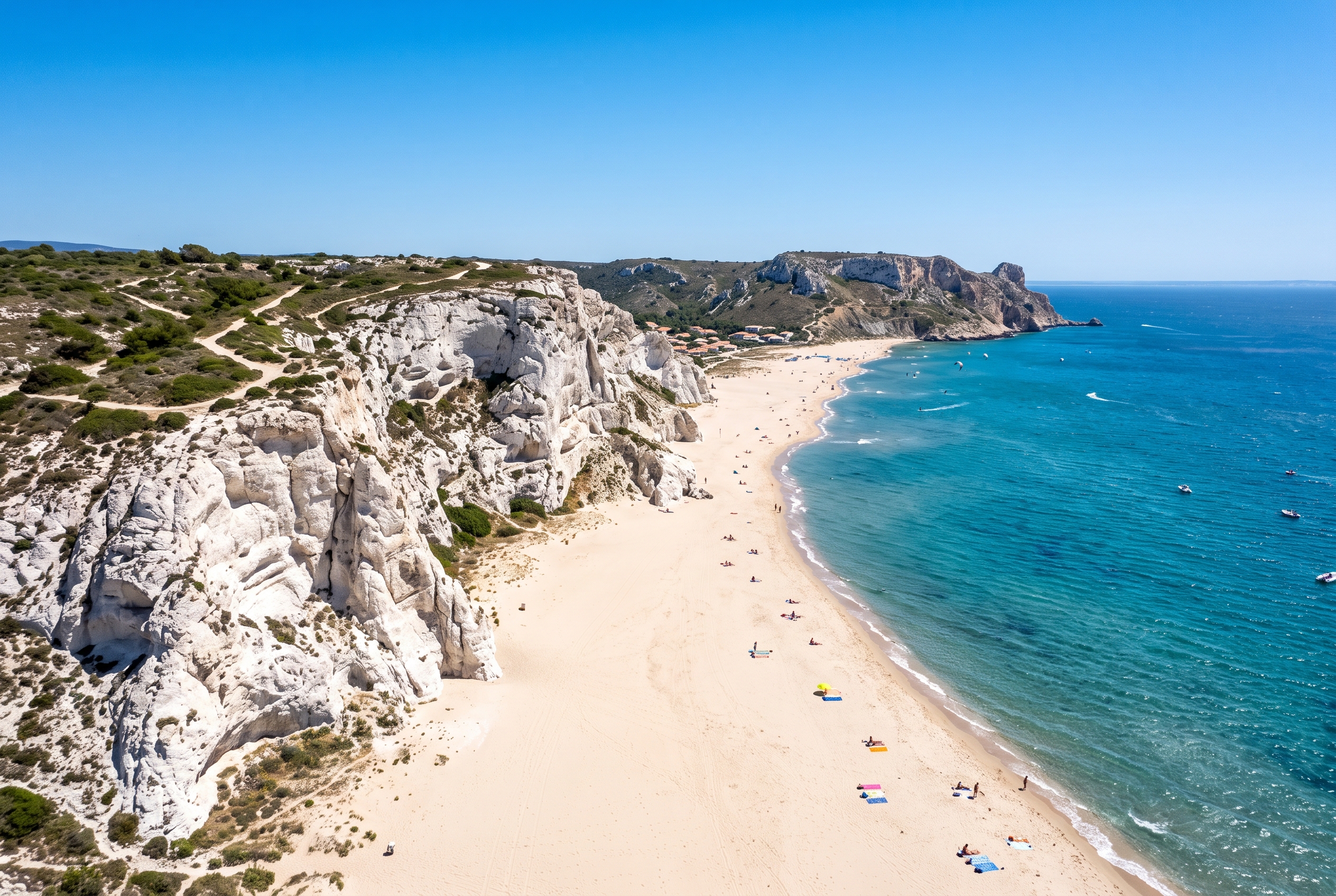
The Cap Leucate cliff rises about 51 metres and is the only true cliff on this stretch of coast, giving a 180-degree panorama over the Mediterranean, ringed by coves, clear water and fish-filled rocks. The signed Sentier du Guetteur, the watchman’s path, is a 4.3 km loop with around two kilometres running right along the cliff edge. Down at sea level, La Franqui beach stretches some eight kilometres and claims to be the oldest seaside resort on the Languedoc-Roussillon coast, gloriously shabby-chic and wild, while Coussoules beach is the legendary turquoise jewel of the lot. Inland, the imposing Forteresse de Salses, built between 1497 and 1503 and considered virtually impregnable in its day, makes an easy and rewarding half-day excursion southwest of town.
Practical Travel Information
How to Get There
The closest airport is Perpignan-Rivesaltes (PGF), roughly 25 km and around a 20 to 30 minute drive from Leucate. Carcassonne (CCF) is the next option at about 65 to 70 km, with Montpellier (MPL) around 130 km and an hour and a half away; Girona and Toulouse are further afield but can throw up useful budget flights. A hire car is by far the easiest way to handle Leucate, because the spots, your accommodation and the oyster shacks are spread across the commune and you will likely be hauling a board bag.
If you would rather not drive, the public-transport mix works but takes patience. From Perpignan airport you can chain local Sankeo and Citibus services via the TGV station and Le Barcares, with individual bus journeys around 1.20 euros. From Carcassonne airport, take the shuttle to the railway station (about 5 euros) then the train to Leucate-La Franqui changing at Narbonne, with tickets typically in the 14.50 to 22 euro range. The rail option is genuinely handy: Leucate-La Franqui has its own station on the Narbonne line.
Where to Stay
Accommodation is spread across distinct areas, each with its own character: lively Port Leucate by the marina, the more traditional Leucate Village up the hill, family-friendly Leucate Plage, the retro charm of La Franqui, and the naturist villages for those so inclined. The full range is on offer, from hotels and apart-hotels to campsites, camper-van parks, holiday villages, guest houses and gites. Riders chasing the lagoon spots often base themselves around Port Leucate or the village for quick access to the water; those drawn to the open-sea swell may prefer La Franqui. Self-catering apartments and villas, bookable through the usual platforms and local agencies, tend to offer the best value for a week-long foiling trip, especially with a group.
Best Time to Visit
For the most reliable wind, aim for spring, with April and May the sweet spot; this is when the Tramontane is most consistent and when the Mondial du Vent showcases the place at its best. The trade-off is cooler water around 15 degrees and the need for a full wetsuit. If you want warmer water and a livelier town, summer delivers around 21 to 22 degree seas but lighter, more thermal winds and bigger crowds. Autumn is an underrated compromise, with retained warmth and renewed wind, while winter is strictly for committed riders who do not mind cold and the occasional savage gale in exchange for an empty spot.
Budget Estimates
Leucate is mid-range by Western European standards and can be done affordably outside peak summer. Wing foil group lessons run roughly 60 euros an hour, 120 euros for two and 190 euros for three, with progression packages bringing the per-session cost down. Budget for gear rental on top if you are travelling light, and for a hire car if you want freedom across the spots. Self-catering keeps food costs down, and the local oysters are a luxury that happens to be reasonably priced at the source. Shoulder-season trips, particularly spring, tend to give the best value-to-wind ratio, since you get prime conditions before the summer price bump. As always, exact figures shift with season and operator, so confirm directly when you book.
Wrapping Up
Leucate and La Franqui add up to one of the most complete wing foiling destinations in Europe: a forgiving flat lagoon and a punchy open-sea spot side by side, a wind that genuinely blows most of the year, a deep teaching infrastructure, and a town that feeds you oysters and cliff-top sunsets when the wind finally drops. It is a place that works for a nervous first-timer and a world-cup racer in the same week, which is rare. Time your trip for the spring Tramontane, pack a proper wetsuit, and let the Mondial du Vent town show you why it has been on the wind-sports map for decades.
If you are still building your basics before you go, our complete beginner’s guide to wing foiling will get you ready for those first lagoon sessions, and our wing foil calculator will help you dial in the right wing and board size for Leucate’s wide wind range. Craving more Mediterranean flat-water? Compare notes with Lo Stagnone in Sicily, another lagoon legend, or the wind-blasted shores of Tarifa in Spain. For France’s Atlantic side, our Lorient guide covers the Ria d’Étel flat-water ground and the Fort Bloqué swell.
Frequently asked questions
When is the best season to wing foil in Leucate?
Spring, especially April and May, when the Tramontane is most consistent and the Mondial du Vent runs. Expect cooler water near 15°C. Summer is warmer but lighter and busier; autumn is a good warm-and-windy compromise.
How much wind does Leucate get?
A lot. The Tramontane northwesterly blows more than 300 days a year, regularly powering past 40 knots, with force 6-9 reported on the lagoon over 200 days annually. The gentler Marin southeasterly is the backup wind.
Is Leucate good for beginners?
Yes. The shallow, standing-depth lagoons such as the Etang de la Palme offer flat, forgiving water, and certified schools run small-group lessons from around 60 euros per hour. Pick a lighter day, as the Tramontane can be strong and gusty for first-timers.
What water temperature and wetsuit should I expect?
Water ranges from about 11-13°C in winter and early spring up to 21-22°C in August. Wear a full steamer from autumn to spring (with hood and gloves in winter) and a 2-3mm shorty in peak summer. April sits near 15°C, so a wetsuit is essential.
How do I get there and what does it cost?
Fly into Perpignan (PGF), about 25 km and a 20-30 minute drive; Carcassonne, Montpellier, Girona and Toulouse are alternatives. A hire car is easiest; Leucate-La Franqui also has a train station on the Narbonne line. Lessons run roughly 60-190 euros plus rental and accommodation.
