
There is a reason the locals slapped “One Happy Island” on Aruba’s licence plates, and a fair chunk of that happiness blows in from the northeast at a steady 20-something knots, basically every single day. Sitting just off the coast of Venezuela in the southern Caribbean, well outside the hurricane belt, Aruba is one of those rare places where the wind is less a forecast and more a personality trait. For wing foilers, that combination of relentless trade winds, bathwater-warm flat water, and a sandbank so shallow you can stand on it half a kilometre offshore is close to the platonic ideal of a learning-and-progression zone.
The headline spot is Fisherman’s Huts, also known as Hadicurari Beach, a turquoise lagoon on the island’s northwestern shoulder that has been a windsurfing mecca for decades and has comfortably absorbed the wing-foiling boom. It sits a short walk from the high-rise hotel strip on Palm Beach, which means you can roll out of an air-conditioned resort, cross a road, and be riding a foil over flat water before your coffee has gone cold. Aruba does not make you suffer for your sessions, and after a few days here you may struggle to take “marginal conditions” seriously ever again.
This guide walks through what to expect on the water, where to ride depending on how confident you are above (and below) the surface, the local school and rental scene, and how to actually get yourself, your jet-lagged body, and possibly your gear onto the island. We will keep the numbers honest and the wind talk grounded, because Aruba genuinely delivers without needing the hype.
Wing Foiling Conditions
Wind Patterns and Seasonality
Aruba’s wind is delivered by the northeast trade winds, and they are about as reliable as wind gets anywhere on the planet. On a typical day the trades blow between 20 and 25 knots, with lighter days dipping to 15-20 knots and the punchier days climbing into the 30-35 knot range. For a wing foiler that is a beautiful spread: enough grunt on an average day to keep a mid-size wing loaded, and rarely so much that you are white-knuckling for survival.
The windiest months are May, June, and July, when averages sit in the 20-35 knot band and the island turns into a full-throttle playground. Many riders rate the broader December-through-August window as the most consistent stretch, and according to WindFinder statistics the probability of usable wind tops 80% from December all the way to August. The quieter season runs across just three months, roughly September to November, when averages soften to 10-18 knots. That is the time for big light-wind wings, small foils, and a more philosophical attitude to your session count, but it is hardly a dead zone.
To put a number on the kit: the local kite crowd typically rigs anywhere from 6m to 13m depending on the day, which tells you everything about the range a wing foiler should pack. A two-wing quiver covering something in the mid-range plus a larger option for the shoulder season will keep you powered across most of the calendar. If you only own one wing, bring the one you trust at 22 knots and you will be in business the majority of the time.
Water Conditions
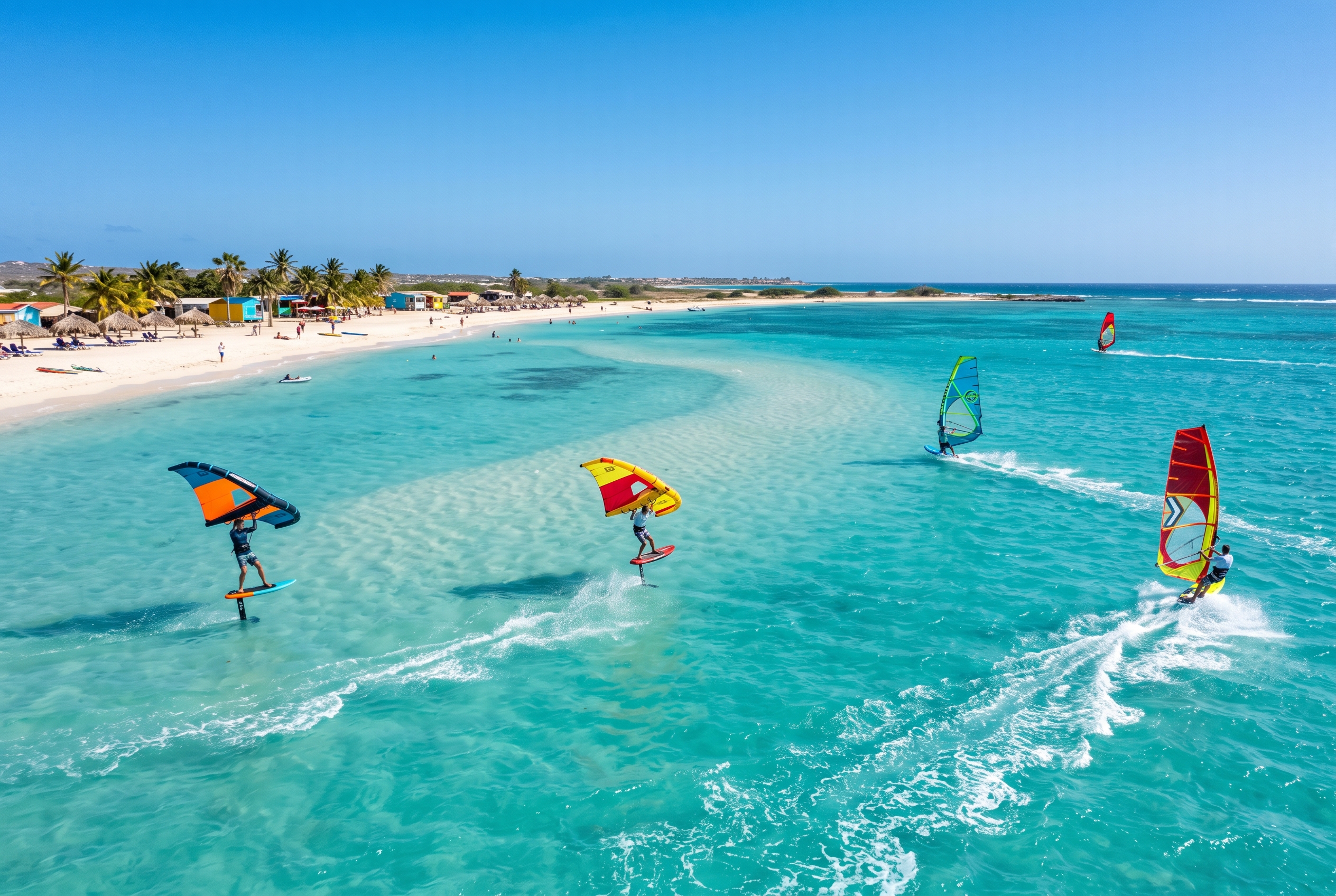
Here is where Aruba earns its reputation. The water at Fisherman’s Huts is offshore-protected, gin-clear, turquoise, and famously shallow, often only waist-deep across a long sandbank that runs well out from the beach. For learning to foil, where the difference between dignity and a faceplant is measured in centimetres of recovery space, that combination of flat water and a stand-up-and-reset bottom is genuinely hard to beat.
Temperature-wise, you can leave the thick rubber at home. Sea temperatures sit around 26°C (79°F) in the cooler January-to-March window and climb to roughly 28.5°C (83.5°F) from September through November, peaking near 29-30°C (84-86°F) in the warmest stretches. In practical terms that means a rash vest and boardshorts year-round, with maybe a thin top if you chill easily or plan marathon sessions. A wetsuit on Aruba is mostly dead weight in your bag. The main things to respect are the strength of the sun and, on the windier coasts, the reef and rock underfoot, so reef booties and a generous attitude toward sunscreen are the smart calls.
Best Spots for Different Skill Levels
Fisherman’s Huts / Hadicurari (beginner to intermediate). This is the heart of the action and the obvious home base for most visiting wing foilers. The wind here tends to blow offshore, which keeps the water glassy and flat, and the shallow sandbank means beginners can stand, reset, and try again without a long swim of shame. It is suitable for every level, but it especially rewards anyone learning to foil or drilling tacks, gybes, and toeside in controlled conditions. Most of the island’s wind-sport centres are clustered right here, so support, rescue, and a spare downhaul line are never far away.
Boca Grandi (intermediate to advanced). On the southeastern coast you will find Boca Grandi, which the local school crowd affectionately calls the kitesurfer’s skatepark. It sits in a half-moon bay with white sand, deeper water, and a side-onshore wind that ranges from 20 to 30 knots. Conditions here run choppy to wavy, with the reef throwing up flat-water pockets behind it for freestyle and rolling swell further out for anyone who wants to point and ride. This is proper advanced terrain, and the access road is rough enough that a 4×4 is strongly recommended. Treat Boca Grandi as the reward you earn after you have your foiling dialled at Fisherman’s Huts, not the place you learn the hard way.
Local Wing Foiling Scene
Schools and Lessons
Aruba punches well above its size when it comes to wind-sport instruction, and the wing-foiling boom has been folded neatly into operations that already had decades of windsurfing and kitesurfing pedigree. Aruba Active Vacations runs lessons in the waist-deep water right at Fisherman’s Huts, covering kitesurfing, windsurfing, and wingfoiling, and even branches out into oddities like blokarting. Vela Aruba (also branded Vela Sports) sets up at the Sarah-Quita Beach end of the Fisherman’s Huts zone, just past the Ritz-Carlton, and offers wingfoil lessons for beginners alongside rentals for riders who already have it dialled.
Venture Holidays Aruba proudly notes it was among the first wave of wingfoiling schools in the world, and it too operates from the Fisherman’s Huts location. Wing foiling lessons typically run an hour and are conducted entirely on the water: you learn to handle the wing, get up on the board, build speed, and eventually rise onto the foil. On price, expect lessons in roughly the $100-200 range per session depending on the operator and whether you go private or group. As a concrete reference point, Aruba Active Vacations lists a group lesson (max three students) at around $130 for two hours and a private lesson at about $190 for two hours, with multi-lesson packages bringing the per-hour cost down. If you are completely new to the sport, it is worth reading up before you arrive so the on-water hour is spent progressing rather than absorbing basics.
Gear Rentals
If you would rather not lug a board bag across an ocean, the rental scene has you covered. Vela Sports lists equipment rentals at around $50 for two hours or $80 for a full day, with gear due back by 5 PM. Aruba Active Vacations sits in a similar bracket, with rentals averaging roughly $35-45 for two hours, around $50 for a half day, and $60-70 for a full day. Renting also lets you sample different foil and wing sizes against the day’s conditions, which is a genuinely useful way to dial in your own future purchases. The flip side is that popular rental kit can get booked out in the windy peak months, so a quick message ahead of a session during May-July peak season is wise.
Clubs and Community
There is no single members-only clubhouse to join, but the scene at Fisherman’s Huts functions as a de facto community hub. With multiple centres sharing one beach, the rigging area buzzes with windsurfers, kiters, and a growing wing-foil contingent swapping conditions reports, comparing foil setups, and generally keeping an eye out for one another on the water. Because the schools are so concentrated here, it is easy to fall in with the regulars, find a rescue buddy, and get honest local intel on whether Boca Grandi is firing or whether today is a “stay on the flat water” kind of day. Striking up a conversation at the launch is the fastest way into the loop.
Off the Water
Cultural Attractions
Aruba’s Dutch heritage shows up most charmingly in Oranjestad, the capital, where pastel-hued buildings, Dutch colonial gables, and palm-lined streets blend colonial history with a modern, walkable buzz. It is an easy half-day wander between sessions, with duty-free shopping, museums, and a streetcar to ferry you around. The island’s culture is a genuine melting pot, with Papiamento, Dutch, Spanish, and English all in play, so a friendly “bon dia” goes a long way with the locals.
Dining
Eating well on Aruba is effortless. The Palm Beach high-rise strip and downtown Oranjestad are packed with everything from fresh-off-the-boat seafood to international fare, and the beach bars do double duty as casual restaurants by day. Spots like Bugaloe Beach Bar & Grill, perched out on the De Palm pier, and Moomba Beach Bar, planted directly on the Palm Beach sand, serve up the kind of post-session food and sunset views that make you forget you have salt in your eyes. Keep an eye out for local Aruban dishes, which lean on fresh fish and a Caribbean-Dutch-Latin mash-up of influences.
Nightlife and Entertainment
If you have any energy left after a day of foiling, Palm Beach delivers a nightlife scene that is lively, safe, and varied. The strip comes alive after 9pm, with restaurants morphing into bars, live music spilling onto outdoor terraces, and casino floors that keep going until the small hours. You will find dance clubs, karaoke, cocktail lounges, sports bars, and wine bars scattered across the high-rise resort area and downtown Oranjestad. It is the kind of place where a “quiet dinner” can quietly escalate, so pace yourself if there is wind in the morning.
Nature and Sightseeing
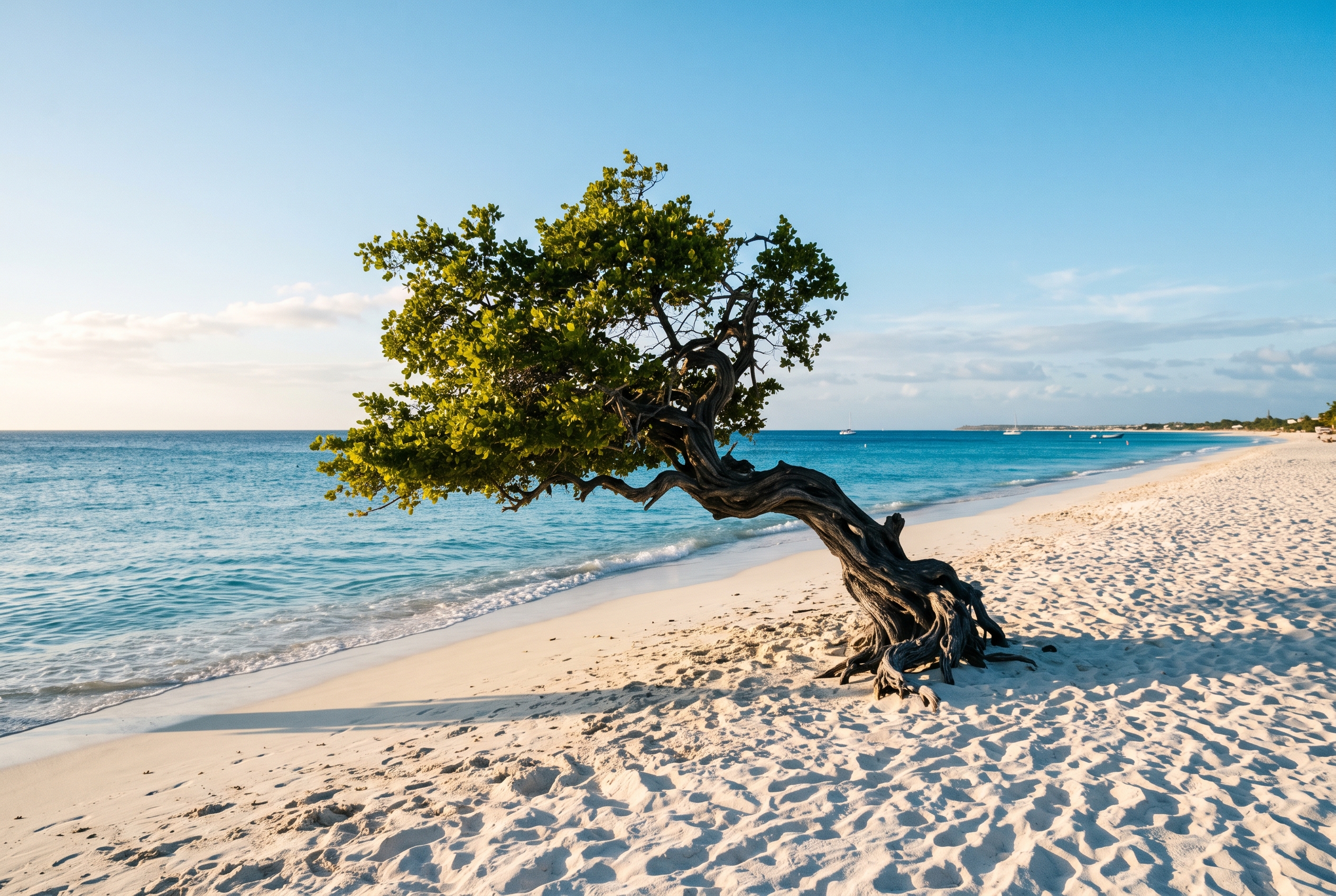
For your inevitable down day, Arikok National Park covers nearly 20% of the island and showcases Aruba’s surprisingly rugged desert interior, with caves, the natural Conchi pool, and distinctive wildlife. On the northwestern tip, the California Lighthouse, named after the SS California that sank nearby in 1891, offers panoramic coastal views and a popular backdrop for Jeep and ATV tours. And no trip is complete without paying respects to the famous divi-divi (watapana) tree, permanently bent toward the southwest because the same northeast trade winds that power your sessions have been sculpting it for years. It is, fittingly, the island’s natural windsock.
Practical Travel Information
How to Get There
You will fly into Queen Beatrix International Airport (airport code AUA), which is well connected to North America and Europe and sits remarkably close to the action. The high-rise hotels of the Palm Beach / Noord area are only around 6-7 miles (roughly 10.7 km) from the terminal, a drive of about 10 minutes in light traffic. A fixed-rate taxi to Palm Beach runs in the region of $30-40, the major rental-car brands (Hertz, Avis, Budget) have desks right at the airport, and there is even a public bus if you are travelling light and patient. Given that Boca Grandi demands a 4×4 and that having your own wheels makes chasing the best beach effortless, a rental car is the move for most wing foilers.
Where to Stay
The smart play is to base yourself in the Palm Beach high-rise strip or the surrounding Noord area, which puts you within walking distance of Fisherman’s Huts and steps from dining and nightlife. The big resorts here, including the Marriott and Ritz-Carlton, sit right beside the launch, but the area also has a deep bench of condos, boutique hotels, and vacation rentals to suit a range of budgets. Staying close to Hadicurari means you can read the wind from your balcony and walk to your board, which is exactly the kind of low-friction logistics that turns a good trip into a great one.
Best Time to Visit
For maximum wind, target May through July, when the trades average 20-35 knots and the island is at its windiest. For a strong balance of reliable wind and broadly pleasant conditions, the December-to-August window is the sweet spot, with usable wind probability above 80%. If you are an early-stage foiler chasing lighter, friendlier days, the September-to-November shoulder (averages of 10-18 knots) can actually suit your learning curve, just bring a big wing and manage expectations. Crucially, Aruba sits outside the hurricane belt, so the late-summer storm anxiety that haunts other Caribbean destinations is largely off the table.
Budget Estimates
Aruba is not a budget Caribbean island, but the wind-sport costs themselves are reasonable. Lessons land in the $100-200 per session range, with a sample two-hour group lesson around $130 and a private around $190; multi-lesson packages lower the hourly rate. Rentals run roughly $35-50 for two hours and $60-80 for a full day depending on the operator. Beyond the water, your main costs are accommodation (which spans resort-premium down to more modest condos and rentals), a car (worth budgeting for, especially for Boca Grandi runs), food, and the airfare to get there. Pack a rash vest instead of a wetsuit and you will at least save on baggage weight, if not on cocktails.
Wrapping Up
Aruba makes a compelling case for being one of the easiest places in the world to fall in love with wing foiling. The trade winds show up with near-comical reliability, the water at Fisherman’s Huts is warm, flat, and forgivingly shallow, Boca Grandi offers a proper step-up when you are ready, and the whole package sits a ten-minute drive from a well-connected airport and a strip of resorts, restaurants, and beach bars. Add in a hurricane-belt-free location and water you can ride in boardshorts all year, and the only real risk is that every other destination starts to feel like hard work afterward.
If you are just starting out, it is worth getting the fundamentals straight before you go with our complete beginner’s guide to wing foiling, and our wing foil calculator will help you nail the right wing and foil sizes for those 15-30 knot Aruban days. And if Aruba whets your appetite for steady trade-wind cruising, the wider region delivers more of the same: Cabarete in the Dominican Republic pairs thermal-boosted afternoon wind with a buzzing town, while La Ventana in Mexico serves up flat-water bays on the Sea of Cortez. One happy island, one very happy quiver. See you on the sandbank.
Frequently asked questions
When is the best season to wing foil in Aruba?
May to July is windiest (averaging 20-35 knots), while December to August is the broadly reliable window with over 80% usable-wind probability. September to November is calmer at 10-18 knots, suiting light-wind days.
How much wind does Aruba get?
The northeast trade winds blow most days at 20-25 knots, with lighter days around 15-20 and stronger days reaching 30-35 knots. Local riders use a versatile quiver, so pack a range of wing sizes.
Is Aruba good for beginners?
Yes. Fisherman's Huts (Hadicurari) has offshore-protected flat water over a shallow, often waist-deep sandbank, plus several schools offering on-water wingfoil lessons, making it an excellent place to learn.
What is the water temperature, and do I need a wetsuit?
Sea temperatures range from about 26C (79F) in January-March to 28.5-30C (83-86F) later in the year. A rash vest and boardshorts are fine year-round; a wetsuit is unnecessary.
How do I get there and what does it cost?
Fly into Queen Beatrix International Airport (AUA); Palm Beach is roughly 6-7 miles, about a 10-minute drive, with taxis around $30-40. Lessons run $100-200 per session and rentals roughly $35-80 depending on duration.
