
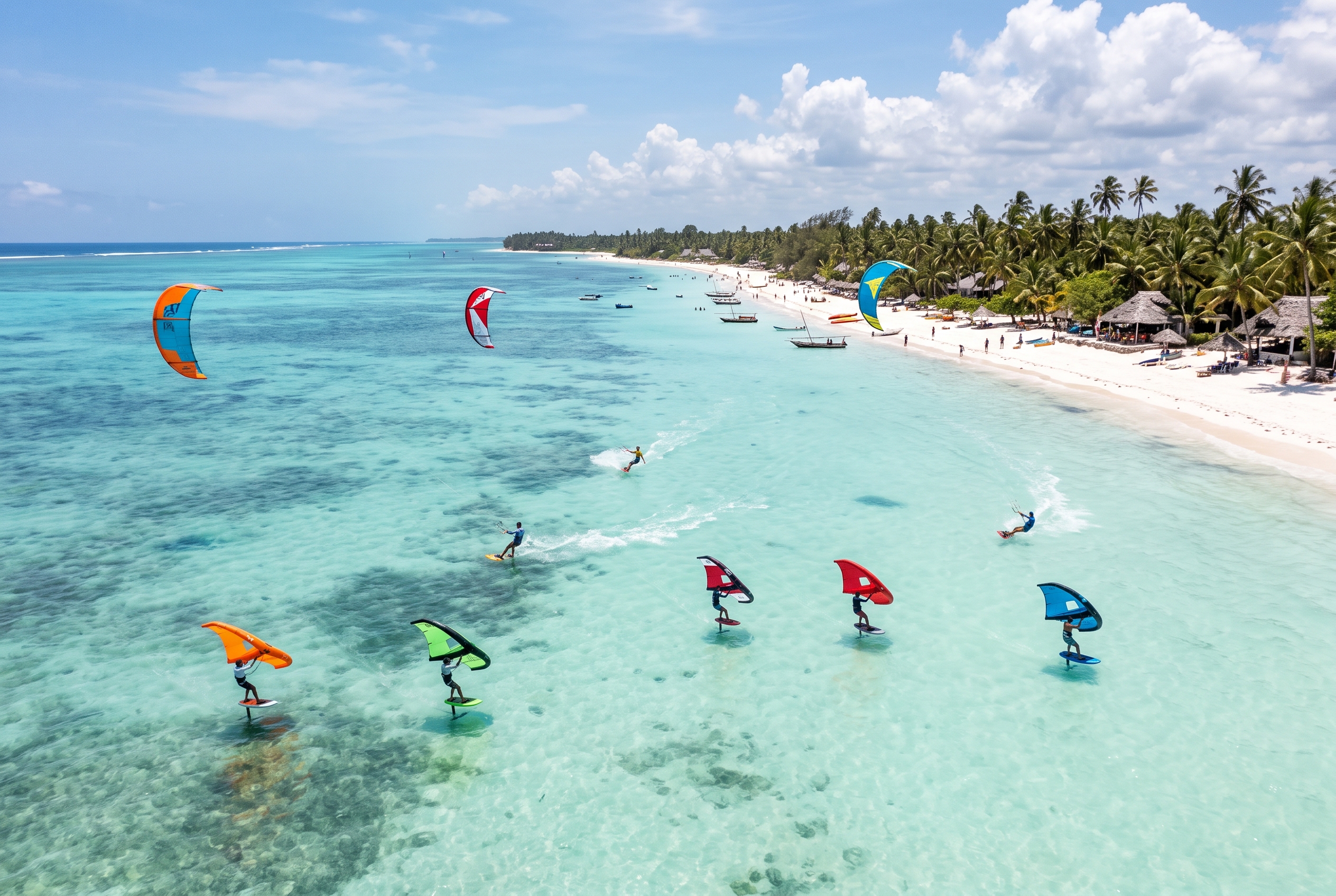
Some destinations make you work for the reward. Zanzibar is not one of them. On the island’s east coast, the village of Paje fronts a turquoise lagoon so flat and so reliably windy that it has quietly become one of the planet’s great wind-sports playgrounds, and over the past few seasons, wing foiling has muscled its way in alongside the kites. Picture warm, waist-deep water stretching for hundreds of metres, a steady cross-shore breeze, and a beach lined with palms, coffee shacks and barefoot kite schools. If you have ever wanted to learn to fly above the water, this is about as forgiving a classroom as the ocean offers.
The short version: Paje, on the Tanzanian island of Unguja (the main island people mean when they say “Zanzibar”), works for wing foiling across two distinct trade-wind seasons. The Kaskazi season runs roughly December to mid-March with gentler 12–18 knot north-easterlies, and the Kusi season runs June to October with punchier 18–22 knot south-easterlies that peak in July and August. Water sits at a bathtub-warm 25–28 °C year-round, so the only rubber you’ll need is the grip on your board. It suits everyone from first-timers wobbling onto a foil to seasoned riders chasing power and chop.
What makes the place genuinely special, and slightly comedic if you arrive at the wrong moment, is the tide. Paje sits behind a reef roughly 1.5 kilometres offshore, and the lagoon between empties and refills dramatically twice a day. Time your sessions with the water and you’ll have a flat, shallow, beginner-proof arena. Ignore the tide chart and you may find yourself walking your gear across a kilometre of exposed sand and seaweed while the locals smile knowingly. More on that below. First, let’s talk wind.
Wing Foiling Conditions
Wind Patterns and Seasonality
Zanzibar’s wind is governed by two monsoonal trade winds, and learning their names is the single most useful piece of local knowledge you can pack. The Kaskazi blows from the north-east, arriving in December and holding through to mid-March. It’s the gentler, friendlier of the two, typically 12 to 18 knots, with the odd stronger day nudging 20. This is the learner’s season: steady, predictable, and forgiving, which is exactly what you want when you’re still negotiating a truce between a wing, a board and a foil that all seem to have their own agenda.
The Kusi is the other half of the story. This south-easterly trade wind fills in around June and runs through to October, with the strongest, most consistent days landing in July and August. Expect averages of 18 to 22 knots with gusts pushing past 23, properly powered conditions that reward riders who already have their water-starts and transitions dialled. If you’re chasing speed, distance and the confidence to ride deep into the lagoon’s chop, Kusi is your season. A nice quirk of Paje’s east-coast geography is that the wind is almost always cross-shore and remarkably stable, often gusting just 2–3 knots either side of the average rather than the lurching swings you get at less sheltered spots.
Between the two seasons sits the part nobody puts on a postcard: mid-March to late May is the “long rains,” when the trades stall, averages drop to a frustrating 8–12 knots, and genuinely wind-free days stack up. If wind is the whole point of your trip, treat that window as the off-season and book around it. The sweet-spot transitional months, June, September, December and March, offer moderate power that keeps mixed-ability groups happy, which is handy if your travel companions span the full spectrum from “never done it” to “owns three foils.”
Water Conditions
Here’s the bit that makes Paje feel almost unfair. The water is warm, 25 to 28 °C year-round, occasionally creeping toward 30 °C inside the lagoon on a hot afternoon. There is no wetsuit decision to agonise over; boardshorts, a rash vest for sun, and you’re done. For a sport where falling in is a core part of the curriculum, having that fall land you in tepid, clear water rather than a cold grey swell is a meaningful morale boost.
The lagoon itself is the headline feature. That offshore reef knocks down the ocean swell, leaving a broad expanse of protected, flat water that runs hundreds of metres out, chest-deep at high tide and shallow enough to stand across much of it at lower water. For wing foilers learning to manage a foil, being able to plant your feet and reset between attempts is gold. But, and this is the big “but”, the tidal range here is significant. At low tide the lagoon drains, exposing sand, seagrass and coral flats and leaving too little water to foil safely in close. The reliable rhythm is to ride on the mid-to-high tide when there’s depth under your foil, and use the low-tide windows for coffee, lunch or a flat-water SUP. Every school in Paje plans the day around the tide chart, and so should you.
Best Spots for Different Skill Levels
Beginners should plant themselves squarely in the main Paje lagoon during the Kaskazi season (December to March). The combination of gentle 12–18 knot wind, flat protected water and a standable bottom at the right tide is about as benign as wing foiling environments get. Pick a low-to-mid tide window with a school’s safety boat nearby and you have room to fail gracefully and try again, which is most of what early progression actually is.
Intermediate riders get the run of the lagoon. As the tide pushes in, the flat water deepens and you can string together longer foiling runs, work on toeside and transitions, and start venturing further from shore. The shoulder months, June, September and the back end of December, deliver enough power to stay foiling without the full Kusi intensity, ideal for consolidating skills.
Advanced riders will want the Kusi season’s muscle. July and August bring 18–22 knot south-easterlies and choppier high-tide conditions deeper in the lagoon, plus the option to head out toward the reef on a pushing tide for swell and downwinders. It’s powerful, consistent, and exactly the kind of wind that lets confident foilers send transitions and cover serious distance. Just respect the reef, the tide and the offshore-component days, local advice is worth its weight here.
Local Wing Foiling Scene
Schools and Lessons
Paje has been a kite town for years, and the infrastructure that built up around kitesurfing has expanded neatly to cover wing foiling. The beach is dotted with established centres, several of them IKO-certified. Kite Centre Zanzibar, one of the long-standing original schools, sits on the prime stretch of beach and runs dedicated hydrofoil and wing foil lessons aimed at intermediate and advanced riders. Aquaholics Kite & Surf runs wing foiling courses with a fleet of well-maintained, regularly replaced gear, and Zanzikite offers more budget-friendly tuition pitched at beginners and intermediates with European safety standards.
On price, expect a 3-hour wing foil class to land around 200 USD at the value end of the market, with multi-session packages and progression courses available if you’re committing to actually learning rather than just sampling. Because wing foiling demands solid balance and board feel, some schools will assess where you’re starting from, prior watersports experience genuinely shortens the road, but committed first-timers are well catered for too.
Gear Rentals
If you’re already independent, the same centres rent wings, boards and foils, which spares you the considerable hassle and baggage fees of hauling a foil setup halfway across the world. Renting locally also means you can match your kit to the day’s wind, a bigger wing for a soft Kaskazi morning, something smaller and twitchier for a powered-up Kusi afternoon. Quality varies between schools, so it’s worth a quick chat about how recently the gear has been replaced; the better-run shops cycle their equipment regularly and keep it in genuinely good condition.
Clubs and Community
Paje’s wind-sports community is one of its quiet superpowers. The lineup skews international, friendly and laid-back, a rolling cast of travelling kiters and foilers, seasonal instructors and expats who’ve decided that 28 °C water and daily wind beats whatever they were doing before. Beach bars double as informal clubhouses, and it doesn’t take long before someone’s offering tide intel, a spare downhaul or directions to the best lunch. For a sport that can feel intimidating from the outside, the social fabric here makes the learning curve a lot less lonely.
Off the Water
Cultural Attractions
Zanzibar is far more than a flat-water lagoon, and the obvious cultural day trip from Paje is Stone Town, the historic, UNESCO-listed heart of the island roughly an hour’s drive west. Its labyrinth of coral-stone alleys, carved wooden doors, spice markets and landmarks like the House of Wonders reward an unhurried wander. The island’s Swahili, Arab, Indian and European layers are written into its architecture and its food, and a half-day here is the perfect counterweight to a low-tide window with no wind.
Dining
Paje punches above its size for food. Local stands serve Swahili staples, think coconut-rich curries, grilled seafood and chapati, while a growing crop of cafés and beach clubs cater to the international crowd. Specialty coffee has landed in the form of spots like Zanzabarista and Mr Kahawa, and the B4 Beach Club is the go-to for a post-session burger with your feet still sandy. Seafood is, predictably, everywhere and excellent; eat it the day it’s landed.
Nightlife and Entertainment
Paje’s after-dark scene is lively without tipping into chaos. It’s a known hub for younger backpackers, solo travellers and expats, with a rotating schedule of beach-club day parties and evening bars offering music and the occasional dance floor. It’s more laid-back than the full-throttle party beach of Kendwa up north, enough to find a good night out, mellow enough that you’ll still make the morning tide. Pace yourself; the wind doesn’t care about your hangover.
Nature and Sightseeing
For nature, Jozani Chwaka Bay National Park lies about 15 km from Paje and is the place to see the rare Zanzibar red colobus monkey, with mangrove boardwalks and guided forest trails. South of the island, Kizimkazi village is the launch point for dolphin tours, where you can head out to encounter, and, conditions allowing, swim alongside, pods in their natural habitat. Add in spice farm tours and a boat trip to a sandbank, and you’ve got enough non-foiling adventure to fill every windless afternoon of a two-week trip.
Practical Travel Information
How to Get There
You’ll fly into Abeid Amani Karume International Airport (airport code ZNZ), just outside Stone Town, which is well connected via hubs like Dar es Salaam, Nairobi, Addis Ababa, Doha and Istanbul. From the airport, Paje is on the east coast roughly 50 km away, about a 1 hour 10 minute drive. A pre-booked private transfer or taxi runs in the region of 33–36 USD (around €35), and arranging one in advance is the low-stress option after a long-haul arrival. Most hotels and kite schools will happily organise a pickup if you give them your flight details.
Where to Stay
Paje’s accommodation spans the full range. Budget beds, guesthouses, hostels and simple bandas, start from around 17 USD a night, with backpacker favourites like Demani Lodge, Mbuyuni Beach Village and Mustapha’s Place. Mid-range three- and four-star hotels average somewhere around 85–95 USD per night, and a clutch of upmarket beachfront properties (the likes of Zanzibar White Sand and Kisiwa on the Beach) push into the several-hundred-dollar bracket, with five-star options averaging close to 500 USD. For wing foilers, the priority is proximity: stay on the Paje beachfront within walking distance of your chosen school so you can react to the tide and wind without a commute.
Best Time to Visit
If you’re learning, target the Kaskazi season, December through mid-March, for its gentler, steadier wind and the most forgiving progression conditions; January and February are prime. If you want power, come in the Kusi season, with July and August delivering the strongest, most reliable days. June, September and the shoulders of December and March are the all-rounder months that keep mixed groups smiling. The one window to avoid is mid-March to late May, when the long rains stall the trades and wind-free days pile up.
Budget Estimates
Zanzibar is flexible on budget. A lean trip can run on roughly 17–40 USD a night for a bed, cheap-and-cheerful local meals, and a 200 USD wing foil course to get you started. A mid-range week, comfortable hotel, mix of restaurants, gear rental or a lesson package, sits in a comfortable middle band, while luxury beachfront stays can push your daily spend dramatically higher. Budget separately for the airport transfer (around 33–36 USD each way), day trips to Stone Town, Jozani or the dolphins, and a margin for the inevitable “no wind today, let’s go on an adventure” pivot.
Wrapping Up
Paje earns its reputation honestly. It pairs two dependable trade-wind seasons with a vast, warm, flat-water lagoon, a deep bench of schools and rentals, and an island’s worth of culture, food and wildlife waiting for the windless hours. The only real homework is reading the tide chart and picking the season that matches your ambition, gentle Kaskazi for learning, powered-up Kusi for sending it. Do that, and Zanzibar delivers one of the most enjoyable, low-friction wing foiling trips going.
Not sure Zanzibar is your match this year? It’s worth weighing against the wind-machine consistency of Dakhla, Morocco or the swell and trade winds of São Vicente, Cape Verde, and if warm, flat lagoons are your thing, Sanur, Bali plays a similar tune in another ocean. If you’re still building the basics before you book, start with our complete beginner’s guide to wing foiling, then run the numbers on wing and foil sizing with our wing foil calculator so you arrive in Paje ready to fly.
Frequently asked questions
When is the best season to wing foil in Zanzibar?
There are two trade-wind seasons. Kaskazi (December to mid-March) brings gentler 12-18 knot north-easterlies, ideal for learning, with January and February prime. Kusi (June to October) brings stronger 18-22 knot south-easterlies peaking in July and August, best for advanced riders. Avoid mid-March to late May, when the long rains stall the wind.
How much wind does Paje get?
It depends on the season. The Kaskazi season averages 12-18 knots, with occasional days reaching 20. The Kusi season is punchier at 18-22 knots, with gusts pushing past 23. The east-coast wind is almost always cross-shore and notably stable, often varying just 2-3 knots either side of the average.
Is Paje good for beginners?
Yes. The Paje lagoon is protected by a reef about 1.5 km offshore, leaving flat, shallow water you can stand in across much of it at the right tide. Combined with the gentle Kaskazi-season wind and warm water, it is one of the more forgiving places to learn. Plan sessions on the mid-to-high tide and use a certified school.
What is the water temperature and do I need a wetsuit?
No wetsuit needed. Zanzibar's water stays warm year-round at roughly 25-28 °C, sometimes nearing 30 °C inside the lagoon on hot afternoons. Boardshorts and a rash vest for sun protection are all you need.
How do I get to Paje and what does it cost?
Fly into Abeid Amani Karume International Airport (ZNZ) near Stone Town. Paje is about 50 km away on the east coast, roughly a 1 hour 10 minute drive. A private transfer or taxi costs around 33-36 USD. Accommodation starts near 17 USD a night for budget beds, and a 3-hour wing foil class runs about 200 USD.
