
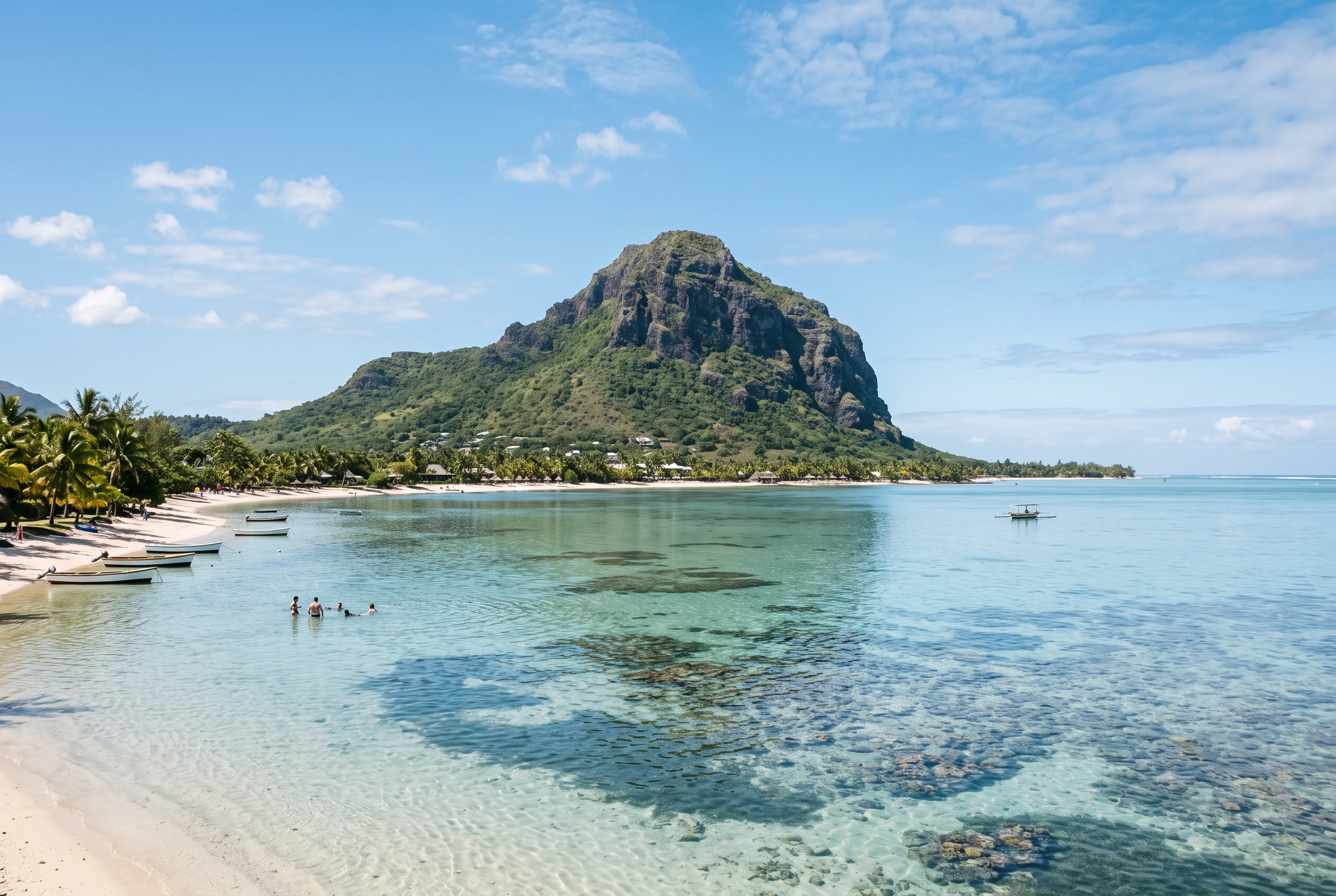
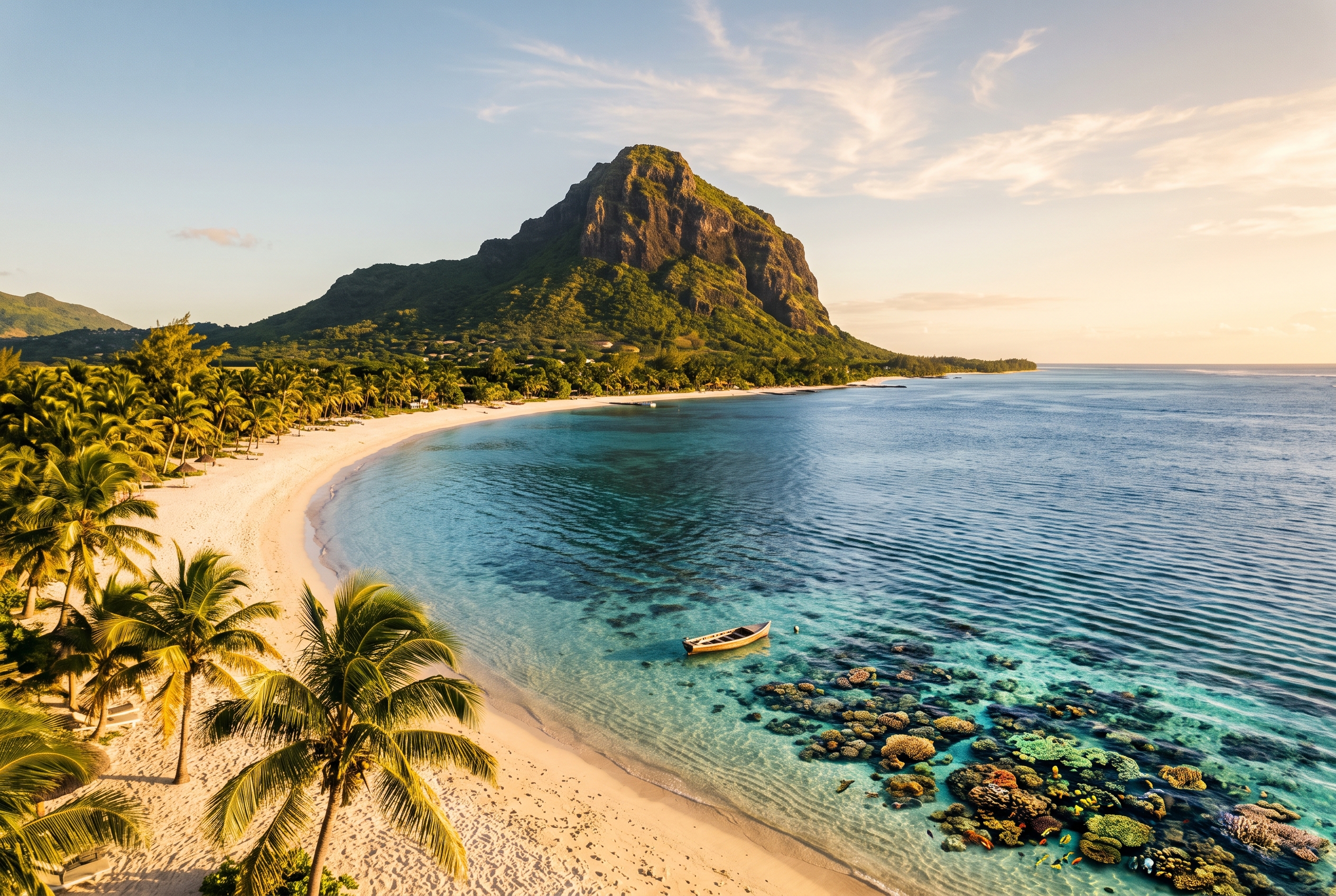
Tucked into the southwestern tip of Mauritius, in the lee of a brooding UNESCO-listed basalt monolith, Le Morne is the kind of place that makes you wonder why you ever bothered learning to wing foil anywhere with a current, a tide chart, or a water temperature that requires a 5mm and a stern talking-to. This is the Indian Ocean’s marquee wind-sports playground: a vast, turquoise, waist-deep lagoon ringed by reef, fanned by reliable trade winds, and watched over by the dramatic silhouette of Le Morne Brabant. If you’ve seen a postcard of Mauritius, you’ve probably already seen it.
The headline numbers are easy to love. The wing season runs roughly June through November, with the most reliable, muscular trades blowing from August into October. Those are the Mauritian winter months, when the southeast trade winds settle in and deliver day after day of usable wind. The lagoon itself is flat, shallow and forgiving enough for a nervous first-timer, while just beyond the reef sits One Eye, one of the fastest, hollowest waves in the Indian Ocean and a name spoken in slightly hushed tones by people who know exactly what it can do to them.
That contrast is the whole appeal. Le Morne is rare in offering genuine beginner water and world-class wave terrain within sight of each other, served by long-established schools and warm water that rarely demands more than a shorty. Bring a quiver, bring a partner who’d rather lie on a white-sand beach, and bring a tolerance for the fact that you may never want to fly your foil at a colder, greyer break again. Here’s how to make the most of it.
Wing Foiling Conditions
Wind Patterns and Seasonality
Le Morne’s wind is driven by the southeast trades, and the season is firmly a winter affair. The window runs from around June to November, with August through October generally the most dependable stretch. During the core season, riders typically see somewhere in the range of 15 to 25 knots, and on the windier days through the heart of winter the trades can push up into the 20-to-30-knot bracket. The Mauritian summer (November to March) is lighter and more variable, averaging around 12 to 20 knots, so if you want to be confident of riding every day, aim for the winter months.
The direction is consistent: wind comes predominantly from the east to southeast, blowing across and into the lagoon in a way that keeps you safely inside the reef rather than worrying about being carried out to sea. A useful local rhythm to know is that the wind often builds through the morning, frequently picking up around late morning and holding through until sunset. That makes for a civilised schedule: leisurely breakfast, watch the lagoon start to ripple, rig up around lunchtime, ride into golden hour. As ever with trade-wind destinations, treat these as patterns rather than promises, and check a forecast the night before.
Water Conditions
This is where Le Morne quietly wins the argument against half the wing destinations on the planet. The water is warm year-round and the lagoon is shallow, flat and largely free of the hazards that make some spots a nervous experience. Sea temperatures sit at their warmest in the Mauritian summer, climbing to around 26 to 29°C in January through March, when most people happily ride in boardshorts and a rashguard. In the winter wing season they cool to roughly 23 to 25°C, bottoming out near 22 to 24°C around late August.
In practical terms, that means a wetsuit is rarely a hard requirement. Through the warm months you can skip it entirely; through the cooler wing season a shorty, a wetsuit top or a thin jumpsuit is plenty for most people, and the genuinely cold-blooded might reach for a 2mm on the windier mornings. A rashguard or light top also doubles as sun protection, which in the Mauritian sun is not optional. The lagoon’s shallow, sandy-and-reef bottom is part of what makes it so beginner-friendly, but it’s also a reminder to wear boots or at least watch your footing around coral, and to respect the reef both for your skin’s sake and the reef’s.
Best Spots for Different Skill Levels
Le Morne’s genius is its range: a single lagoon system that caters to a wobbling first-timer and a hardened wave rider on the same afternoon. Here’s how it breaks down.
Beginners belong in the main lagoon. It’s flat, shallow, sandy in patches and protected by the reef, which makes it an ideal classroom for learning to fly a wing, get up on the foil and work on your first jibes without the ocean trying to teach you a lesson. The cross-onshore trades keep you blowing back toward land rather than out to sea, which is exactly what you want when you’re still learning to relaunch and water-start.
Intermediates can start venturing toward the edges of the lagoon and the gentler reef zones, where small waves at spots like Little Reef offer a first taste of riding swell without serious consequence. This is the sweet spot for building wave skills, dialling in your toeside and getting comfortable in slightly bumpier water before committing to anything heavier.
Advanced and expert riders are spoiled. The outer reef serves up Manawa and the more powerful Chameau, and then there’s the main event: One Eye. Breaking along the outer reef off Le Morne Brabant, One Eye is a long, fast, hollow left-hander widely regarded as one of the most powerful waves in the Indian Ocean. It is emphatically not a spot to “have a look at”, the bottom is shallow, the wave forgives nothing, and reaching it safely demands full self-sufficiency and real experience. Earn it elsewhere first.
Local Wing Foiling Scene
Schools and Lessons
Le Morne is a properly established wind-sports hub, not a fringe spot you have to organise yourself, and the best-known operator is ION CLUB, which runs multiple centres in the area. Their Kite Lagoon base handles kitesurf, wingfoil and windsurf lessons and rentals, while a second centre near the JW Marriott caters to windsurf and wingfoil riders, beginner through advanced. Wing foil lessons are typically taught in very small groups, on the order of a couple of students per instructor, covering the fundamentals of safe flying, jibing and, for those progressing, jumping.
For a beginner, this setup is close to ideal: warm shallow water, steady wind, and instructors who teach here day in and day out. If you’re brand new to the sport, it’s worth reading up on the basics before you arrive so the lesson time is spent on the water rather than on theory. The flat lagoon means you’ll spend less time fighting conditions and more time actually progressing, which is exactly why so many people choose Mauritius to learn.
Gear Rentals
You don’t need to haul a full quiver halfway across the Indian Ocean. ION CLUB offers rental wing and foil equipment alongside lessons, stocking current gear from major brands, so you can ride modern kit sized to the day’s wind without lugging board bags through three airports. Renting also lets you experiment, try a different wing size or foil setup against the consistent trades and see what clicks. If you’re a committed rider with a setup you love, bringing your own is of course an option, but for most travellers the on-site rental fleet covers it comfortably.
Clubs and Community
Because Le Morne draws kitesurfers, windsurfers and wingers from all over the world, the on-the-water community is international, friendly and seasoned. During the winter season the lagoon hums with riders of every level, and the established centres act as natural gathering points, somewhere to swap forecasts, find a downwind buddy or get an honest read on whether the outer reef is within your pay grade today. It’s the kind of scene where you arrive solo and leave with a WhatsApp group, which is half the fun of a wing trip in the first place.
Off the Water
Cultural Attractions
The mountain that looms over your every session is more than scenery. Le Morne Brabant is a UNESCO World Heritage Site, recognised for its role as a refuge for escaped slaves, maroons, who hid in its near-inaccessible cliffs and caves. That history gives the place a weight that goes well beyond its postcard looks, and it’s worth taking the time to understand it. Mauritius as a whole is a genuine cultural melting pot, with Indian, African, Chinese, French and Creole threads woven through its temples, churches, mosques and markets, a reminder that there’s a rich island to explore once you’ve peeled off the wetsuit.
Dining
Mauritian food is one of the great underrated cuisines, a delicious collision of its many cultures. Expect fragrant Creole curries, fresh-off-the-boat seafood, Indian-influenced street snacks like dholl puri and gateaux piments, and Chinese-inflected noodles, all washed down with local rum or a cold Phoenix beer. The resorts around Le Morne run polished restaurants, but some of the most memorable eating happens at humbler spots and roadside stalls. If you’re self-catering at a villa or guesthouse, the local markets are a joy to wander and stock up at.
Nightlife and Entertainment
Let’s be honest about expectations: Le Morne is a remote, resort-and-nature corner of the island, not a clubbing capital, and after a full day on the foil most riders are happy with a sundowner and an early night. The bigger resorts host live music, sega dancing and bars that tick along pleasantly into the evening. For anything livelier, the buzzier nightlife clusters elsewhere on the island, particularly around the north coast and Grand Baie, which is a fair drive away. Most wing travellers treat Le Morne as the wind-and-wave base and dip into the rest of Mauritius for variety.
Nature and Sightseeing
This region is stacked with natural drama. Hiking Le Morne Brabant rewards you with sweeping views over the lagoon you’ve been riding, though the upper sections are steep and best tackled with a guide. Nearby, the southwest of the island holds the Black River Gorges National Park, the surreal seven-coloured earths of Chamarel and its waterfall, and a coastline of beaches that earn every cliché thrown at them. On no-wind days (they happen), you’ve got a genuinely spectacular island to explore rather than just sitting around refreshing the forecast.
Practical Travel Information
How to Get There
You’ll fly into Sir Seewoosagur Ramgoolam International Airport (airport code MRU), in the southeast of the island. It’s well connected to Europe, the Gulf, South Africa and several Asian hubs, so reaching Mauritius from most of the world is straightforward if not exactly quick. From the airport to Le Morne is roughly 55 to 60 km, which works out to about 70 to 80 minutes by road depending on traffic. Most travellers pre-book a private transfer or taxi, your hotel or wing school can usually arrange one, and watching the landscape shift from cane fields to that iconic mountain as you approach is a fine way to start the trip.
Where to Stay
Le Morne is anchored by a cluster of well-known resorts, several of which sit right on the wind-sports action: LUX* Le Morne, the JW Marriott, Paradis Beachcomber, the St. Regis Le Morne and Riu Le Morne among them. Staying at a resort with an on-site or partnered wind centre means you can roll from breakfast to the rigging area in minutes, which is hard to beat. For travellers on tighter budgets or who prefer independence, there are guesthouses and private villas in and around the area, a good option if you’d rather self-cater and stay flexible. Whatever the tier, proximity to the lagoon and the schools is the thing to optimise for.
Best Time to Visit
For wind, target the Mauritian winter: June through November, with August to October the most reliable core. That’s when the southeast trades are strongest and most consistent, delivering the highest hit-rate of windy days. The trade-off is that winter water is a touch cooler and you may want a shorty. If your priority is warm water and a beach holiday with wing foiling as a bonus rather than the whole point, the summer months are warmer but the wind is lighter and less dependable. For most riders chasing a proper wing trip, plan around the winter season and you’ll be glad you did.
Budget Estimates
Mauritius spans the full price spectrum, so your budget is largely a function of how you sleep and eat. The flagship resorts at Le Morne sit firmly in the premium bracket, while guesthouses and villas can bring nightly costs down dramatically, especially if you self-cater from local markets. On the water, factor in lessons (taught in small groups) and gear rental from a centre like ION CLUB, plus your airport transfer of around 55 to 60 km each way. Prices shift with season, operator and the exchange rate, so rather than quote figures that’ll be stale by the time you read this, get current quotes directly from your chosen school and accommodation, and remember that renting gear locally saves both excess-baggage fees and the stress of your foil arriving in a different time zone than you.
Wrapping Up
Le Morne is about as close to a complete wing-foiling destination as the planet offers: warm water, dependable winter trades, a flat lagoon that flatters beginners, and a legendary reef that humbles experts, all framed by one of the most photogenic mountains in the tropics. Add a deeply rewarding island to explore on the off days and an established, welcoming wind-sports community, and it’s easy to see why Mauritius sits near the top of so many riders’ lists.
If you’re still building your skills before you book, our complete beginner’s guide to wing foiling will get you lagoon-ready, and the best wing foiling gear guide covers what’s worth packing versus renting on arrival. And if Le Morne whets your appetite for trade-wind travel, the reef breaks of Cape Town and the endless flat-water of Dakhla, Morocco make natural next stops. Pack the rashguard, respect the reef, and we’ll see you on the lagoon.
Frequently asked questions
When is the best season to wing foil at Le Morne, Mauritius?
The wing season is the Mauritian winter, running roughly June to November. The most reliable, strongest trade winds blow from August through October. The summer months (November to March) are warmer but lighter and less dependable for wind, so committed riders should target winter.
How much wind does Le Morne get?
Wind comes mainly from the east to southeast. During the core winter season riders typically see around 15 to 25 knots, and on the windier days it can reach the 20-to-30-knot range. Summer is lighter, averaging about 12 to 20 knots. Wind often builds through the morning and holds until sunset.
Is Le Morne good for beginners?
Yes. The main lagoon is flat, shallow and reef-protected, which makes it an excellent learning environment. The cross-onshore trades blow you back toward land rather than out to sea, and established schools like ION CLUB offer small-group wing lessons and rentals. Experts have the outer-reef waves, but beginners stay safely inside the lagoon.
What water temperature should I expect, and do I need a wetsuit?
Water is warm year-round. Summer (January to March) reaches about 26 to 29°C, where boardshorts and a rashguard suffice. The winter wing season cools to roughly 23 to 25°C, dipping near 22 to 24°C in late August. A shorty, wetsuit top or thin jumpsuit is plenty for most riders in winter; a rashguard also helps with sun.
How do I get to Le Morne and is it expensive?
Fly into SSR International Airport (MRU) in the southeast. Le Morne is roughly 55 to 60 km away, about 70 to 80 minutes by road, usually via a pre-booked taxi or transfer. Costs range widely: premium resorts are pricey, while guesthouses and villas are far cheaper. Renting gear locally saves on excess-baggage fees.
