
A parawing weighs about a third of an inflatable wing the same size and stows into a waist pouch mid-session, but it needs existing foiling skill, sinks if you drop it, and covers a narrower wind range per size. Inflatables remain the better choice for learning and for one-wing quivers.
Parawings went from curiosity to genuine talking point through 2025, and 2026 is the year second-generation designs landed across almost every major brand. The marketing frames it as a replacement for the inflatable wing. The published numbers tell a more interesting story.
This guide puts 2026 weights, prices and wind ranges side by side, using matched sizes from the same brand where possible so the comparison is honest rather than cherry-picked.
What is the actual difference between a parawing and an inflatable wing?
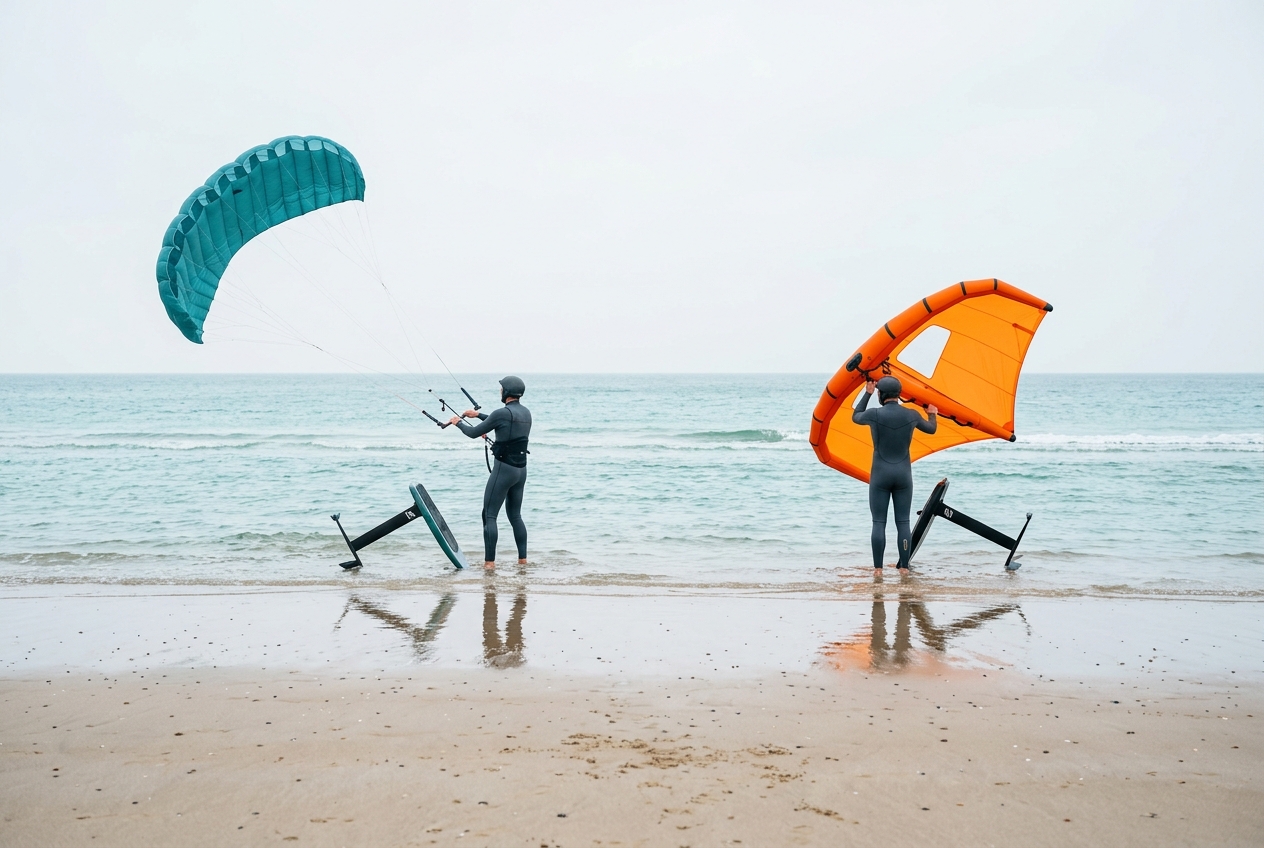
The difference is how you hold it and where it goes when you stop using it. An inflatable wing is a handheld sail with a pumped-up leading edge and strut that stays in your hands for the whole session.
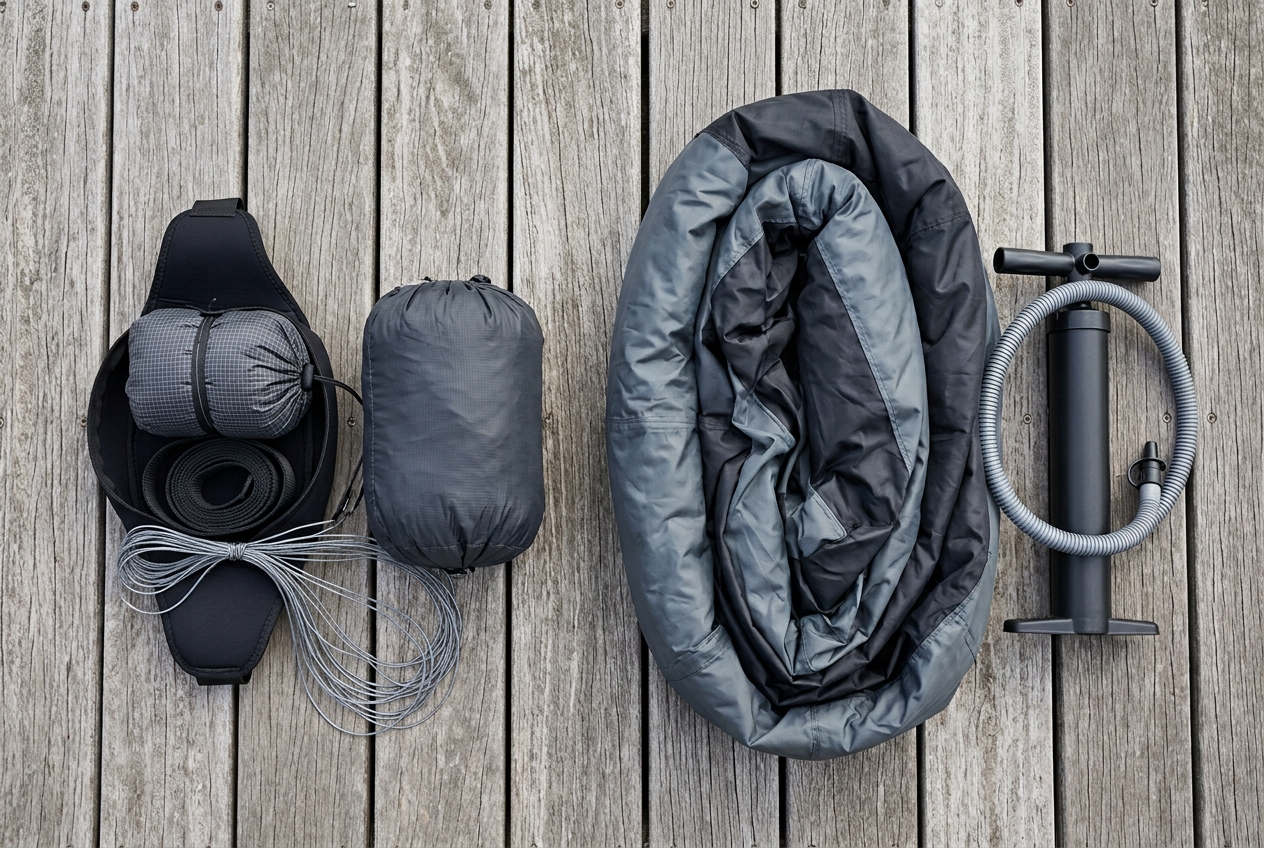
A parawing is a soft canopy flown on short lines to a bar or handle, with no inflation and no pump. Its defining trick is that it can be collapsed and stuffed into a waist pouch mid-ride, then redeployed, something an inflatable wing cannot do.
That single capability is the whole argument. Everything else in this comparison is a consequence of it, and it is why we flagged the rise of parawing foiling as a travel story before it was a performance one.
| Characteristic | Parawing | Inflatable wing |
|---|---|---|
| Structure | Soft canopy, single skin or dual skin | Inflated leading edge and strut |
| Setup | No pump, lay out and untangle lines | Pump every session |
| Control | Short lines to a bar or handle | Held directly in both hands |
| Mid-session | Stows in 10 to 15 seconds, ride hands-free | Stays in your hands |
| If you drop it | Does not float, can sink and tangle | Floats and drifts downwind |
| Suits beginners | No, needs prior foiling skill | Yes, the standard entry point |

How much lighter and smaller is a parawing?
Almost exactly one third of the weight, and the ratio holds across every size. Duotone sells both a parawing and an inflatable in its 2026 range, which makes for a clean like-for-like comparison.
| Size | Stash V2 parawing | Unit inflatable | Weight ratio |
|---|---|---|---|
| 2.8 vs 3.0 m | 585 g | 1,730 g | 3.0x |
| 3.4 vs 3.5 m | 634 g | 1,900 g | 3.0x |
| 4.0 m (exact match) | 693 g | 2,050 g | 3.0x |
| 4.8 vs 5.0 m | 752 g | 2,360 g | 3.1x |
| 5.6 vs 5.5 m | 809 g | 2,520 g | 3.1x |
Figures come from Duotone’s published specs for the 2026 Stash parawing and the 2026 Unit inflatable. Only the 4.0 m pair is an exact size match; the rest are nearest available sizes.
The real gap is wider than the table shows. Duotone lists Unit weights without handles or a boom, and those are sold separately.
Parawing weights vary hugely between brands
Do not assume every parawing is featherweight. Published mid-size weights span nearly three to one across the category.
- BRM Kanaha, 464 g at 4.0 m. The lightest published figure in the category, though it is a legacy model. BRM’s current flagship, the S3, is listed at 635 g at 4.2 m.
- F-One Frigate, 520 g at 4.0 m. Among the lightest from a mainstream brand, offered across eight sizes from 1.9 m to 6.5 m.
- Ozone Pocket Rocket V2, 630 g at 3.6 m. Mid-pack on weight, with seven sizes from 1.9 m to 5.7 m.
- North Ranger, 1,350 g at 4.2 m. Nearly three times the Kanaha and closing on inflatable territory.
Those weights are collated in Parawingfoil’s 2026 comparison of every parawing on the market. Packability follows weight closely, and a light canopy is what makes the waist-pouch trick practical rather than theoretical.
Which one has the wider wind range?
The inflatable, and it is not close. Comparing Duotone’s own published ranges, the Unit covers roughly 60% more wind per size than the Stash parawing.
| Size | Stash V2 parawing | Unit inflatable | Spread |
|---|---|---|---|
| 2.8 vs 3.0 m | 22 to 34 kts | 19 to 37 kts | 12 vs 18 kts |
| 3.4 vs 3.5 m | 18 to 29 kts | 16 to 33 kts | 11 vs 17 kts |
| 4.0 m (exact match) | 15 to 25 kts | 14 to 30 kts | 10 vs 16 kts |
| 4.8 vs 5.0 m | 12 to 21 kts | 10 to 25 kts | 9 vs 15 kts |
| 5.6 vs 5.5 m | 10 to 18 kts | 9 to 22 kts | 8 vs 13 kts |
One important caveat before you read too much into that. Parawingfoil’s sizing guide is explicit that parawing sizes do not translate directly from wing sizes, so treat the pairings as indicative rather than exact equivalents.
The practical consequence is quiver size. A rider covering 10 to 25 knots on one 5 m inflatable will likely want two parawings to cover the same days.
This is also where 2026 changed things. Second-generation canopies are now shipping from Duotone, Ozone, Flysurfer, Naish, Ensis and Flow, so the per-size ranges above are a moving target rather than a settled picture.
On the low end, most riders can get on foil in 10 to 12 knots with the right size, though under 12 knots even the largest parawings may not generate enough pull unless your board and foil are already efficient. Recommended sizing for a 75 to 85 kg rider is 4.0 to 5.0 m in 15 to 25 knots, stepping up to 5.5 to 6.5 m in 10 to 15 knots.
What happens when you crash or need to relaunch?
This is the parawing’s real weakness. A parawing does not float or drift like an inflatable wing and can sink, tangle or become much harder to recover in deep water or current.
An inflatable wing sits on the surface, drifts predictably downwind and doubles as a flotation aid in a self-rescue. Lose grip on a parawing and you are dealing with lines, a sinking canopy and no float.
Relaunching from the water is a learned skill rather than a reflex. The sequence is short but unforgiving.
- Unwrap the wing from the bar without letting the lines loop back on themselves.
- Hold the bar in front of you with the canopy trailing downwind.
- Let the wind catch the leading edge and inflate it gradually rather than forcing it.
- Feed the lines out smoothly. Yanking the bar is the single most common cause of a failed relaunch.
Tangled lines are the other failure mode, and single-skin designs generally need more technique than dual-skin canopies to reinflate cleanly. Gusty or very light wind makes all of it harder.
None of this makes parawings unsafe, but it does raise the floor on conditions and experience. The same rules that apply to wing foiling safety apply with less margin: helmet, impact vest, board leash, and do not ride offshore without support.
How much does each one cost in 2026?
They land in the same bracket, and the parawing is often the cheaper of the two at matched size. That surprises most people who assume the newer category carries a premium.
| Size | Stash V2 parawing | Unit inflatable |
|---|---|---|
| 2.8 vs 3.0 m | $1,089 | $1,169 |
| 4.0 m (exact match) | $1,149 | $1,229 |
| 5.6 vs 5.5 m | $1,209 | $1,359 |
Duotone USD list prices for 2026. The Unit ships without handles or a boom, so the real inflatable figure is higher than the column suggests.
Across the wider market, parawings run from roughly $426 to $1,479 depending on brand and size. Retailer pricing at MACkite’s parawing range puts the Aeryn Pocket Wing P1 at the bottom and the F-One Frigate near the top, with most 2026 models clustered between $800 and $1,300.
The costs that do not show on the price tag
- Waist belt and pouch, around $150. You need one to actually use the stow feature. An NSI parawing waist belt with pouch lists at $149.99.
- No pump required. A genuine saving on the inflatable side of the ledger, and one less thing to pack.
- More sizes in the quiver. The narrower per-size wind range means two parawings where one inflatable would have done, which is the largest hidden cost of switching.
- Handles or boom on the inflatable. Some 2026 wings, the Duotone Unit included, are sold as canopy only.
For where a wing sits against boards, foils and lessons, our full wing foiling cost breakdown maps the whole kit, and the 2026 gear buyer’s guide covers inflatable wing selection in detail.
When should you switch to a parawing?
When you can already foil confidently without thinking about it, and you want something an inflatable cannot give you. A parawing is a second tool, not a replacement for your first wing.
Parawing foiling is explicitly not suitable for absolute beginners. You need solid foiling from downwind, wing, kite or SUP foiling before the canopy makes any sense.
Switch if this describes you
- You want to ride hands-free. Downwinders, swell and wave riding where the wing becomes dead weight once you are up.
- You travel constantly. A 464 g to 800 g canopy and no pump changes what fits in a board bag.
- You already own the foil kit. Any hydrofoil board works, with most riders best served by a mid-length in the 70 to 90 litre range. Our wing foil board and foil size calculator sizes that against your own weight.
- Your local wind is consistent. One mid-range size covers most sessions when conditions do not swing wildly.
Stay on the inflatable if this describes you
- You are still learning to fly. Get your flight hours on an inflatable first. Our guide to how long wing foiling takes to learn sets realistic milestones.
- You want one wing for everything. The wider per-size wind range does more for you than any weight saving.
- You ride alone or offshore. The floating canopy and easier self-rescue matter more than packability.
- Your spot is gusty or marginal. Relaunch difficulty scales with how inconsistent the wind is.
If you do make the jump, the adjustment is quick. Most riders with a foiling background are comfortable within three to five sessions, with the stow becoming automatic by around session five.
The honest 2026 answer is that this was never really a versus. Both belong in a quiver, and the question is which one suits the session in front of you.
Frequently asked questions
Can a beginner learn on a parawing?
No. Parawing foiling is not suitable for absolute beginners, because you need solid foiling skills from downwind, wing, kite or SUP foiling first. Learn to fly on an inflatable wing, then add a parawing once flight time is automatic. Riders with that base are usually comfortable within three to five sessions.
How much lighter is a parawing than an inflatable wing?
About three times lighter at matched sizes. Duotone’s 2026 4.0 m Stash parawing is listed at 693 g against 2,050 g for its 4.0 m Unit inflatable, and the ratio holds across the range. The gap is actually wider, since the Unit weight excludes handles and boom.
Do parawings float if you drop them?
No, and this is the main safety trade-off. A parawing does not float or drift like an inflatable wing, and it can sink, tangle or become hard to recover in deep water or current. An inflatable stays on the surface and doubles as flotation during a self-rescue.
What is the minimum wind for a parawing?
Most riders can get on foil in 10 to 12 knots with the right size. Below 12 knots even the largest parawings may not generate enough pull unless your board and foil are already efficient.
Are parawings more expensive than inflatable wings?
Usually slightly cheaper at matched sizes. Duotone lists its 4.0 m Stash parawing at $1,149 against $1,229 for the 4.0 m Unit inflatable, which ships without handles or boom. The hidden cost is quiver size, since the narrower wind range per parawing often means buying two.
Do you need a different board for a parawing?
Any hydrofoil board will work, so your existing wing setup is a fine starting point. Most riders perform best on a mid-length board around 5’6″ to 6’6″ with 70 to 90 litres of volume. Anything under 60 litres makes getting on foil harder.
