
Tucked onto the eastern edge of Egypt’s Sinai Peninsula, on the Gulf of Aqaba arm of the Red Sea, Dahab is one of those rare spots that feels almost engineered for wing foiling. The wind shows up nearly 300 days a year, the headline season runs from roughly March through November, and the water is bath-warm for most of it. Add a shallow, stand-up-anywhere lagoon for beginners and rolling open-water swell for the show-offs, and you have a destination that punches well above its sleepy-Bedouin-town appearance.
For the uninitiated, Dahab (Arabic for ‘gold’, after its desert-sand beaches) sits about an hour north of Sharm El Sheikh. It built its reputation first on world-class diving and then on windsurfing, and the wing crowd has happily inherited decades of infrastructure: schools, rental shops, downwinder shuttle boats and a community that genuinely knows the local breeze. The wind here is the kind of clean, predictable north/northwesterly that funnels straight down the Gulf of Aqaba with nothing in its way, the sort of consistency you usually only read about in brochures.
What sets Dahab apart, though, is the unhurried vibe. You pump up your wing on a sand-floor beachfront, rig next to the same crew who taught you to water start, then drift between sessions with mint tea and grilled fish while the desert mountains glow pink across the bay. It is a place that rewards both the rider chasing strong-wind training blocks and the traveller who fancies a foil-and-chill week without a second mortgage. Let’s get into the conditions.
Wing Foiling Conditions
Wind Patterns and Seasonality
Dahab’s wind is its main attraction, and it earns the reputation. The breeze blows reliably from a northerly direction effectively all year round, driven by the large-scale north/northwest flow that comes down the Gulf of Aqaba and Red Sea, a product of the high-pressure system over the Mediterranean meeting lower pressure further south. The narrow channel between Saudi Arabia and the Sinai squeezes that airflow into a venturi effect, accelerating it down the corridor so Dahab gets noticeably more wind than the rest of the Sinai. Because it arrives off the sea from the north/northwest with no obstructions, it is about as clean and consistent as wind gets.
The prime window runs from March through November. Summer (roughly May to October) brings the most muscle, with reports of around 90% of days topping 17 knots (over Force 4), and April-through-November averages of 20-30 knots with an 80-100% probability. That is glorious if you are training hard or working on tricks, and a touch sporty if you are still finding your feet. The shoulder months, March-April and September-October, tend to be the sweet spot for most riders: solid wind, smaller crowds, and gentler temperatures. From September into December the wind often kicks in mid-morning, around nine or ten, and blows 18-25 knots until early afternoon.
Even winter holds up better than you’d expect. December through March still sees wind in the 15-20 knot range with a 60-80% chance, and there are typically more than 50% windy days. One quirk worth knowing: the thermal heating of the desert hinterland works against the main wind direction, so on many days, particularly in the shoulder seasons, the breeze softens as the afternoon wears on. Translation: don’t dawdle over that second coffee, get on the water while it’s honking.
Water Conditions
The Red Sea here is warm and inviting. Water temperatures average around 23°C in winter and spring, climbing to about 27°C in summer and 26.6°C in autumn. September, the warmest month, sits near 28°C, while March, the coolest for water, hovers around 21°C. In practical wetsuit terms: a 2mm shorty is plenty through the warm months, while a 3/2mm full suit earns its keep on winter mornings when Egypt’s air, which really isn’t built for cold, takes the edge off.
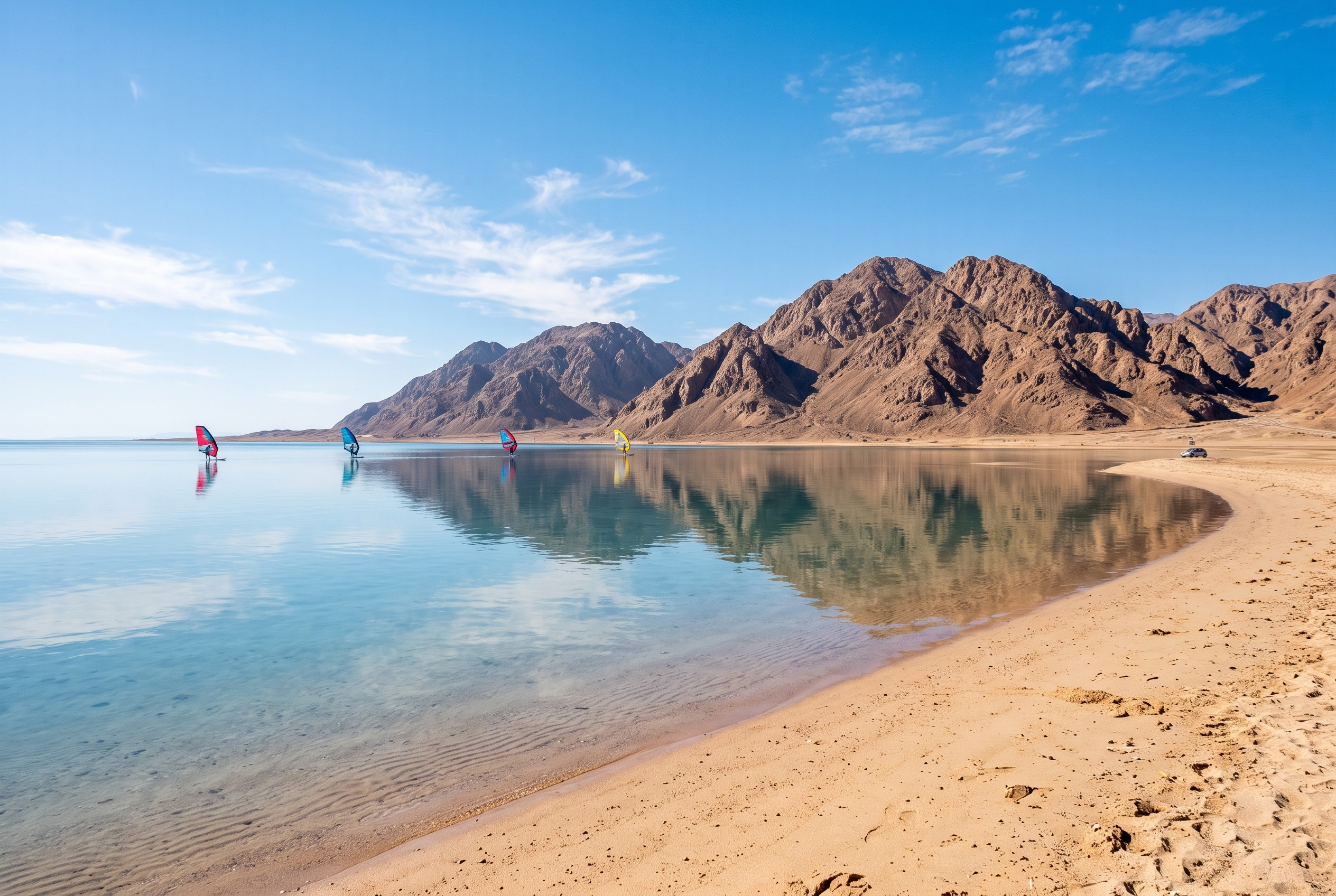
The water itself ranges from glassy to gently textured depending on where you ride. The main lagoon is famously flat and shallow, while the open coast offers rolling swell for those who want to play with bumps. It’s a versatile setup that lets you pick your difficulty for the day.
Best Spots for Different Skill Levels
Dahab’s calling card for newcomers is the main kite lagoon, a flat-water basin roughly 300m x 500m sitting right beside the long-established Harry Nass Centre. It is shallow, turquoise and knee-to-waist-deep, which means you can stand up just about anywhere, a wonderful confidence builder when you’re still learning to balance the wing and pop onto foil. It is the ultimate spot for beginners and improvers to nail water starts and early flight without the anxiety of deep water or current.
When you’re ready to stretch your legs, the Blue Lagoon is the postcard destination: a stunning turquoise inlet about 20 minutes north of Dahab by boat, offering prime flat water and a handful of camps if you want to stay out there. From the Blue Lagoon, intermediate and advanced riders can run the coastal downwind route southward, a roughly 45-60 minute glide along scenic coastline with rolling swell to keep things interesting, before getting a lift back to town. South of Dahab there’s also the South Spot, a small sand strip poking into the sea that serves up both flat water and small waves, though the offshore wind direction there means it’s strictly for experienced riders with a safety plan and ideally a buddy on a boat.
Local Wing Foiling Scene
Schools and Lessons
Dahab’s teaching scene is mature and well organised, a happy inheritance from its windsurf and kite pedigree. Schools cluster around the main kite lagoon, including Harry Nass Dahab, 5 Kvadratov, Club Mistral, Planet Windsurfing and Ibi & Friends. The lagoon layout is a teaching dream: beginners learn inside the shallow ‘puddle’ while more advanced riders launch nearby, and schools typically equip students with radio helmets so instructors can coach you in real time while you’re on the water. Beginner, improver and children’s courses generally start at the lagoon, with a free shuttle boat service smoothing the logistics.
If you’re brand new to the sport, the combination of shallow stand-up water, radio coaching and warm conditions makes Dahab one of the friendlier places on the planet to learn. Booking a few lessons here will save you weeks of frustration back home.
Gear Rentals
Because the schools double as rental operations, you can travel light. The centres around the lagoon rent wings, foil boards and the rest of the kit, which is a genuine bonus given the faff and cost of flying bulky foil gear across continents. If you’re staying out at the Blue Lagoon, the camps there are similarly geared up. As always, message your chosen centre ahead of a trip to confirm they have current wing-foil equipment in your size and skill bracket, as quiver depth varies from shop to shop.
Clubs and Community
The wind-sports community in Dahab is one of its quiet pleasures. Decades of windsurfers, kiters and now wing foilers have created an easygoing, international scene where the day revolves around the breeze and the after-session tea. The compact lagoon means you’ll keep bumping into the same faces, swapping conditions intel and downwinder plans. It’s the kind of place where you arrive a stranger and leave with a WhatsApp group full of foiling friends.
Off the Water
Cultural Attractions
Dahab’s northern Assalah district is a traditional Mzeina Bedouin area where families have lived for generations, and that heritage flavours the whole town. The old Bedouin hamlet of Asalah, up in Masbat to the north, is all palm trees, simple guesthouses and a waterfront promenade. For a bigger cultural hit, Mount Sinai is within easy reach, a popular pre-dawn hike to catch sunrise from the summit before the heat builds, and an overnight camel safari to Ras Abu Galum offers a two-day immersion in the Sinai’s untouched coast.
Dining
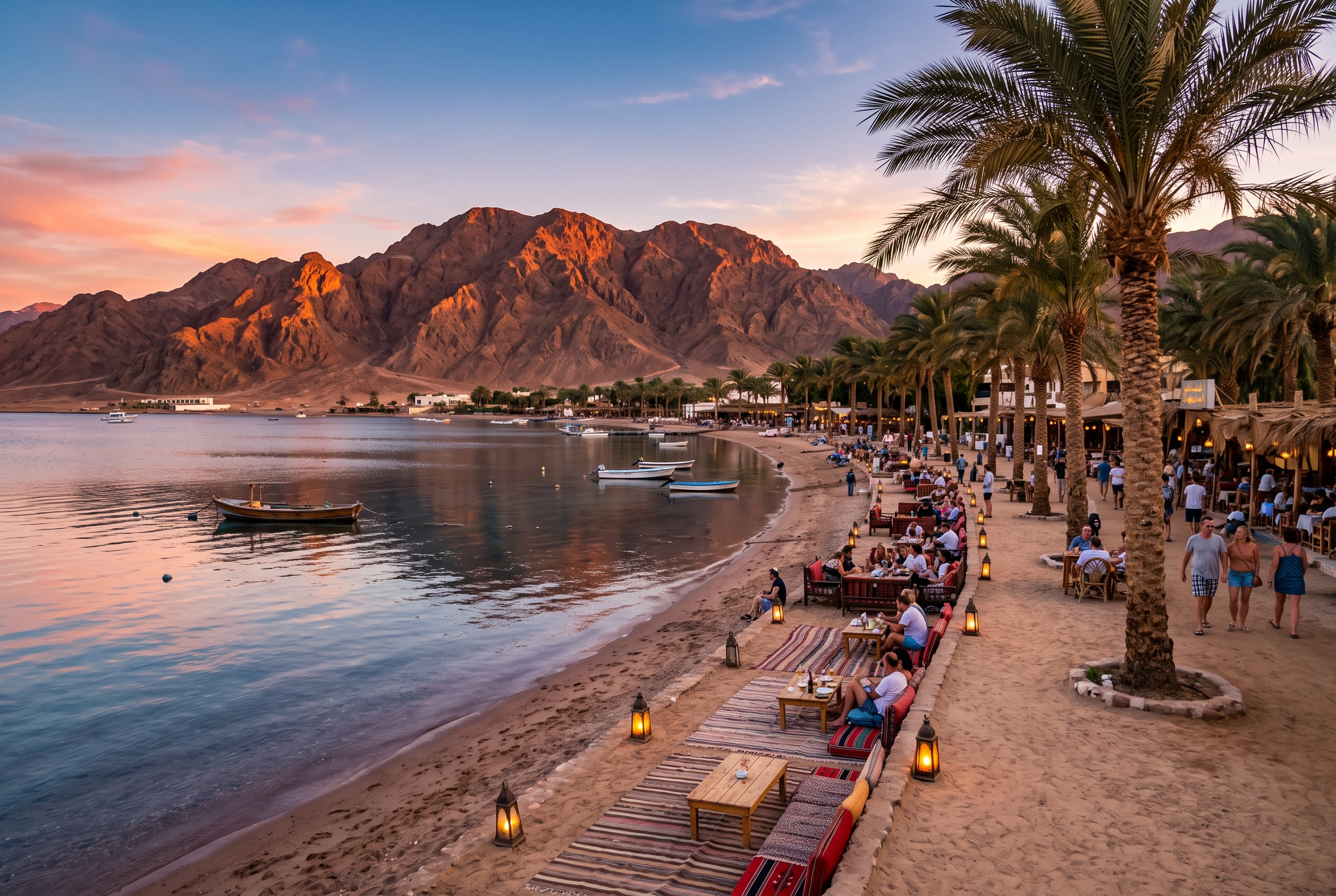
Eating in Dahab is half the holiday. The waterfront promenade is lined with sand-floor cafés where you can have grilled fish with your toes in the sand, and the menus swing easily from Egyptian staples to genuinely good international cuisine. Waterfront cafés serve sweet Bedouin tea alongside Italian espresso, a neat little summary of the town’s laid-back, East-meets-Med personality. Best of all, it’s cheap: expect somewhere around 150-300 EGP (roughly $5-10) for a main dish, so you can refuel guilt-free after a long session.
Nightlife and Entertainment
Dahab’s nightlife is mellow rather than thumping, which suits a town where everyone’s up early chasing wind. Think artistic cafés with rooftop terraces and indoor swings, cosy beach bars with reggae on the speakers and cold beer, and long candlelit dinners by the water. It’s the kind of evening scene where conversations stretch out and nobody’s in a hurry, the perfect antidote to a day of adrenaline on the foil.
Nature and Sightseeing
You can’t write about Dahab without the Blue Hole, one of the world’s most famous dive sites, reachable by car from the centre. It’s spectacular for snorkelling and diving, though it carries a sobering nickname, ‘the diver’s cemetery’, so respect your limits and go with a reputable operator. Beyond the Blue Hole, the reefs around Dahab are teeming with marine life, and the surrounding desert and mountains offer endless hiking, camel trekking and stargazing. Many visitors plan to stay a week and end up extending; the place has a habit of slowing you down in the best way.
Practical Travel Information
How to Get There
The nearest airport is Sharm El Sheikh International (SSH), about an hour’s drive south of Dahab and well served by flights from across Europe and the Middle East. A private transfer from the airport runs roughly 800-900 EGP (around $30), and it’s a straightforward, scenic drive up the coast. Once you’re in town, getting around is dirt cheap: shared pickup trucks shuttle you about for 25-50 EGP per ride, less than $2. Most foilers don’t bother with a hire car, the lagoon, schools and town are all close together.
Where to Stay
You’ve got two broad options. Base yourself in town, in the Assalah district, where you’ll find everything from budget Airbnbs to all-inclusive resorts such as the Swiss Inn, Dahab Lagoon Club & Resort, Safir Dahab Resort and the Meridian, all within reach of the main lagoon and the waterfront scene. Alternatively, go full immersion at the Blue Lagoon, where dedicated kite and wing camps such as Abo Aid Surfcamp, El Omda Kitecamp, Shoky Kite Paradise and Dahab Dream Kite put you right on the flat water. Town suits those who want restaurants and culture on tap; the Blue Lagoon suits those who want to roll out of bed and onto the foil.
Best Time to Visit
For the best all-round trip, target the shoulder seasons of April-May and September-October-November: reliable wind, comfortable temperatures and fewer crowds. October/November and April/May are especially popular and almost every day delivers wingable conditions. If you want maximum wind and don’t mind the heat and the busier vibe, May through August brings the strongest, most consistent breeze, ideal for a focused training block. Winter (December-February) is the quietest and coolest, still with better than half the days windy, so pack a 3/2mm and you can absolutely score.
Budget Estimates
Dahab is one of the better-value wing destinations going. Once you factor in the cheap transfers (about $30), pickup rides under $2, and main meals at $5-10, your daily on-the-ground costs stay modest. The bigger line items will be your flights, accommodation and any lessons or rentals, all of which still tend to undercut comparable spots in Europe or the Atlantic. Confirm current lesson and rental rates directly with your school, as prices shift with season and the Egyptian pound, but plan on Dahab giving you more foiling days per dollar than almost anywhere.
Wrapping Up
Dahab is a near-perfect storm of the things wing foilers actually want: dependable wind nearly all year, warm water, a shallow lagoon that makes learning genuinely fun, open-water swell for when you’ve outgrown the puddle, and a slow, sun-soaked town to recover in. It’s affordable, it’s friendly, and it’s been honing its wind-sport craft for decades. Whether you’re chasing your first foiling flight or a strong-wind training camp, this little gold-sand corner of the Sinai delivers.
If Dahab whets your appetite for warm-water foiling further afield, the African continent is spoiled for choice: the flat-water lagoons of Dakhla in Morocco scratch a similar beginner-friendly itch, the dramatic conditions around Cape Town offer a wind-soaked step up, and the trade-wind reliability of São Vicente in Cape Verde rounds out a serious Atlantic wishlist. Brand new to all this? Start with our complete beginner’s guide to wing foiling, then dial in your kit with the wing foil calculator before you book those flights. The lagoon’s waiting.
Frequently asked questions
When is the best time to wing foil in Dahab?
The prime season runs March through November, with the strongest, most consistent wind from May to August. For the best balance of reliable breeze, comfortable temperatures and smaller crowds, target the shoulder months of April-May and September-October-November. Even winter (December-February) still sees better than half the days windy.
How much wind does Dahab get?
Dahab is windy nearly 300 days a year, blowing from a reliable north/northwesterly direction. From April through November expect roughly 20-30 knots with an 80-100% probability, while December to March typically brings 15-20 knots. Note the thermal effect can soften the wind through the afternoon, especially in shoulder seasons.
Is Dahab good for beginners?
Yes, it's one of the friendliest places to learn. The main kite lagoon is a flat, shallow, knee-to-waist-deep basin where you can stand up almost anywhere, and schools cluster right beside it. Many provide radio helmets for in-water coaching, so you get real-time guidance while practising water starts and early flight.
What water temperature should I expect, and do I need a wetsuit?
Water sits around 23°C in winter and spring, rising to about 27-28°C in summer, with September the warmest near 28°C and March the coolest near 21°C. A 2mm shorty is plenty through the warm months, while a 3/2mm full suit is worth packing for winter mornings.
How do I get to Dahab and is it expensive?
Fly into Sharm El Sheikh International (SSH), about an hour's drive south. A private transfer runs roughly 800-900 EGP (around $30), and local pickup rides cost 25-50 EGP (under $2). Meals are around 150-300 EGP ($5-10), making Dahab one of the better-value wing destinations.
